

Blancpain 2035
How a high horology brand became defined by a dive watch – and what it means for what comes next

I find Blancpain to be one of the most fascinating brands in modern watchmaking.
It has a non-linear, occasionally controversial history – one that explains the existential crisis the Swiss watch industry faced in the 1970s and the mechanical revival that followed.
It is a brand that helped rekindle complicated watchmaking in the 1980s. And yet today, it is best known for a dive watch.
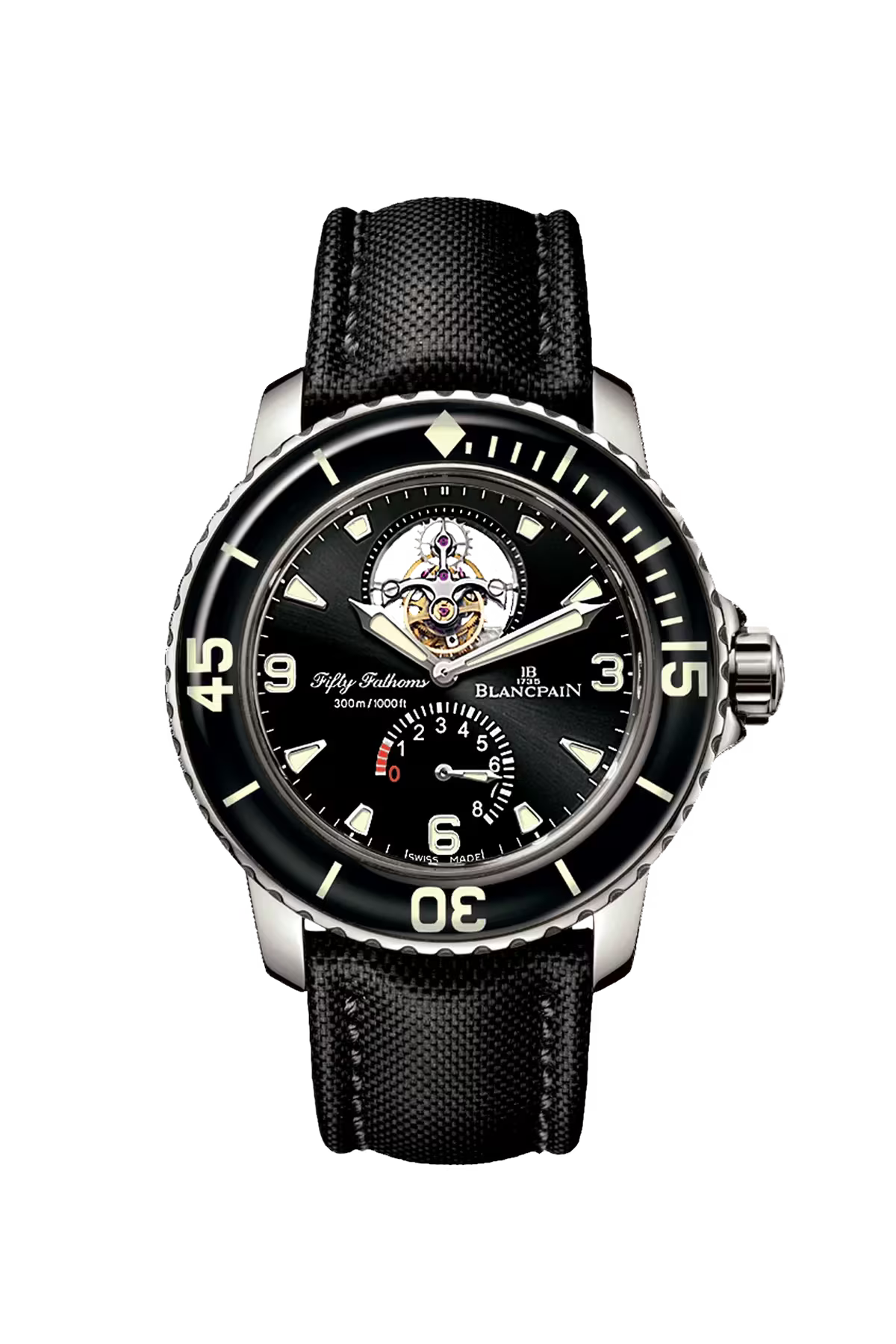
Its marketing communication points to an origin in 1735, but strip that date from its branding and you’ll see it is largely irrelevant to its modern identity.
Its record of complicated watchmaking and horological firsts should put it in a conversation with the greats, yet it often struggles with perception and secondary market softness.
As it approaches its stated 300th anniversary, the question is not whether Blancpain will celebrate.
It is what, exactly, will it be celebrating? And what watches will it celebrate the occasion with?
The Question of 1735
Before looking forward to 2035, it’s necessary to address 1735.
Blancpain’s claim to have been founded in that year has been scrutinised recently, most notably by José Perez of Perezscope.
I have something of an affinity for Perezscope’s forensic, evidence-based style – it’s how I like to approach my own writing about watches (though I would not claim to be as knowledgeable nor as thorough as Mr Perez).
I don’t refute any of his findings with regard to Blancpain, which, in summary, suggest that in the 1950s Blancpain started claiming 1735 as the year of its birth when 1815 previously had featured in its marketing.
I do think it’s largely irrelevant in terms of how to think about Blancpain today, though.
Few collectors in the 21st century buy a Blancpain because it claims roots in 1735 – just as few buy a Rolex because it was founded in 1905.
Would I prefer that 1735 carried less weight in the brand’s present-day communication and it didn’t make as much noise as it does about being the world’s oldest watch company? Yes. But the claim was made decades ago, long before its re-emergence. Disentangling it now would serve little practical purpose for the brand.
The modern identity of Blancpain wasn’t forged in the 18th or 19th century.
The Revival
I’ve written before about Blancpain’s resurgence in the 1980s. I consider it one of the most consequential – and least understood – moments in modern watchmaking. Its ripples can still be felt in the watch industry today.
The story goes that the legendary Jean-Claude Biver resigned from his role at Omega in 1980, frustrated with the way the industry was reshaping itself under pressure from the advancement of quartz and a weak US dollar.
At the same time, Frédéric Piguet – supplier of ultra-thin movements to the likes of Patek Philippe, Vacheron Constantin and Audemars Piguet – had (according to a Europa Star interview with Biver in 2019) reluctantly accepted a contract to make quartz watches for Ebel, forcing the layoff of watchmakers.
Jacques Piguet, friend of Biver and owner of Frédéric Piguet, was similarly frustrated with where the industry was heading.
Together, Biver and Piguet hatched a plan to purchase Blancpain, a name lying dormant within the corporate structure of the Société Suisse pour l’Industrie Horlogère (SSIH).
According to Biver in a 2018 interview with Fondation Haute Horologie (FHH), they bought Blancpain with a CHF 30,000 bank loan (which my research suggests came from Credit Suisse).
It seems Biver had been trying to secure financing for the purchase by pitching his idea of traditional watchmaking, rather than quartz, being the future of the industry.
“One day, I received a letter from the Fédération Horlogère reproaching me for having said at a Credit Suisse meeting that quartz was carcinogenic, dangerous because of its batteries – it’s true that I’d invented the story of a Zurich doctor who forbade his patients to keep their quartz watch on their wrist and offered them a mechanical watch in exchange (laughs).”
So why did Biver and Piguet target the Blancpain name as the vehicle to execute their strategy? Why not launch a brand under one of their own names, as Biver did in 2023?
Frédéric Piguet could not realistically become a watch brand itself without jeopardising its role as a supplier.
Biver had not yet become the industry legend he is known as today.
Blancpain, however, had real watchmaking history.
The 1735 claim had been made decades before, of course, but Blancpain was also involved in producing the world’s first automatic wristwatches.
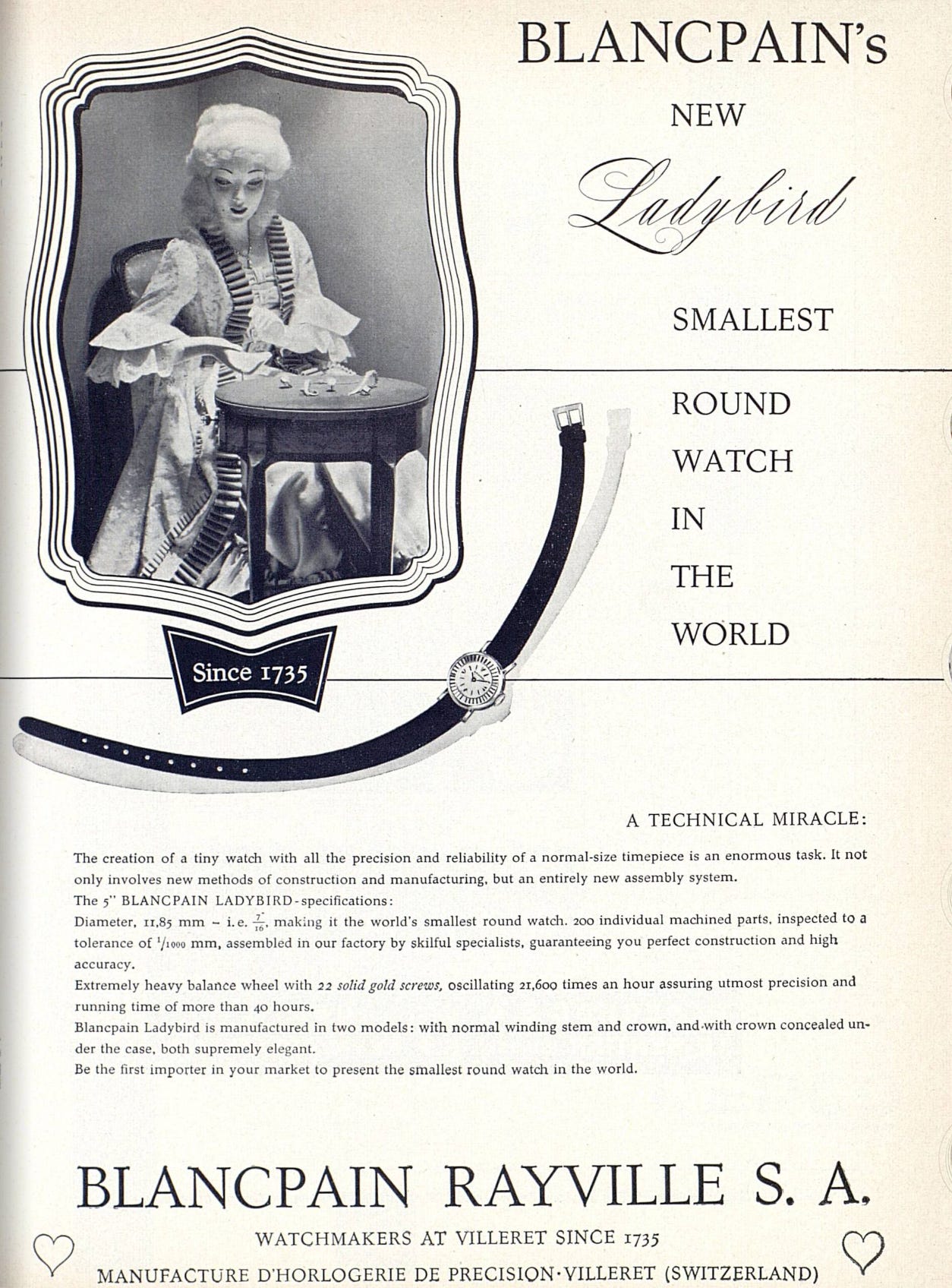
Then, in 1956, Blancpain created the Ladybird, which at the time was marketed as the smallest round watch ever made.
The Blancpain name gave Biver and Piguet a legitimate platform upon which to pursue their vision. Notably, the Fifty Fathoms played no role in that vision.
Horological Romanticism
When Biver and Piguet acquired Blancpain, the name came with almost nothing attached – no archives, no tools, no parts. It was mostly a marketing vehicle.
But when you strip away the marketing, what you see is a company focused on traditional watchmaking at a time when that seemed like a radical idea.
As Aldo Magada – later CEO of Zenith – recalled in a Harvard Business School case study:
“[To] a young guy in the industry, Blancpain was a miracle. It was the first and only time I’d seen a traditional brand, in terms of product and look, with a young image. Suddenly, young people wanted to wear Blancpain. Biver made it fashionable to have a mechanical watch again. He built a community. Creating community has always been one of Jean-Claude’s greatest strengths.”
Biver and Piguet’s first watches under the Blancpain name were the references 6395 (26mm) and the 6595 (34mm), both complete calendar moonphases.
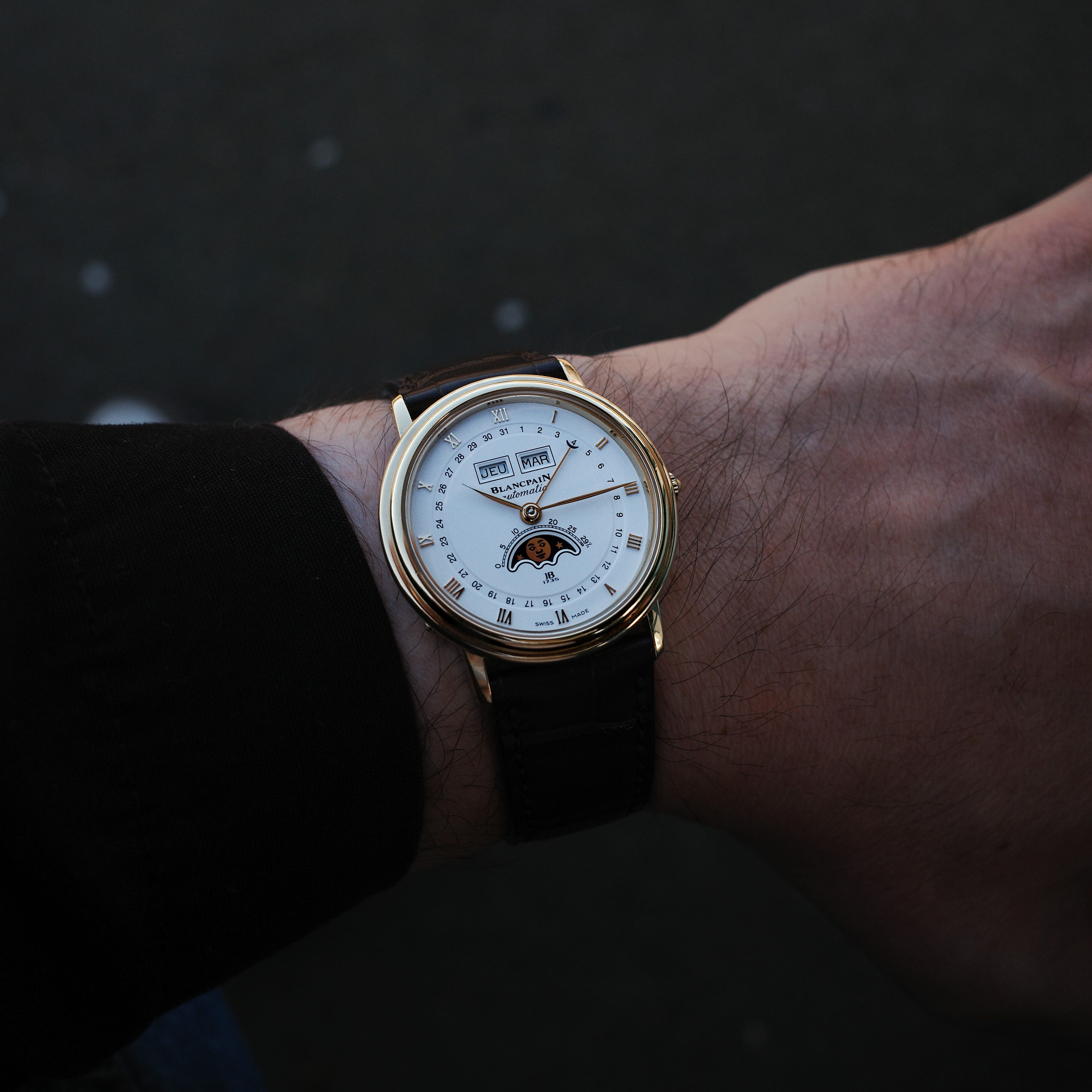
These complete calendar moonphases do not look radical to modern eyes. Why were they viewed as so disruptive at the time?
Because they rejected quartz industrialisation, yes.
But also because they stood apart from what almost everyone else was doing at the time.
The Holy Trinity’s focus coming out of the 1970s was on uncomplicated watches with a new design language – that of the integrated sports watch: the Nautilus, the Royal Oak, the 222.
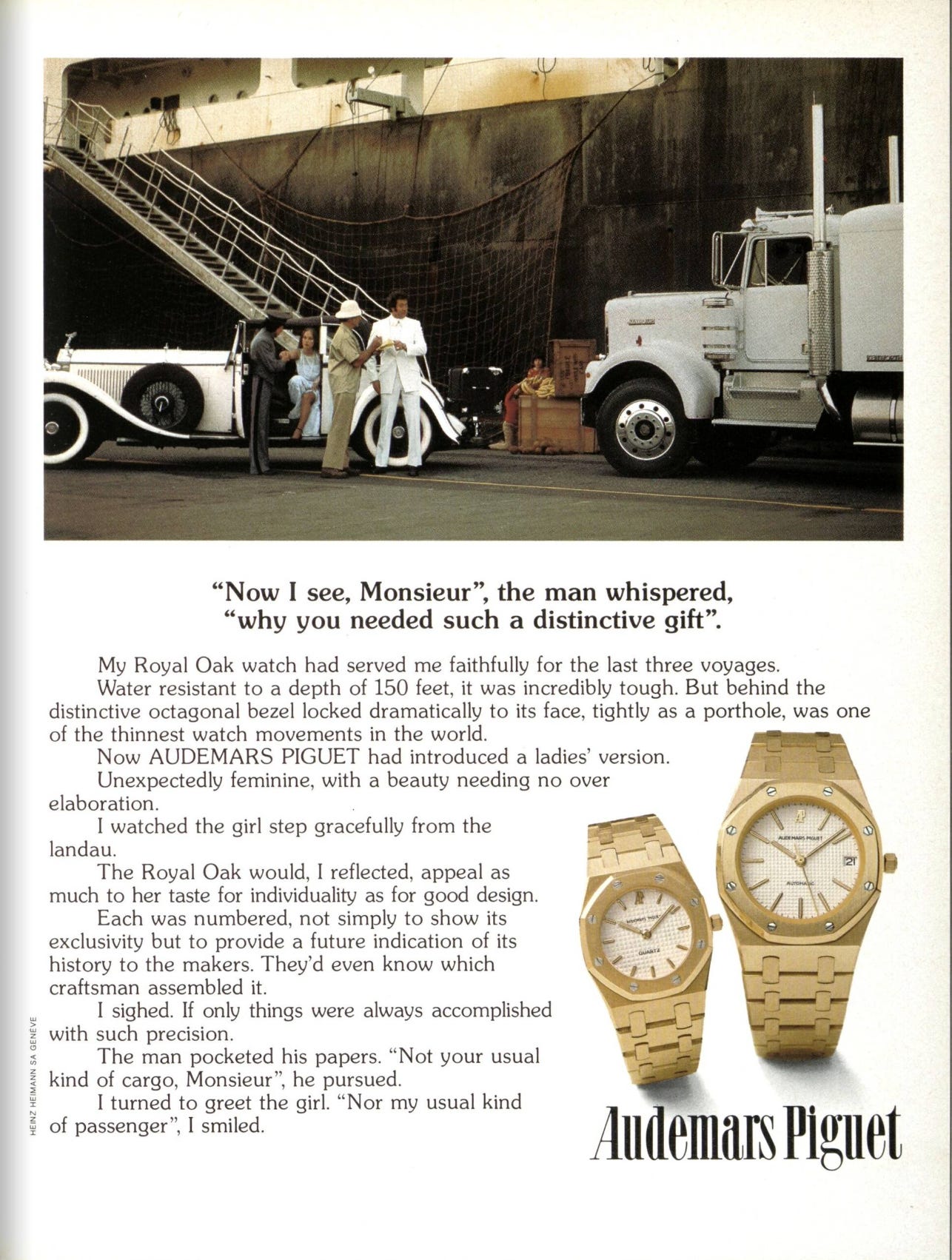
These houses were still making complicated, traditional watches – the Audemars Piguet 5448 stands out here – but they were doing so in vanishingly small numbers compared to their other product lines. Complicated, traditional watchmaking was Blancpain’s entire business.
These Blancpain watches represented a rejection of modernity. They were horological Romanticism. They were postmodern architecture. They were Arts and Crafts.
Biver speaks to the impetus for these first references in the 2019 interview with Europa Star:
“I didn’t want to relaunch Blancpain solely with hours and minutes watches. They had to have the traditional sobriety, beautiful finishes, but also additional features. A moon phase was an ideal indicator to our minds, infused with nostalgia and poetry. In the attic at Frédéric Piguet, we found all the tools we needed, unused since the 1940s, to make a day, month, date and moon phase movement. We got to work right away and modified it so that the month changed automatically every 31.”
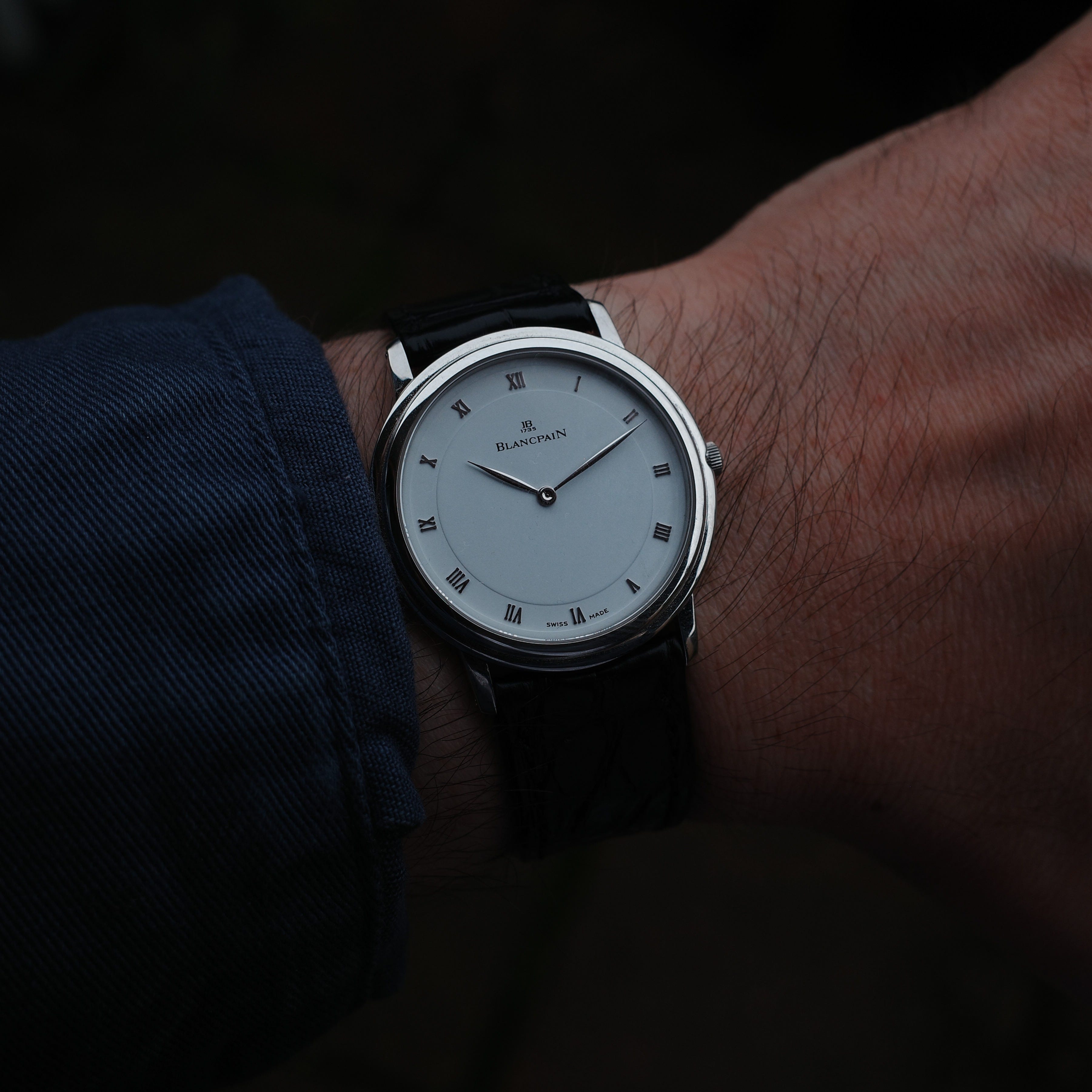
The ultra-thin reference 0021 was launched soon after the complete calendar moonphases.
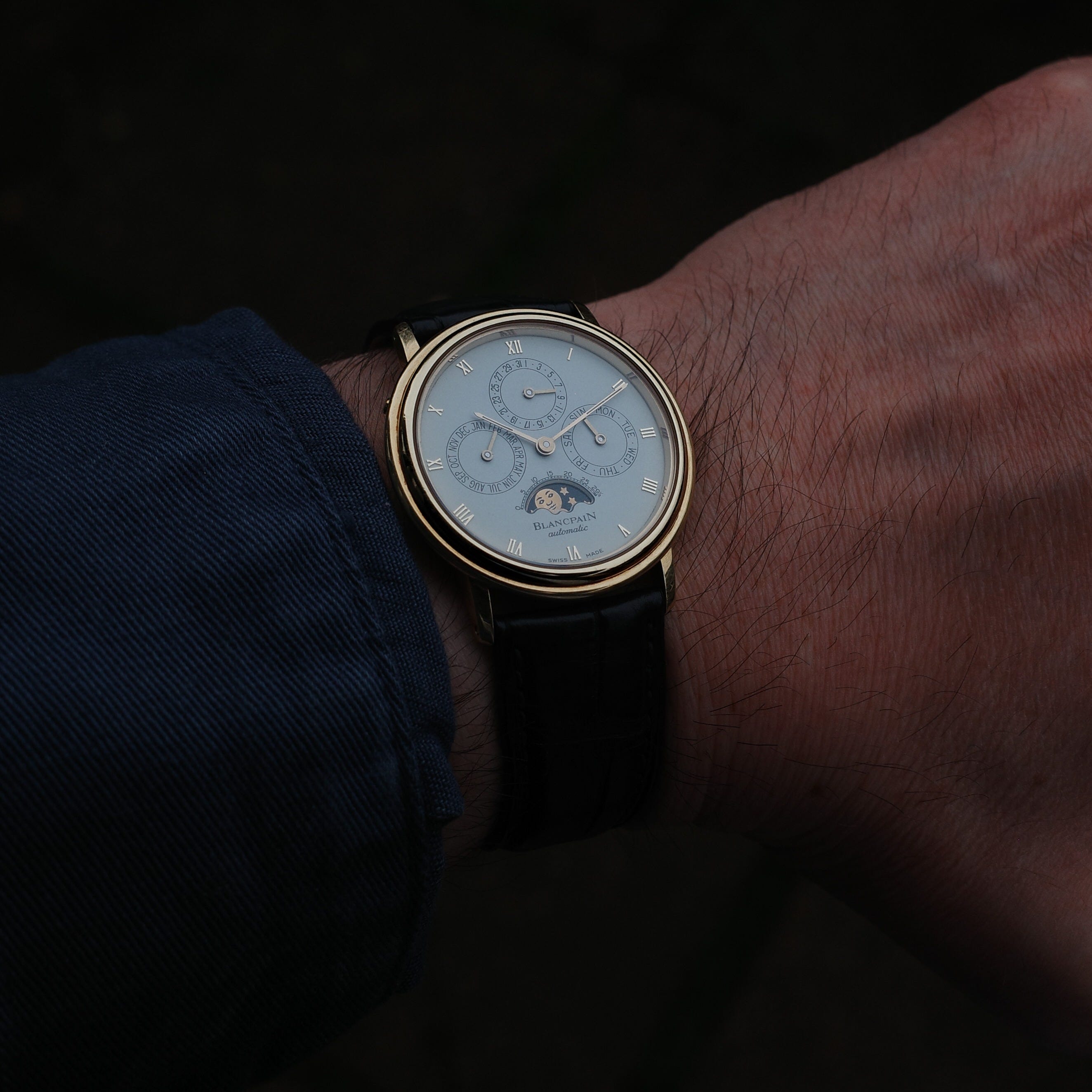
Followed by the 5395 perpetual calendar.
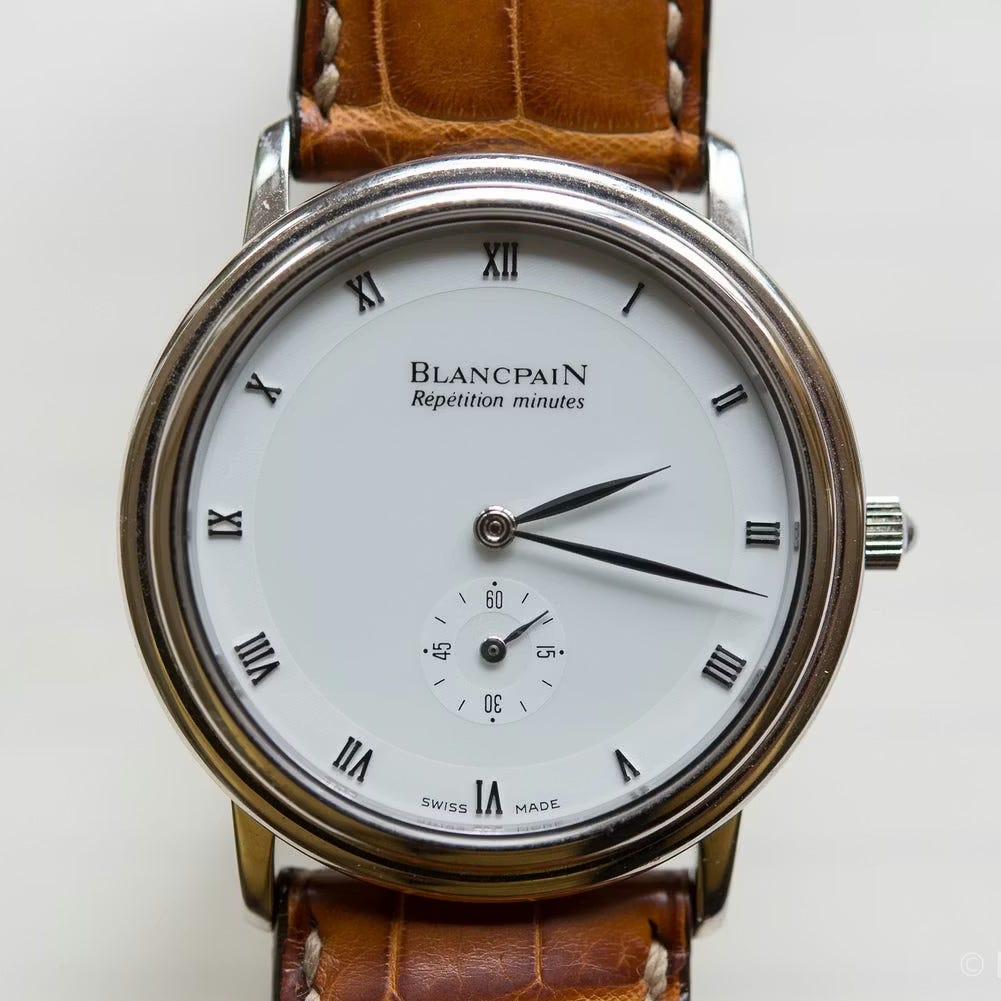
Then the reference 0033 minute repeater.
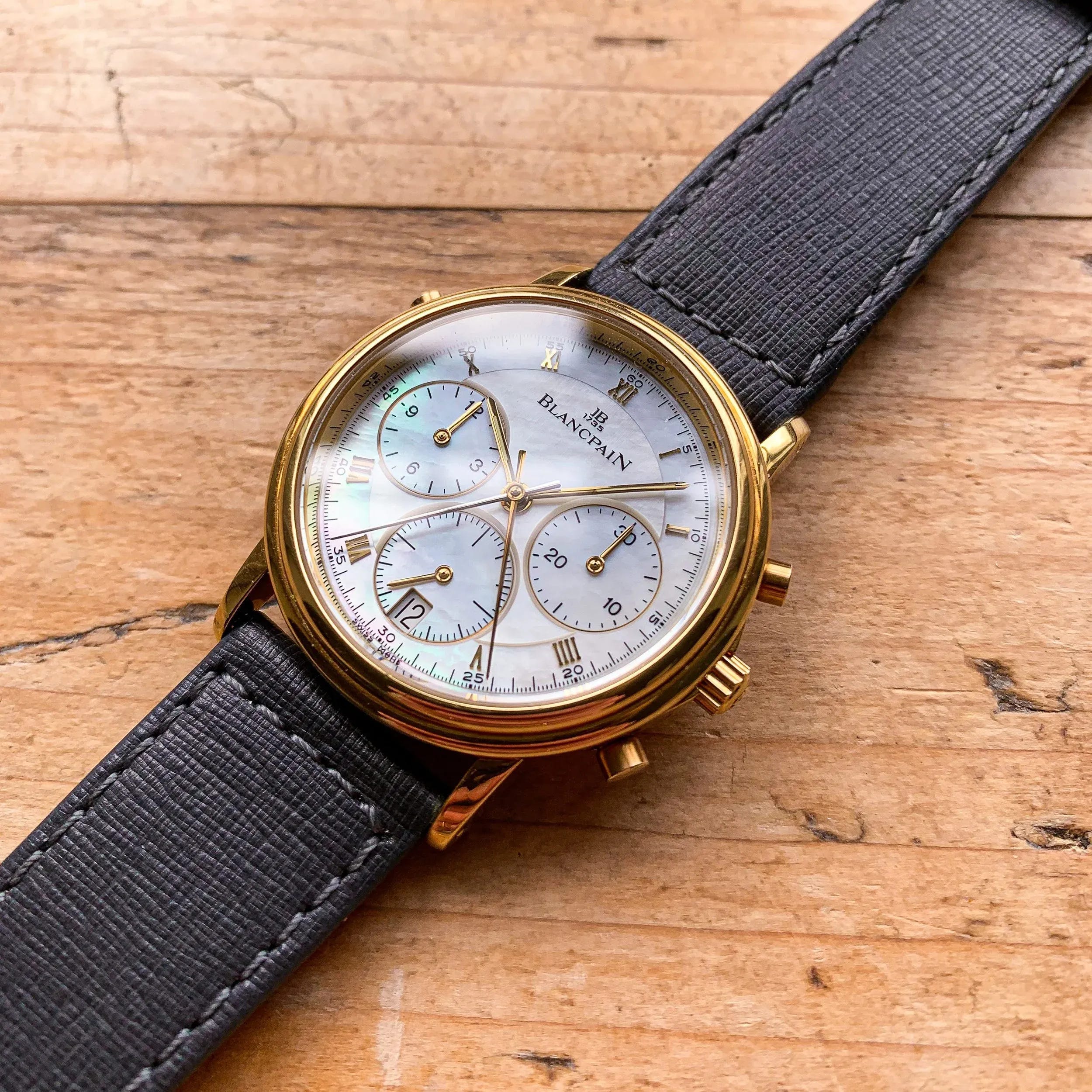
The 1186 rattrapante.
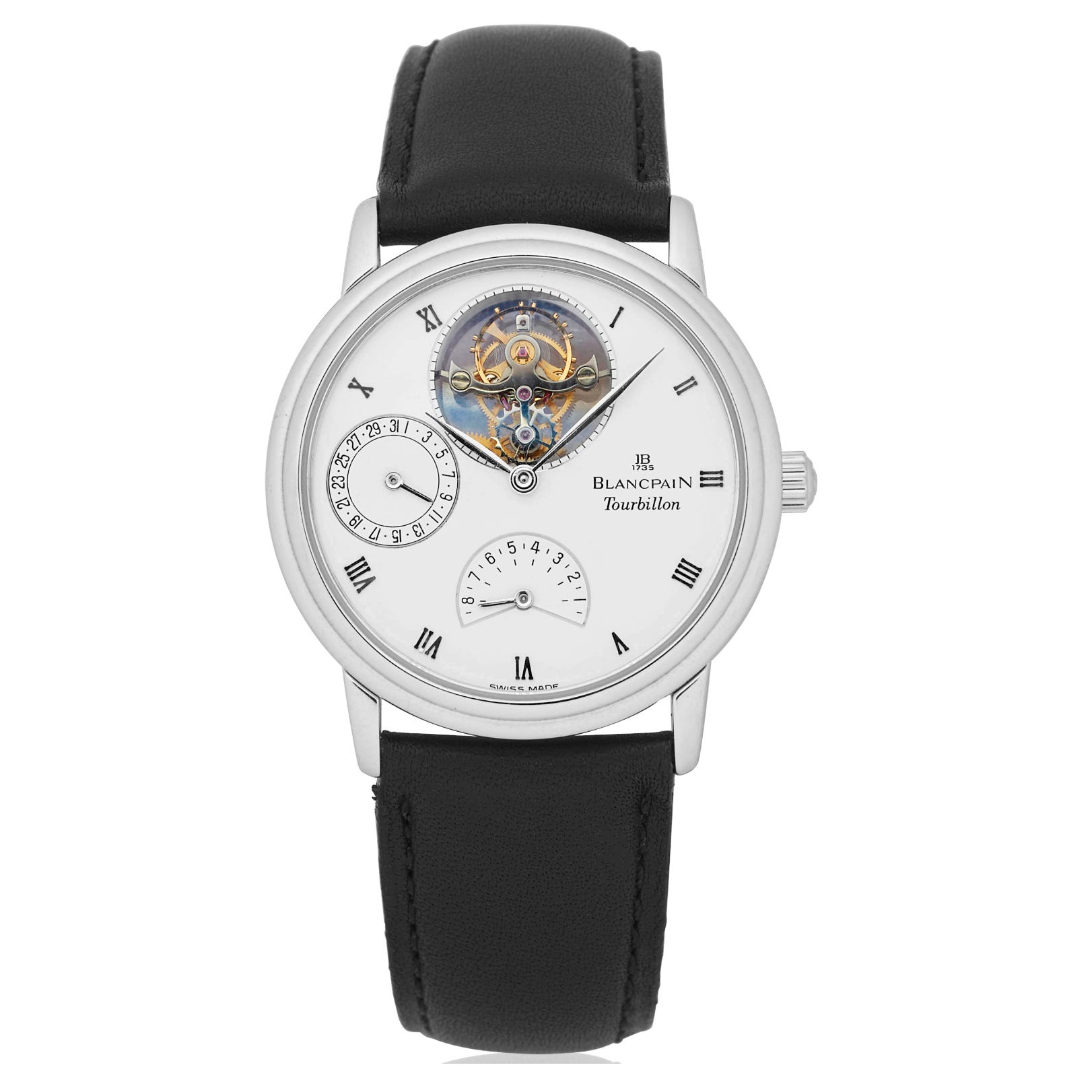
And finally by the 0023 flying tourbillon.
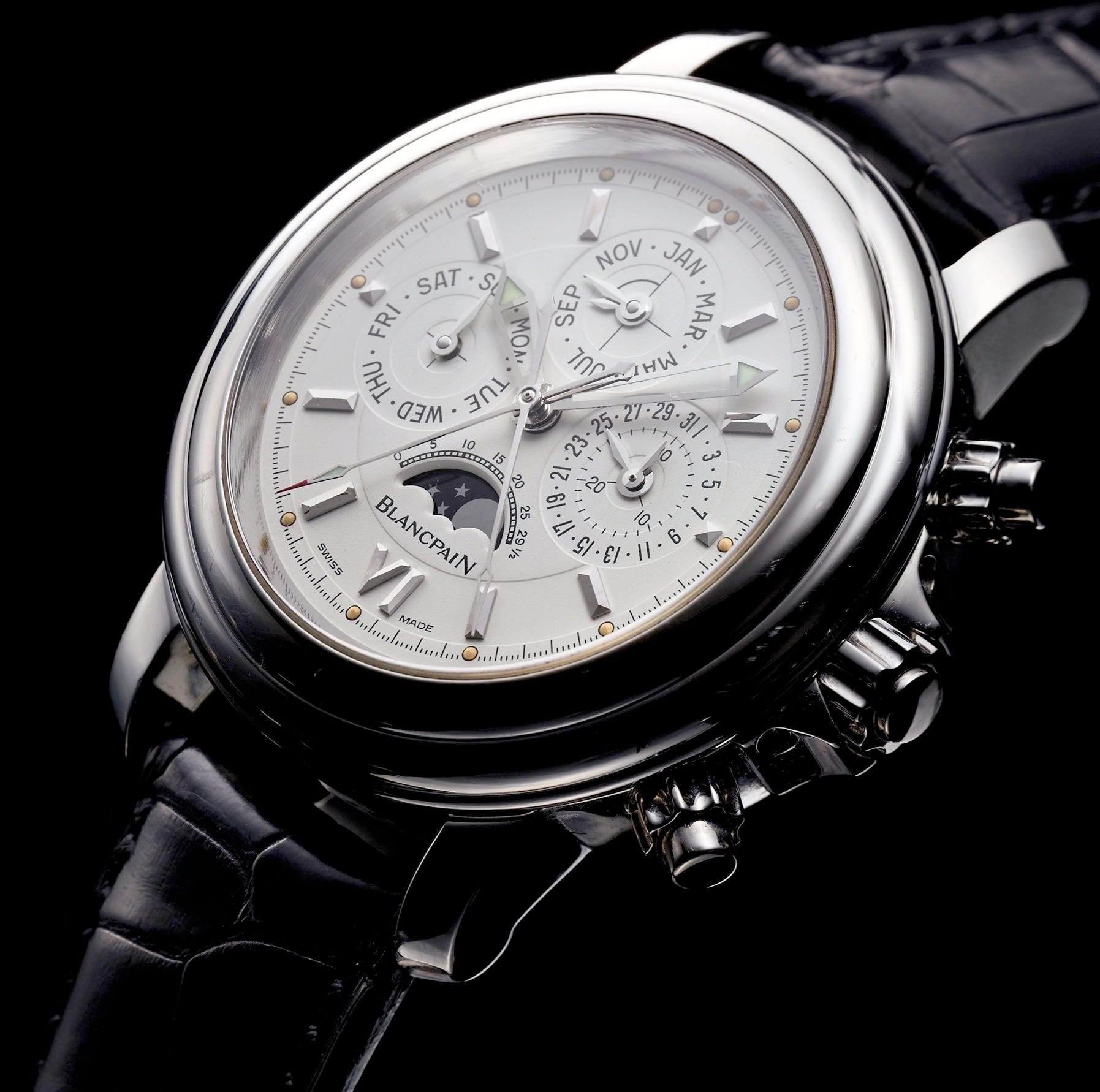
These six references became known as the Masterpiece Collection and were presented as such in 1991 to coincide with the launch of the 1735 Grande Complication – which combined all six complications in a single watch that was the most complicated automatic winding wristwatch of its era.
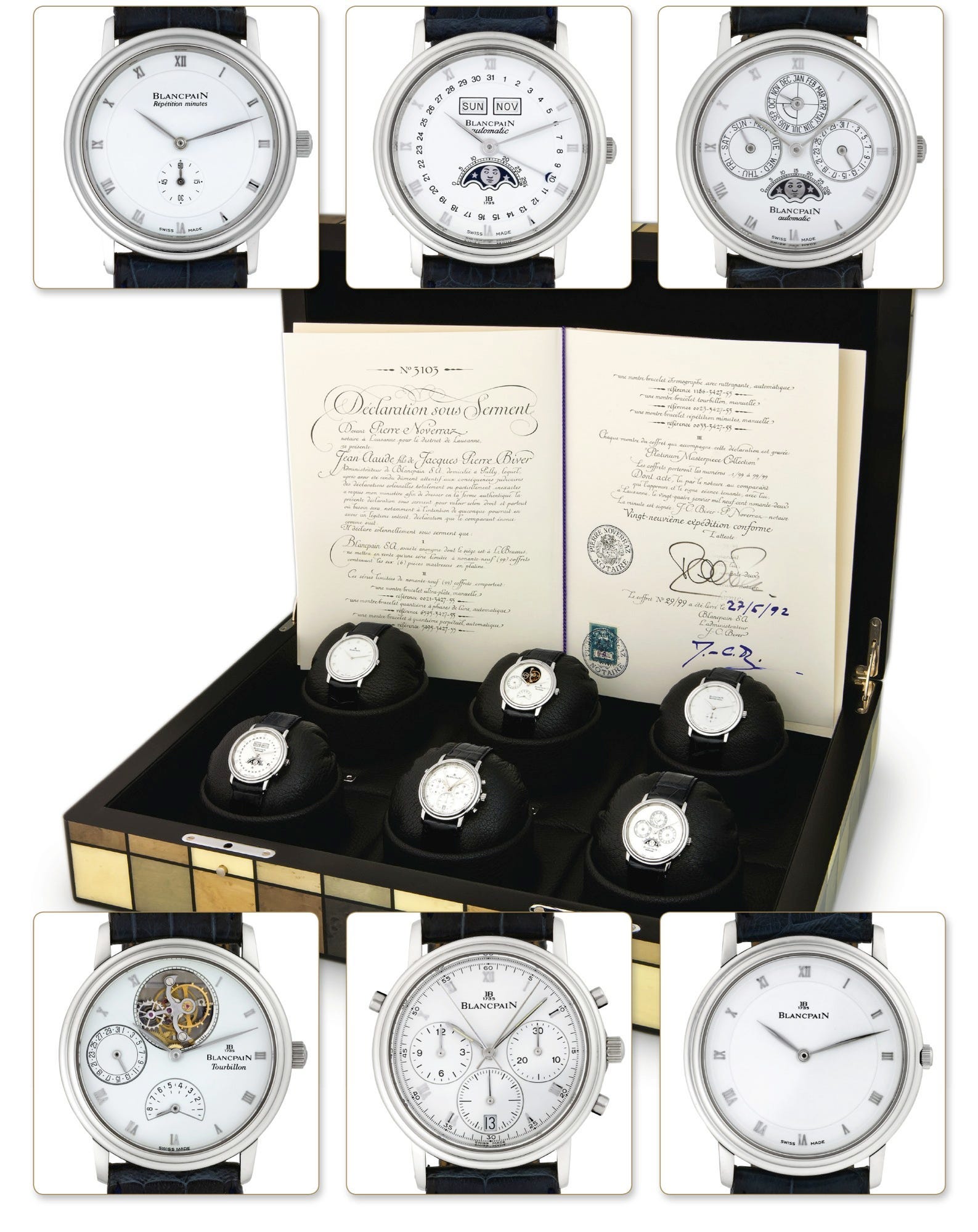
That’s a remarkable amount of watchmaking packed into less than a decade.
What’s more is that in 1987 the 0033 was the world’s smallest minute repeater.
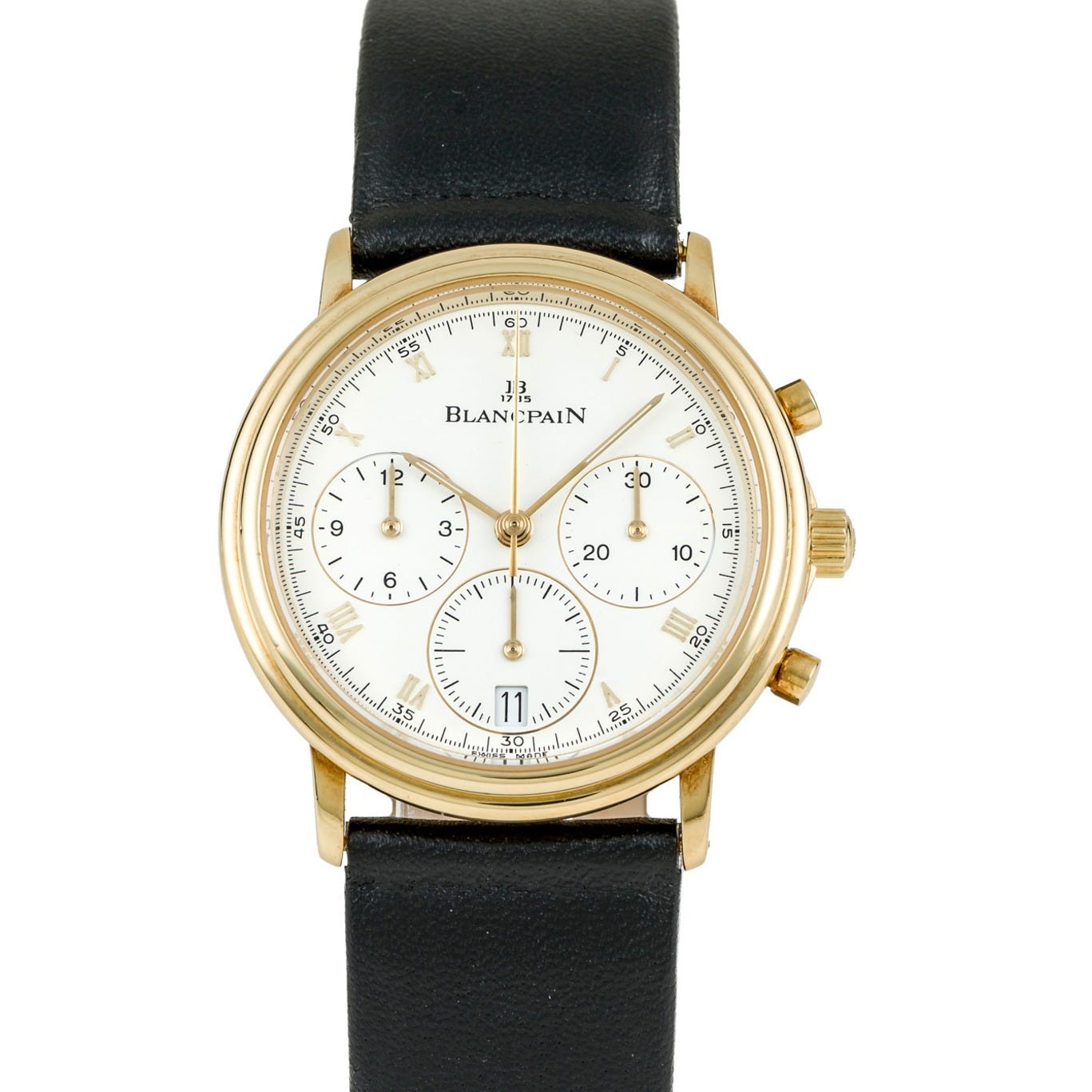
In 1988 the 1186 was the world’s thinnest split-seconds chronograph.
The 1185, a non-split seconds chronograph, was the world’s thinnest automatic chronograph at its launch.
And the flying tourbillon, the 0023, was the world’s thinnest tourbillon when it was released in 1989.
It’s hard to argue that the revived Blancpain, based on its watchmaking alone, had anything but an absolutely sensational first decade. There is so much watchmaking and compelling design to admire here – yet many collectors skip over it all and jump straight to the Fifty Fathoms.
Proto-Independence
Two of the Masterpieces illustrate how Blancpain was operating almost like a modern independent at the time of their release.
The minute repeater reference 0033 used a case made by the legendary Jean-Pierre Hagmann, while the tourbillon reference 0023 incorporated an off-centre flying tourbillon designed by Vincent Calabrese, co-founder of the AHCI. Blancpain was collaborating with elite specialists in much the same way brands like MB&F or Akrivia do today.
And it wasn’t just the watchmaking that showed Blancpain had an independent spirit.
The company’s early years also had more in common with a startup than established Swiss watchmakers.
Biver back then was not leading the cushy life of a corporate executive – he was on the road, pushing hard to get the company off the ground, as detailed in the Harvard Business School case study:
“When starting Blancpain I felt alone. I didn’t have any confidence, and so I got angry when someone on my team didn’t do the right job. I was traveling between meetings in a Volkswagen camping bus because I could not afford to sleep in a hotel. I would put a dime in the railway station shower to get 3 minutes of water. It didn’t give me much tranquility. And so I would get angry because I had no security. I did not trust myself.”
Blancpain was also very transparent about its production numbers, finances and growth in its early days – something that sits in stark contrast to how big privately-owned watch companies and the major watch groups communicate today.
It looks and sounds a lot more like how independents talk about their businesses today, both in terms of production numbers and capacity.
Compare this quote from H.Moser & Cie. Chief Executive Edouard Meylan in 2023:
“We manufacture around 3,500 watches a year. Ramping that up overnight to 7,000 would make no sense. And would be impossible, anyway. We don’t have enough watchmakers, we don’t have enough space and we can’t magically double the number of machines.”
To the information in this article from the finance section of Journal de Genève in 1987 about Blancpain:
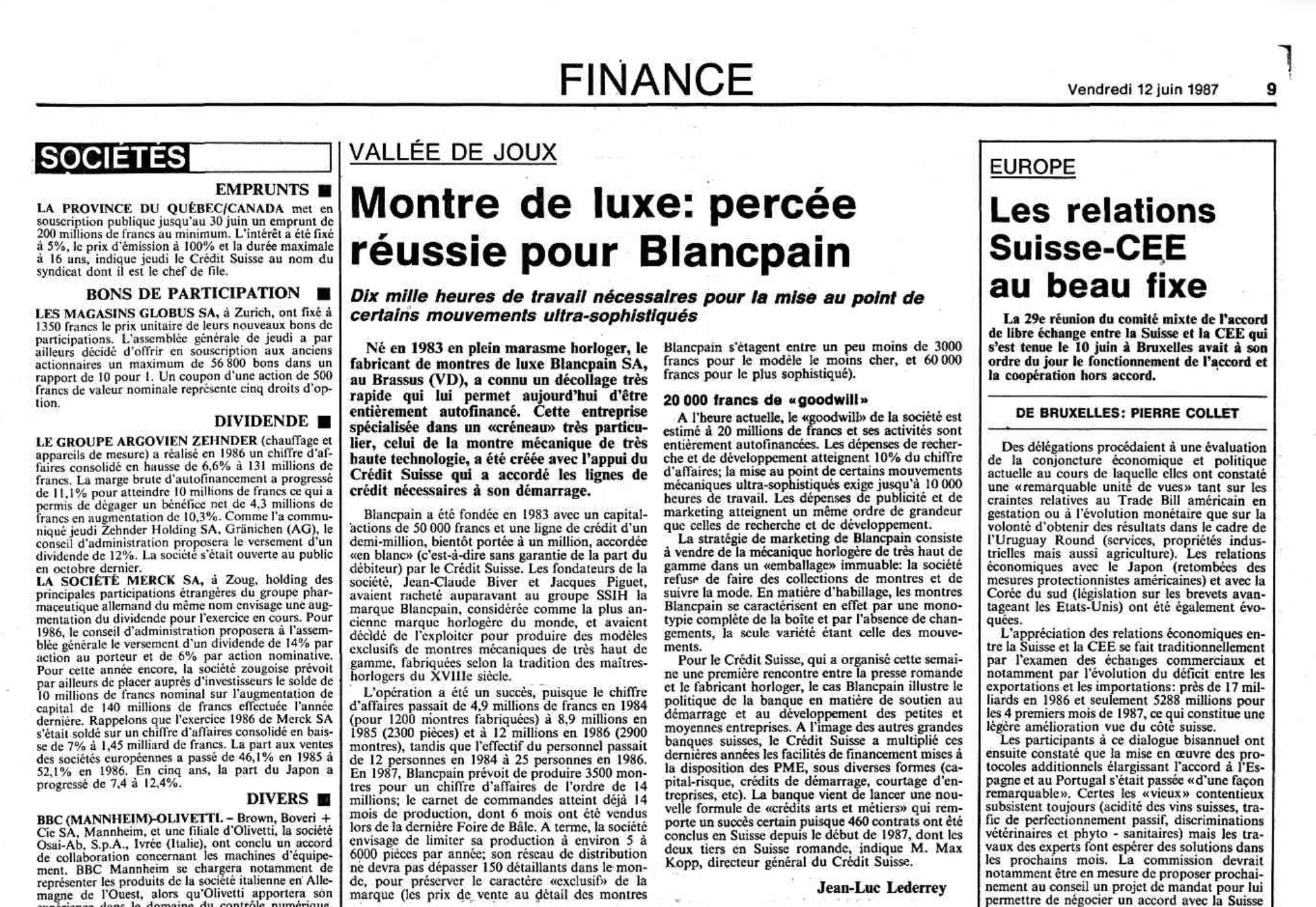
For those of you who don’t read French, it describes how Blancpain was self-financed, operating in a very specialised niche, growing rapidly and how in 1986 it produced 2,900 watches – fewer than the “Very Rare” H.Moser & Cie. makes today.
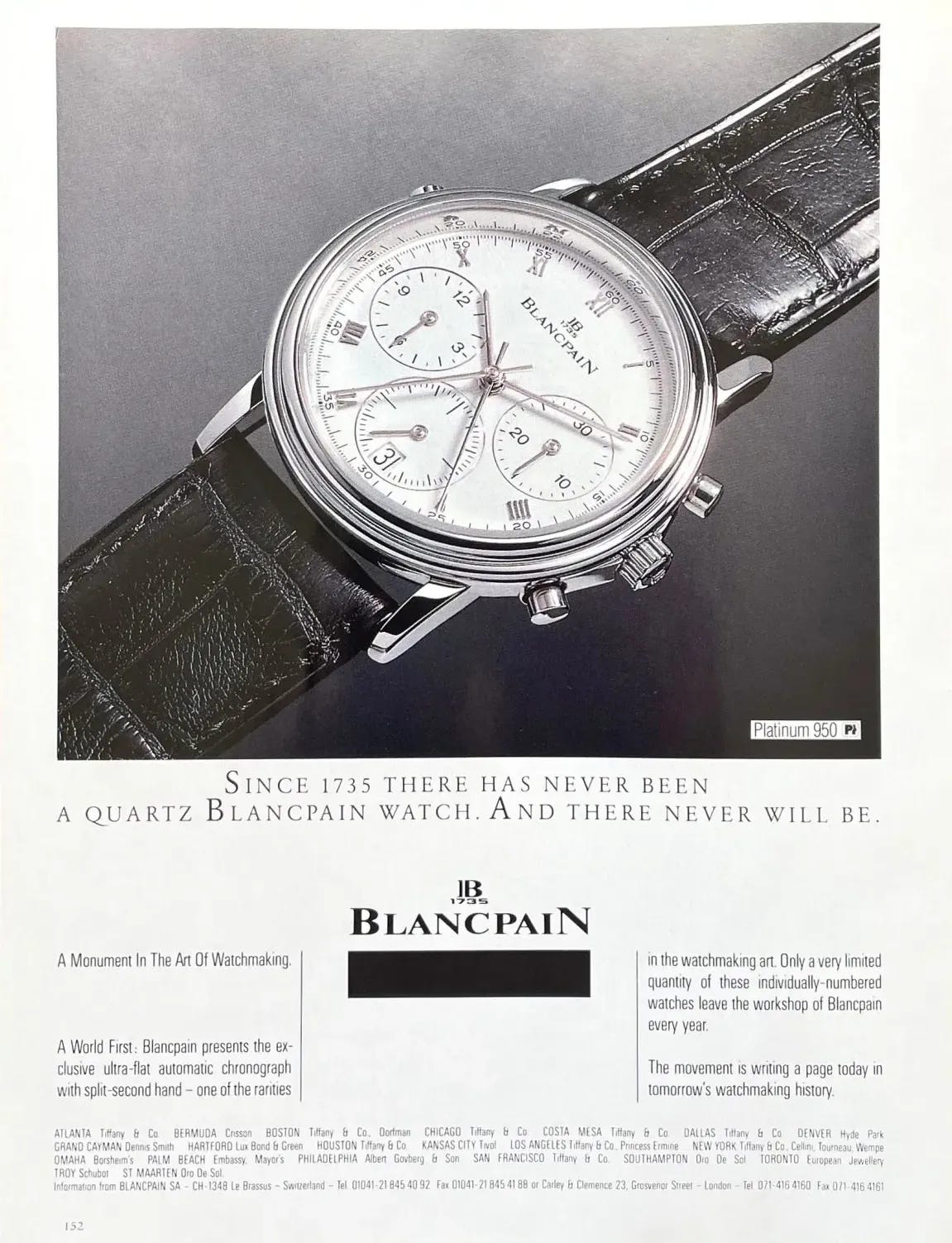
While we’re on the topic of marketing taglines, Blancpain’s slogan that featured in its first ads from this period remains iconic: “Since 1735 there has never been a quartz watch. And there never will be.”
Frédéric Piguet, Blancpain’s movement maker, was not so dogmatic about new technologies, however. It was still dabbling in quartz movements, including developing the 1270P – an early mechaquartz chronograph movement.
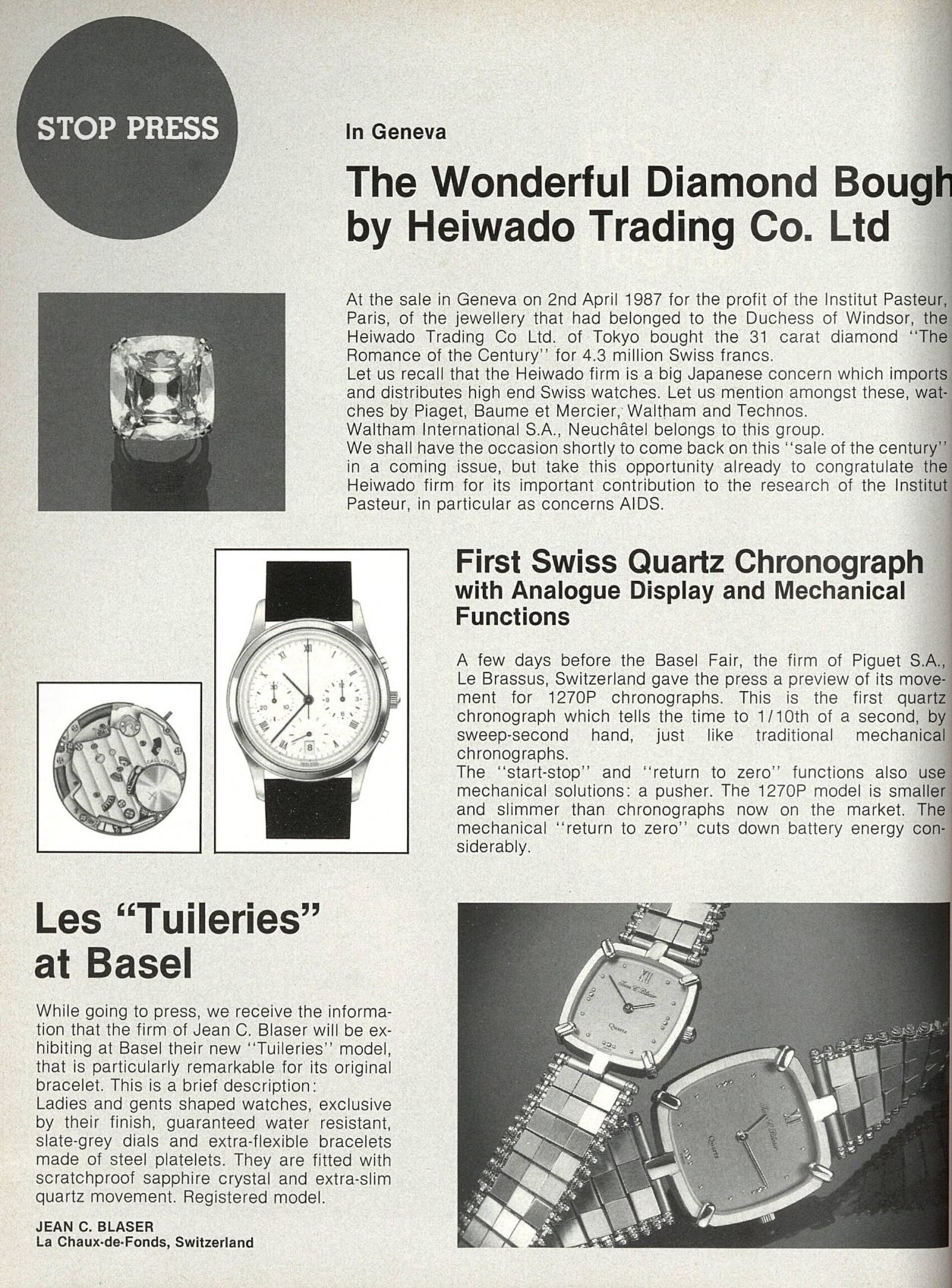
I’m highlighting Frédéric Piguet’s quartz dalliances to make this point: Blancpain did not exclusively control Frédéric Piguet at the time. Blancpain could be better described as the brand of the manufacturer and a route to market for its high-end mechanical movements when many other avenues had been cut off.
Blancpain in the 1980s then was operating less like a traditional Swiss brand and more like a proto-independent: small production numbers, a network of specialist collaborators, complicated watchmaking and a leader personally carrying its message to the market in a camper van.
The SMH Acquisition
In July 1992, Société Suisse de Microélectronique et d’Horlogerie (SMH), an evolution of the group from which Piguet and Biver had originally bought the Blancpain name, bought Frédéric Piguet and Blancpain.
While the timing is clear, the reasons for the sale are a little harder to untangle.
In Breguet: A New Tradition, I noted persistent lore that Nicolas G. Hayek, SMH chairman at the time, was trying to buy Breguet in 1992 – plausibly to get hold of its prestigious manufacturer Lemania. He couldn’t make the purchase happen and so bought Blancpain instead.
If that’s true, and Nicolas G. Hayek was actually trying to buy a high-end manufacturer rather than just a watch brand, then it would make sense that he went after Frédéric Piguet once Lemania was off the table.
But why would Biver and Piguet both want to sell up?
A Grail Watch article from 2021 says that Frédéric Piguet “was in need of capital and put itself up for sale in 1991. Biver tried to put together financing with Jean-Marc Jacot, formerly of Ebel, but was distracted by a divorce.”
Biver has mentioned multiple times, including in a recent Revolution interview, he was going through a difficult period which led to him selling the company.
“[A] few years later, while going through my divorce, I fell into a depression and I stopped going to the office. One day, my friend who sat on my board of directors, said to me, ‘Either you snap out of it and you come back to this office or you should sell the company, because there are some people interested to purchase it.’ Before I knew it, I instinctively said, ‘Go ahead and sell it.’ A few days later, he called me up and told me that he had organized the sale to Mr. Hayek of the Swatch Group.”
Of course, the interesting perspective here is that Blancpain was not Biver’s alone to sell – and Frédéric Piguet certainly wasn’t.
Issue 8 of Lettres du Brassus, Blancpain’s in-house magazine, tells a slightly different story about the acquisition of Blancpain that seems to provide some insight into its ownership structure at the time of its sale:
“Jacques Piguet’s acquisition of Blancpain in 1982 begins our perfect historical circle. At that moment Blancpain and Frédéric Piguet became joined as one, with Blancpain and its, at that time, nearly 250 year history merging with the then 120 year history of Piguet. It was Jacques Piguet’s idea to sell his watches featuring Piguet movements through Blancpain. Indeed, marketing of the watches was early on conceived to highlight both the name “Blancpain” and the name “Frédéric Piguet”. The structure was modified somewhat a year after Piguet bought Blancpain, when Blancpain was spun out of Piguet in 1983 to become 48% owned by Jacques Piguet and 48% owned by Jean-Claude Biver, who was brought in by Piguet as Vice President of the Board to manage the sales and marketing of Blancpain. The remaining 4% was given to Michel Favre as Secretary of the Board. Jacques Piguet maintained control, however, as he kept for himself the position of President of the Board of Blancpain (and of course he was President of the Board of Frédéric Piguet).”
A pair of articles in French-language Swiss newspapers Le Nouveau Quotidien and Journal de Genève reporting on the sale provide interesting detail.
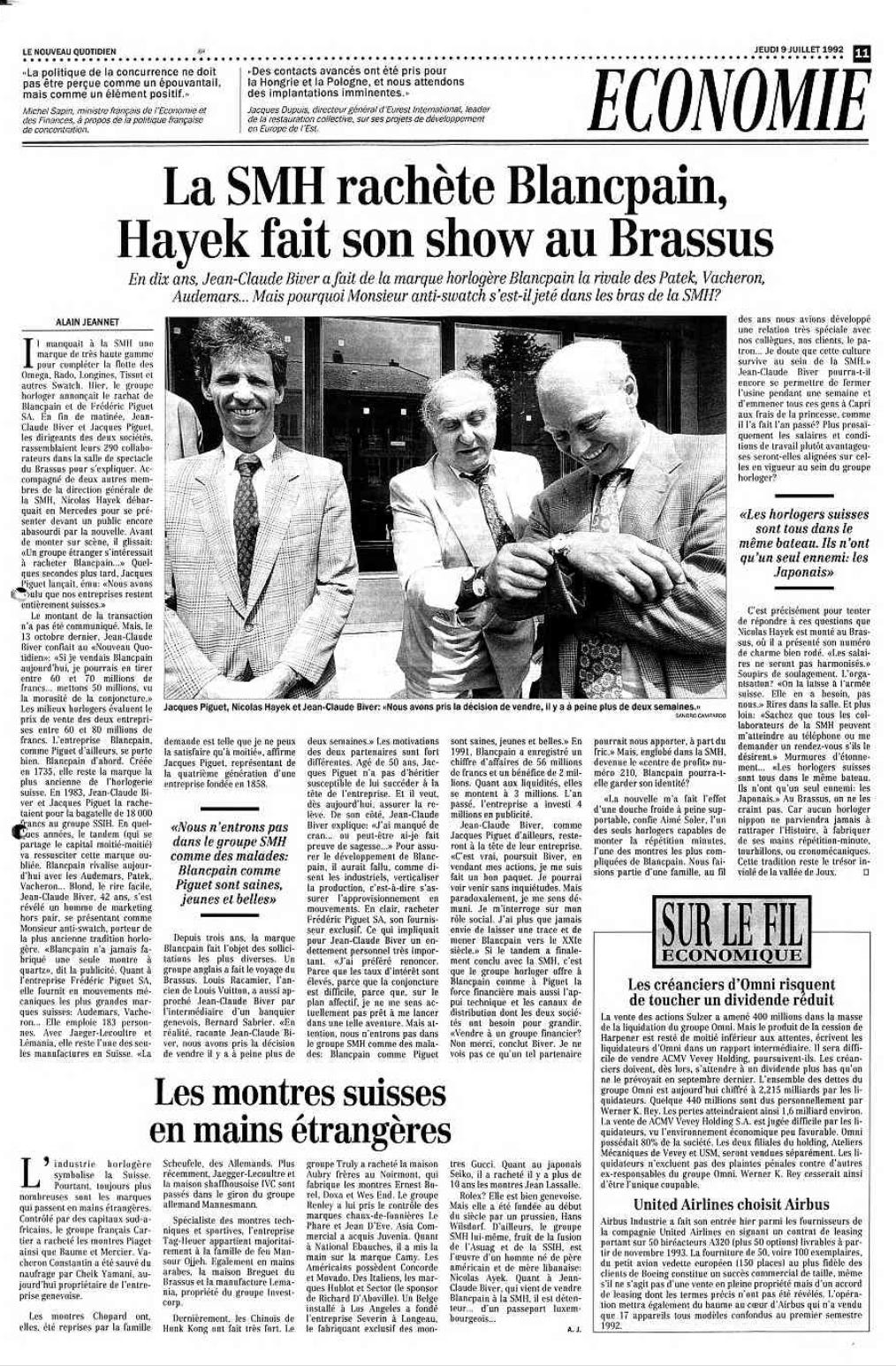
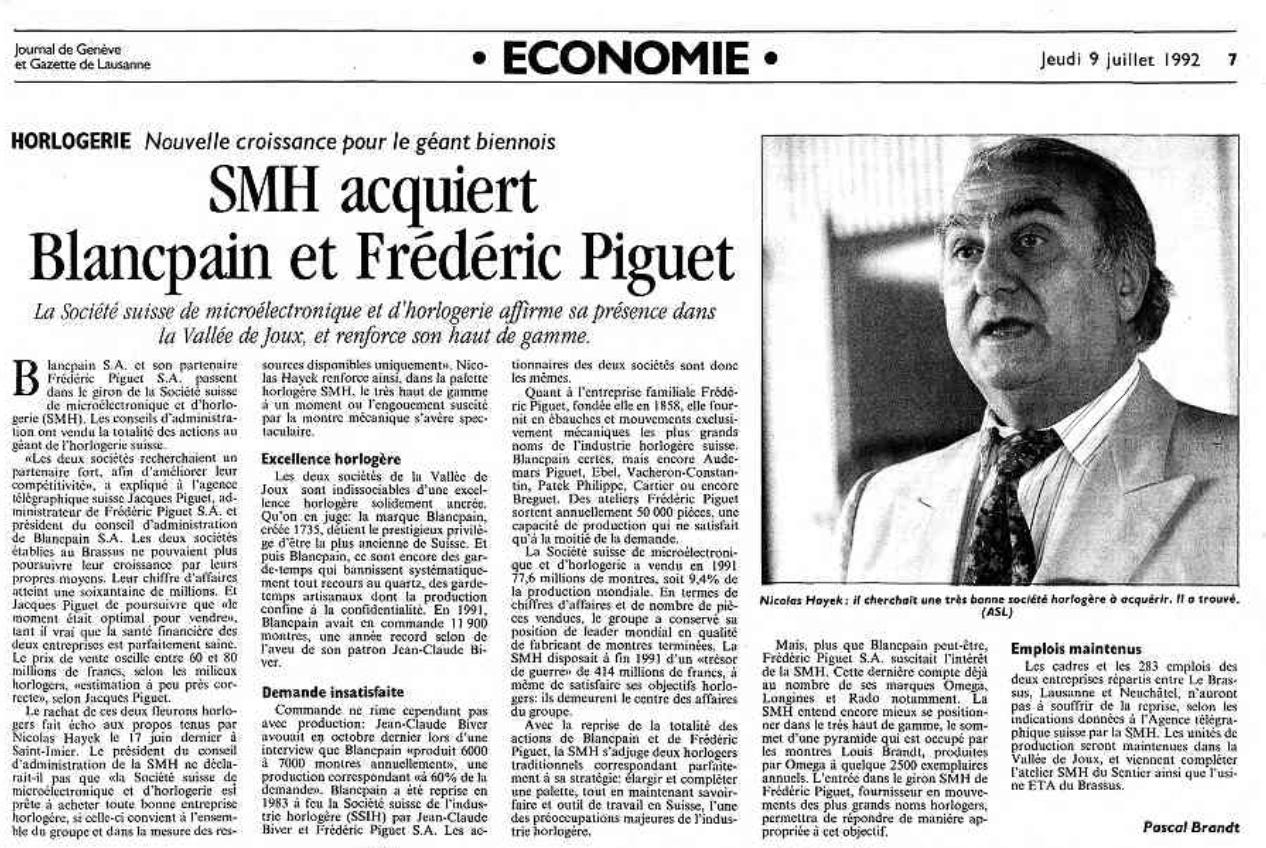
Taken together, these articles have five important takeaways:
There are strong hints that Frédéric Piguet was the true strategic prize for Nicolas G. Hayek, just as Lemania may have been when the Breguet purchase was eventually completed in 1999.
Both Blancpain and Frédéric Piguet could not satisfy customer demand. These were not distressed assets – they needed significant investment to unlock further growth. They weren’t looking for investors to save them from ruin; quite the opposite.
Jacques Piguet had no heir – and he was looking for a way out. Add Biver’s divorce troubles into the mix and you have two owners looking for exits for personal reasons rather than cash.
Frédéric Piguet was producing 50,000 “pieces” a year – if pieces here means movements, Blancpain represented a small part of its overall manufacturing output – reinforcing the idea that the manufacturer itself was the strategic prize..
The sale price range suggests a huge return on investment for the relative pittance originally paid for the Blancpain name.
The sale of Blancpain to SMH marked the beginning of a new chapter – one that would ultimately reshape the brand’s identity and set the stage for the rise of the Fifty Fathoms in the decades that followed.
The Second Biver Era
After the sale of Blancpain and Frédéric Piguet to SMH in 1992, Jean-Claude Biver briefly stepped away from the industry. The break lasted only weeks before he called Nicolas G. Hayek asking about a job.
Hayek gave him Blancpain back, installing him as CEO – but also tasked him with reviving Omega.
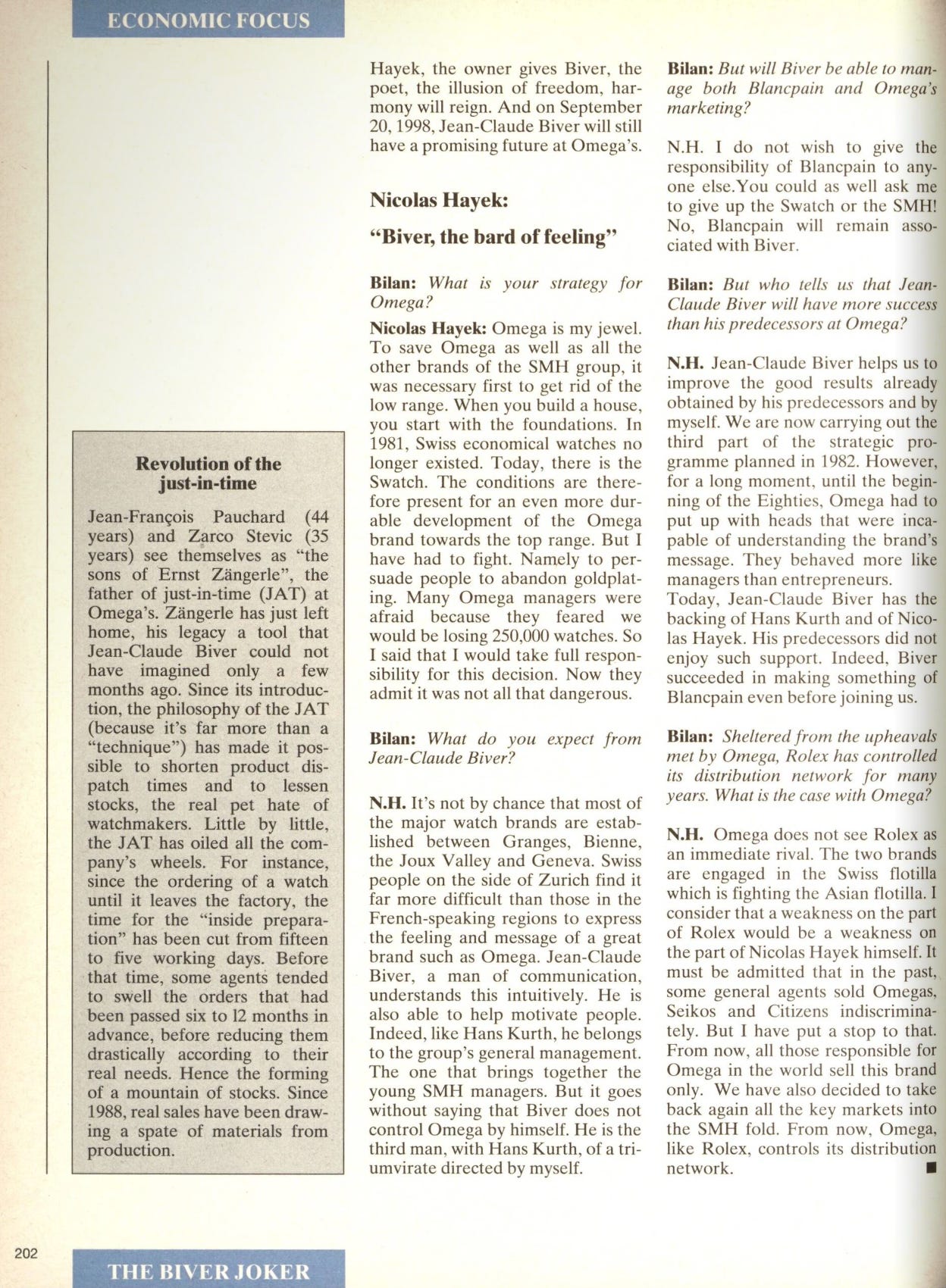
In a Europa Star interview in 1993 Hayek had this to say when asked whether Biver would be able to maintain both his Omega and Blancpain responsibilities:
“I do not wish to give the responsibility of Blancpain to anyone else. You could as well ask me to give up the Swatch or the SMH! No, Blancpain will remain associated with Biver.”
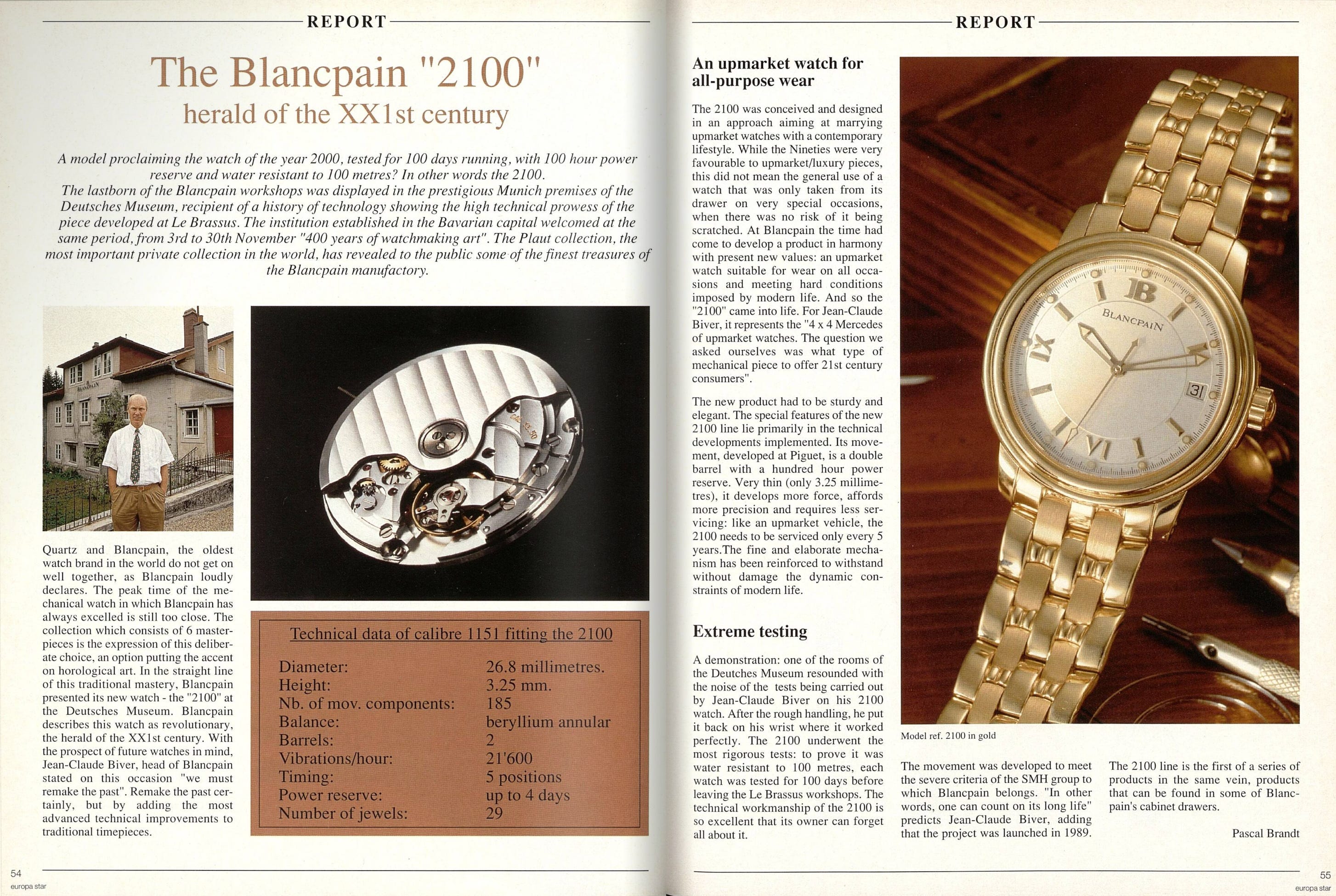
The first new watch line to come out of SMH-owned Blancpain was the 2100 collection.
I’ve written extensively about how and why that collection came about – and why I love some of these watches (later renamed the Léman collection) – so I won’t rehash that here but, in summary, Blancpain put the complications from the Masterpieces into sportier cases to reconcile its traditional, complication-focused identity with the growing demand for steel sports watches in the 90s.
Despite being open to the introduction of sports watches to the catalogue, Biver seems to have been resistant to the idea of reviving the Fifty Fathoms throughout his time at the helm of Blancpain. I’ve also written about this before – and noted how odd and written out of Blancpain history the actual first revival of the Fifty Fathoms (and the Air Command) was in 1997 when it appeared in the Trilogy collection.
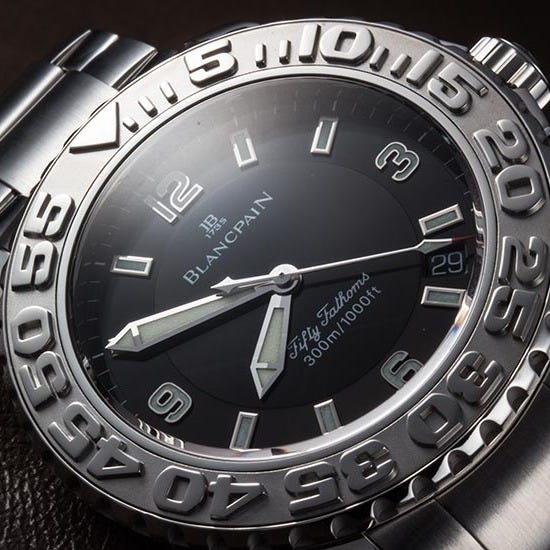
The appearance of the Trilogy collection poses an interesting question: why was Biver so resistant to a historically-accurate revival of the Fifty Fathoms in the first place?
The Return of the Fifty Fathoms
The turn of the millennium marked the end of the Biver era and the beginning of another.
Biver caught Legionnaire’s disease in 1999, which seems to have led to him eventually exiting his responsibilities completely at both Blancpain and Omega by 2003.
Marc A. Hayek, Nicolas G. Hayek’s grandson, was appointed CEO of Blancpain in January 2002 at the age of 32 – and became the driving force behind the true introduction of the Fifty Fathoms into modern Blancpain’s catalogue.
I find the Trilogy collection – and the even stranger Concept 2000 watches – compelling in their oddness, but they are historical anomalies.
The Fifty Fathoms as we know it today – with that distinctive domed, sapphire bezel – didn’t appear until 2003 as a limited edition comprising three series of 50 watches to celebrate the Fifty Fathoms’ 50th anniversary.
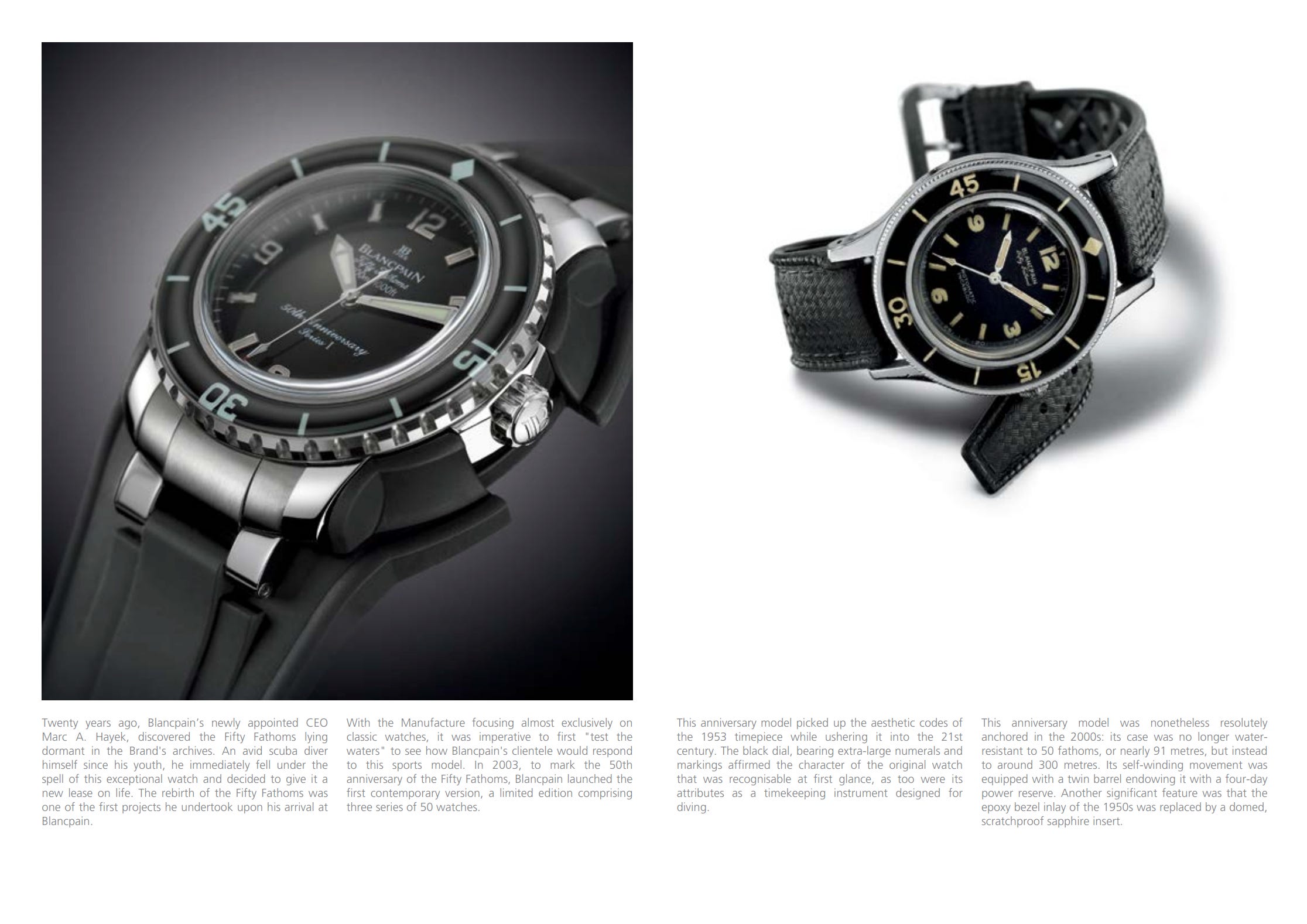
1953 as a launch date for “the world’s first modern diver’s watch” has faced similar scrutiny – again from Perezscope – as the company’s founding date. My view here is broadly the same as my take on the 1735 date and in line with the perspective of The Deadbeat Seconds:
“I do not care which of the two years is correct. It does not change why the watch was made or what role it played. The history still exists. The impact is still there. The watch is still an icon.”
After the limited edition of 2003, the Fifty Fathoms wasn’t seen again until 2007 when a new Fifty Fathoms collection debuted at the Basel Fair that year. The Fifty Fathoms has remained in the catalogue ever since.
It’s worth pausing here for a moment – for more than two decades of Blancpain’s modern history there wasn’t really a Fifty Fathoms in the catalogue. Yet, if you randomly asked people with an interest in watches to name a Blancpain model today, surely the first thing most people would say is “Fifty Fathoms”.
Here’s why I think the Fifty Fathoms has come to dominate the brand’s public image:
It had a strong, compelling history and origin story – unlike anything else in the Blancpain catalogue at the time. It seems plausible to me that this was the key reason Biver was resistant to it – this story didn’t fit with his modern version of Blancpain and he knew it would take attention away from the purity of his vision.
Iconic dive watches tend to come to define watch brands. Submariner. Seamaster. Black Bay 58. Dive watches are easy to explain, easy to wear and easy to build an emotional connection with.
It was one of the earliest successful revivals of a mid-century dive watch, establishing its credentials when the heritage-reissue trend that came later got hot. There’s a reason there have been two Hodinkee limited-edition Fifty Fathoms watches.
It is arguably Marc A. Hayek’s defining achievement for the brand. He is a diver and a keen ocean conservationist. This is his watch; he brought it back. He has repeatedly emphasised the watch’s importance to the brand.
It’s hard to argue the Fifty Fathoms has been anything but a huge success for Blancpain, but it does present a challenge: it anchors the brand in a dive watch identity that makes its other collections – most notably the Villeret collection – significantly harder to communicate.
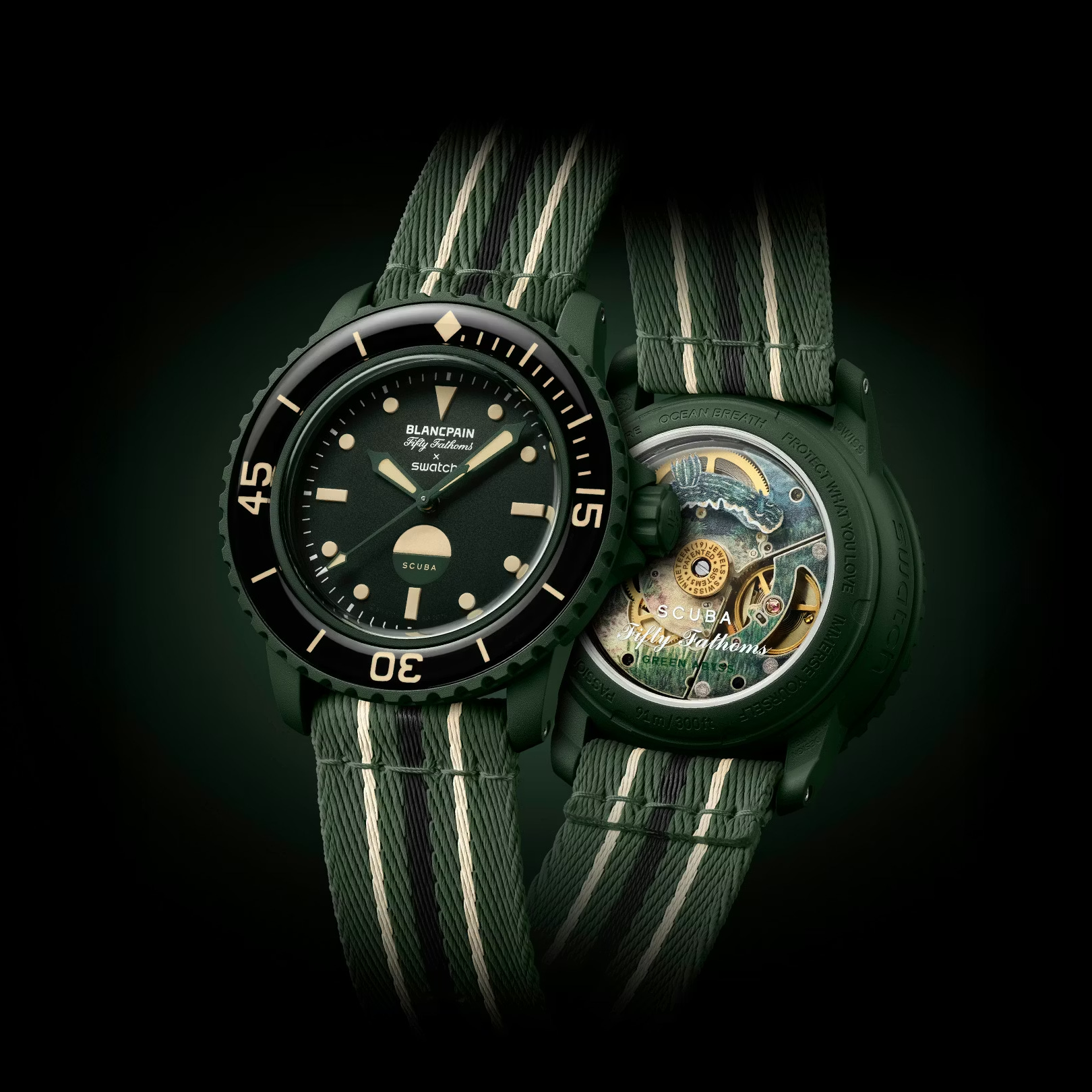
It would be remiss of me at this point to not to mention the Blancpain X Swatch Scuba Fifty Fathoms collection. I am not as worked up about it as some people seem to be but its existence further reinforces the point: the Fifty Fathoms has become Blancpain’s dominant story.
The Tale of Two Blancpains
Blancpain is effectively two distinct brands at this point.
One is Fifty Fathoms – a heritage-revival sports watch brand brought into existence by Marc A. Hayek in the mid-2000s.
The other is Villeret – a complicated, traditional watchmaking brand conceived by Jean-Claude Biver in the 1980s.
The reason this presents a particular challenge for Blancpan is because there are really only three truly iconic dive watches in the industry – and the Fifty Fathoms is one of them. The Nautilus – which I’m picking out because it is a sports watch from a brand otherwise known mainly for high complication – is not, and as such Patek Philippe does not face the same challenge as Blancpain when it comes to coherently marketing watches that have very different design languages.
The other two iconic dive watches are the Rolex Submariner and the Omega Seamaster. Dive watches from brands not known for highly complicated watchmaking and with retail prices that are lower than almost anything in Blancpain’s catalogue.
It’s why the Fifty Fathoms sometimes faces accusations of being too expensive. Price comparisons are made against the Submariner and the Seamaster, not anchored in the other watches in the Blancpain catalogue and usually without reference to differences in watchmaking quality.
In some ways this mirrors the challenge Rolex faces when pushing toward haute horlogerie and the Holy Trinity – it is grounded in a tool watch identity that is hard to shake off.
I’m encouraged then that Blancpain has very recently taken steps to re-establish the traditional, complicated watchmaking credentials of its in-house manufacturer – once known as Frédéric Piguet, known today as Manufacture Blancpain.
The Ringing of the Changes
Earlier this year I had the opportunity to handle the Blancpain Grande Double Sonnerie in person.
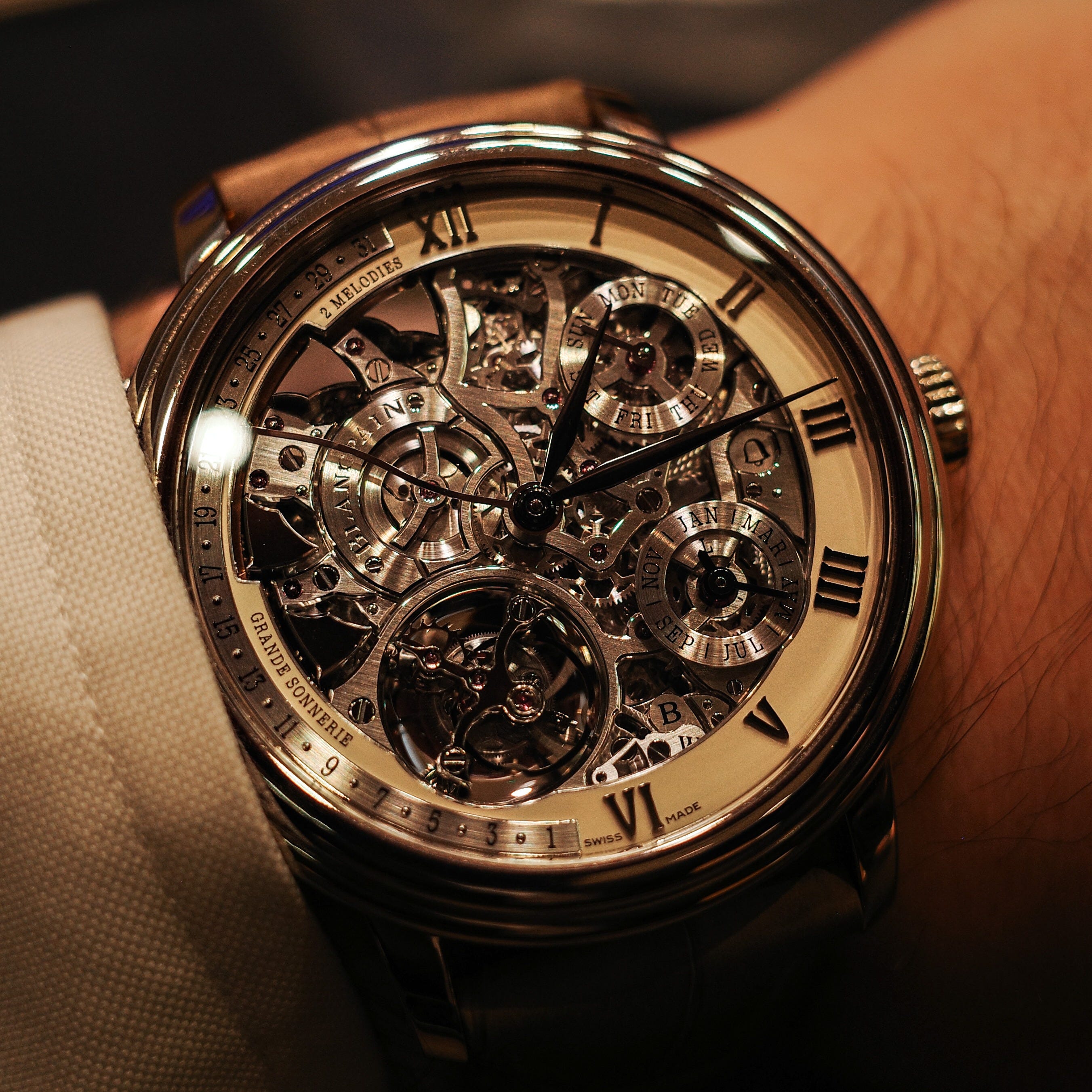
Eight years in development, the watch represents one of the most ambitious projects Blancpain has undertaken in decades. The project also appears to carry the personal imprint of Marc A. Hayek, who seems keen to position the watch as a milestone moment for Blancpain. For example, take this quote from a Revolution article in November 2025:
“So, what does this achievement mean for Blancpain’s future? Hayek is unequivocal: “This watch does not mark the end of a project; it marks the beginning of a new era for Blancpain. While it is the most complex creation in the brand’s history, it is not a standalone achievement. The Grande Double Sonnerie opens the door to a new chapter in which Blancpain will express its full watchmaking capabilities more visibly and more consistently.” He paused before adding, “It is a starting point.”
The Grande Double Sonnerie feels like a modern echo of the 1735 Grande Complication that closed out the Biver era – another moment when Blancpain used extremely complicated watchmaking to communicate what the brand stood for. Hayek seems to be hinting at what would be a welcome rebalancing of Blancpain’s modern identity in the coming years; the refresh of the Villeret collection late last year does not seem coincidental.
The Question of 2035
Given how long the Grande Double Sonnerie took to develop, you have to imagine that Blancpain is already beginning to plan for its biggest anniversary yet. Maybe the “new chapter” Marc A. Hayek spoke about is designed to do just that – to lay the groundwork that marks its 300th year (disputed dates notwithstanding).
In 2010 – Blancpain’s 275th anniversary celebration year – it was the Villeret line that Blancpain used to mark the occasion, even though the Fifty Fathoms was now a permanent collection.
Could it be the Villeret collection that once again marks a year that’s significantly important to Blancpain? Or will the Fifty Fathoms be the vehicle?
What I’d personally like to see Blancpain do in the intervening years is to make the brand more coherent and less a collision of two identities. It could then have multiple lines of celebration as opposed to having a pendulum swing wildly one way or the other.
None of this is easy to solve from the outside. But as Blancpain heads towards its 300th anniversary, there’s an opportunity to sharpen its narrative.
Here are three thoughts around how it could do that:
Claim a signature complication
Patek Philippe has the perpetual calendar chronograph. A. Lange & Söhne, the big date. Breguet can arguably stake a claim to the tourbillon. Building gravity around a particular complication would reassert Blancpain’s position in the world of traditional, complicated watchmaking.
The good news is someone at the brand seems to have already spotted this – and they’ve picked a complication they can justifiably build a moat around: the moonphase.
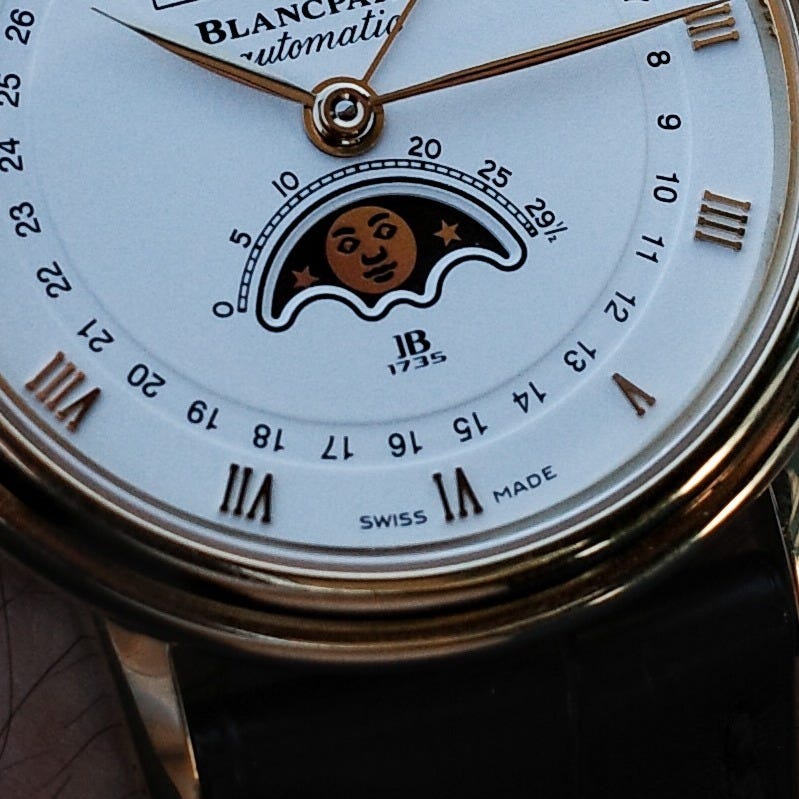
The moonphase is the complication that relaunched Blancpain in the 1980s and is one of the most characterful moonphase designs out there. Tony Traina called it a “Mona Lisa smile”. Go to the brand’s Instagram profile today and you’ll see a grid covered in those smiling moons. I’m hopeful this is a strategic long-term play rather than just a tactical one.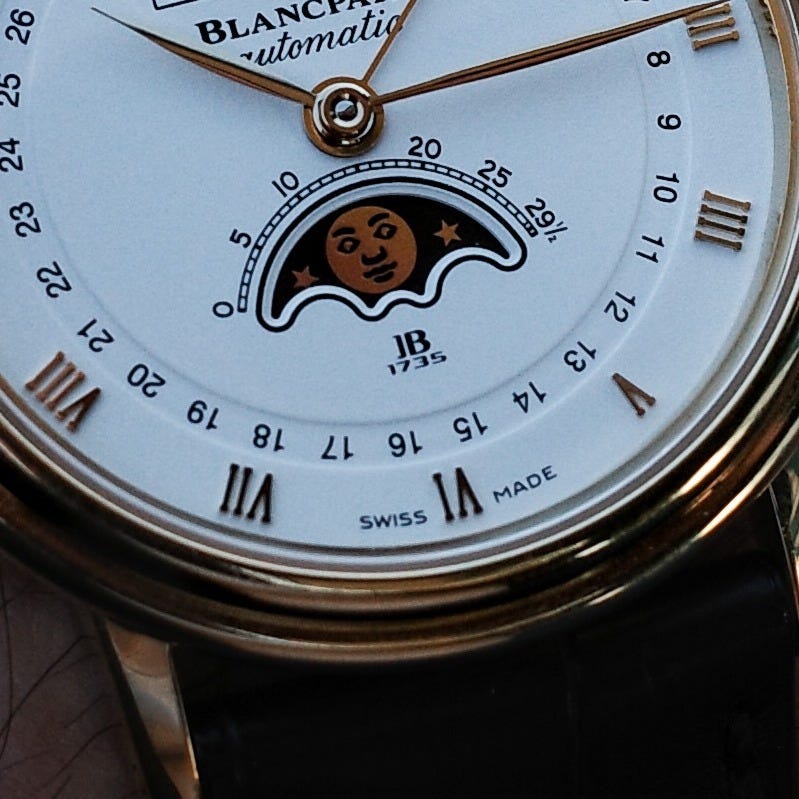
Blancpain’s characterful “Mona Lisa” moon Rebuild the bridge
A true sports watch collection at Blancpain would bridge across the hard-to-explain gap between the Villeret and the Fifty Fathoms, and make their coexistence seem less puzzling to people.
It would enable Blancpain’s impressive complications to appear in sportier, mid-size cases for those less enamoured with the ornate designs of the Villeret collection while facilitating the simplification the Fifty Fathoms collection – tourbillons and moonphases do not belong in dive watches in my mind. It would enable the Villeret collection to size down to nearer its original proportions without losing clients averse to smaller watches. Look, I’m sure there was a good reason the Léman line went away but I think it makes even more sense now than it did in the 90s.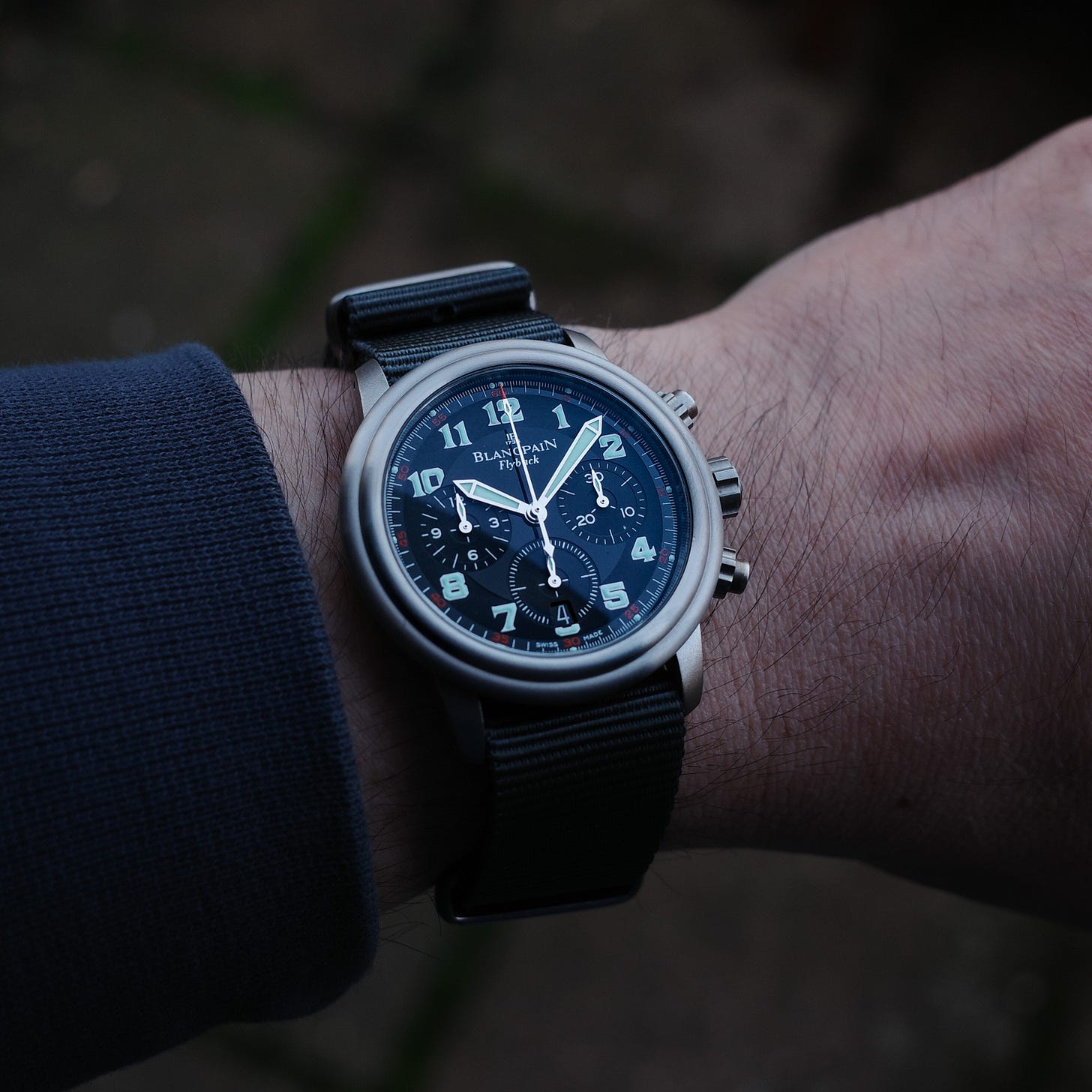
Blancpain 2185F Develop the Air Command
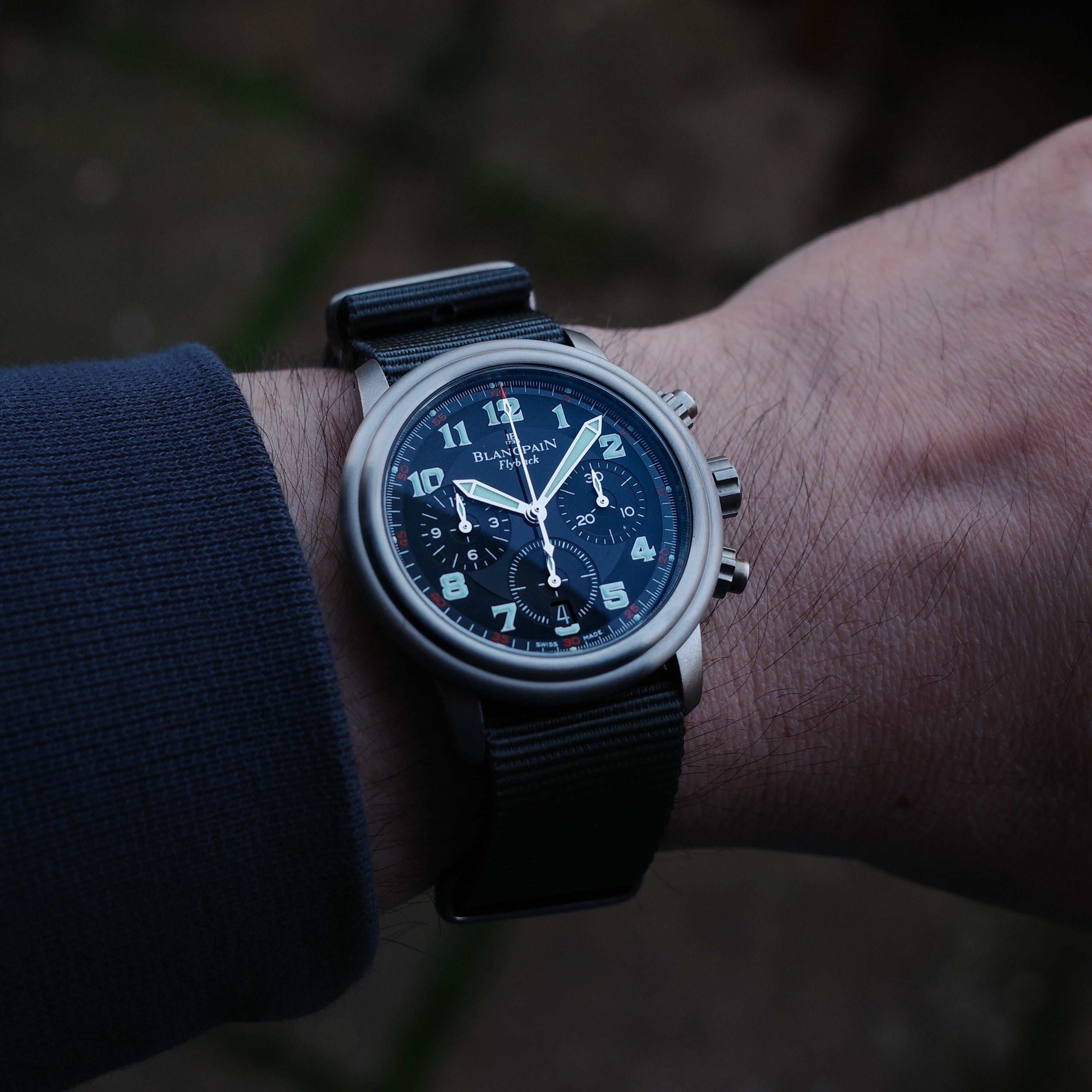
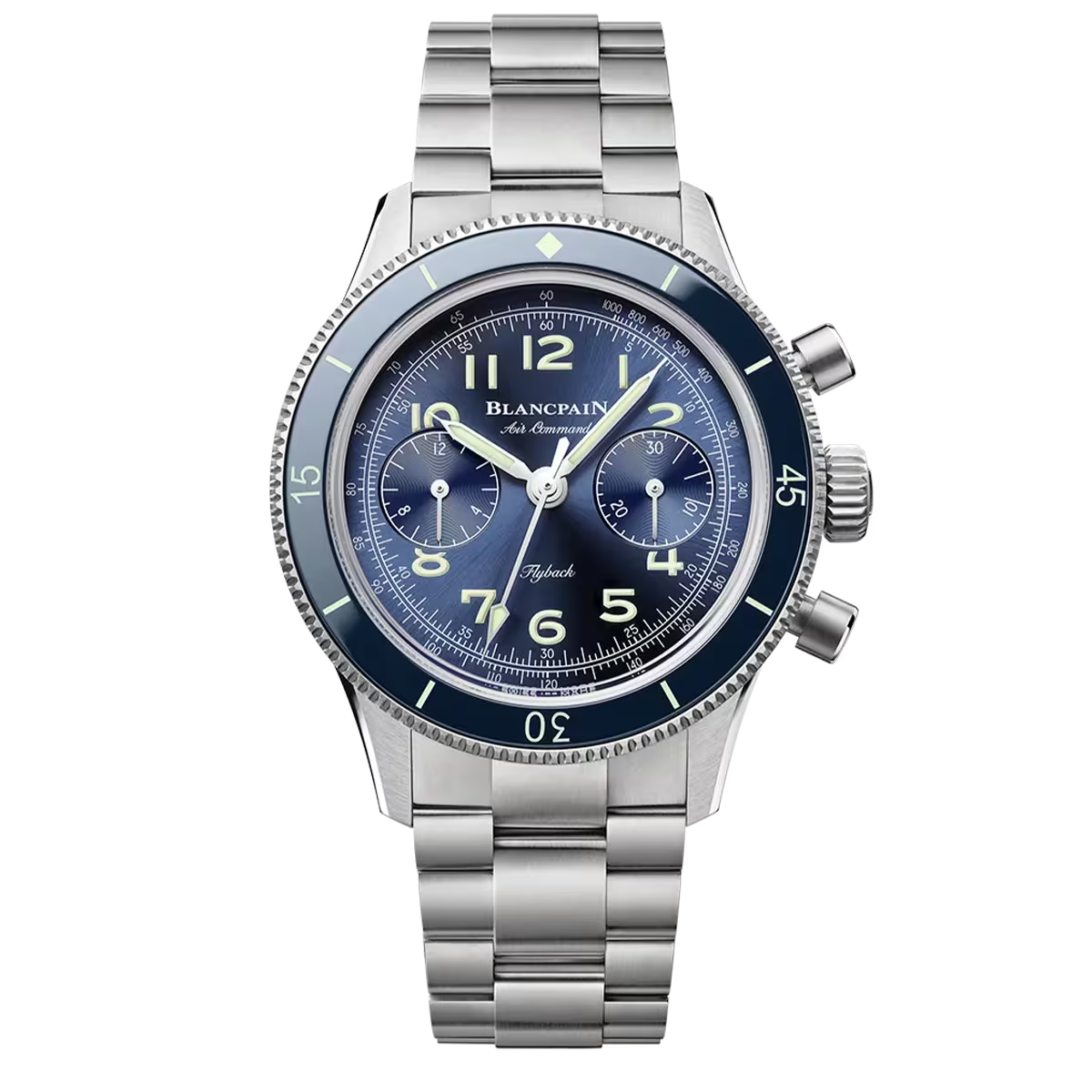
Further development of the Air Command collection would do a little of both the first and second suggestions – and help smooth out the Blancpain catalogue. It’s a collection that plugs a gap between the Villeret and the Fifty Fathoms and features something of a signature Blancpain complication: the flyback chronograph. Less ownable than the moonphase, for sure – sister brand Breguet would probably have something to say here – but Blancpain started focusing heavily on the flyback in the late 90s.
The Air Command has an interesting origin story but not one so compelling that it would ever dominate the brand narrative. And right now the collection contains some of the best watches Blancpain makes today in my view. The AC03 12B40 98S in particular has very few competitors out there – who else is making a 36mm titanium flyback chronograph? – and many admirers in the collector circles I inhabit.
What Blancpain chooses to celebrate in 2035 will say more about where the brand is than debates about its specific origin date.
The more important story for me lies in modern Blancpain, not in a farmhouse in 1735.
What Blancpain’s revival meant for the watch industry in the 80s. How the reclaiming of its midcentury dive watch reshaped the brand. What its return to highly complicated watchmaking in 2025 with the Grande Double Sonnerie signifies. Blancpain today is a product of these moments.
If it can find a compelling way to weave a narrative between its different identities by 2035 it won’t just be celebrating a disputed anniversary – it can rejoice in having found a way to tell the real story of one of the most interesting brands in modern watchmaking.
With thanks and gratitude to:
Jean-Claude Biver (A): The Reemergence of the Swiss Watch Industry by Ryan Raffaelli. [2014]
Jean-Claude Biver: “There’s no question of going one round too many!” by Fondation Haute Horologie. [2018]
Jean-Claude Biver: Past, Present Future by Pierre and Serge Maillard. [2019]
Blancpain, F. Piguet, Biver, and the Path Forward by Stephen Foskett. [2021]
Forgotten Watches – Neo-Vintage Blancpain And The Six Masterpieces by Ben Dunn. [2022]
In-Depth: Blancpain’s Six Masterpieces by Tony Traina. [2023]
A Comprehensive History of the Automatic Watch by Xavier Markl. [2024]
Grand Ambition: Inside Blancpain’s Grande Double Sonnerie by Tracey Llewellyn. [2025]
The Blancpain Fifty Fathoms I Finally Bought by The Deadbeat Seconds. [2025]
The Europa Star archives.
Lettres du Brassus by Blancpain.
Blancpain really need to look at the villeret collection and understand what made the OGs great. Agree that there doesn't seem like a middle ground and a greater sense of coherence woukd help them. Should take a leaf of of rhe Breguet playbook..
Rumor is a whole new Leman line was ready for launch and then put on ice a few years ago. A shame. Hopefully it'll come back.