


I am at an event to celebrate the Fifty Fathoms.
There are many appealing Fifty Fathoms references in the room, both old and new.
But the Blancpain watch that catches my eye isn’t a Fifty Fathoms.
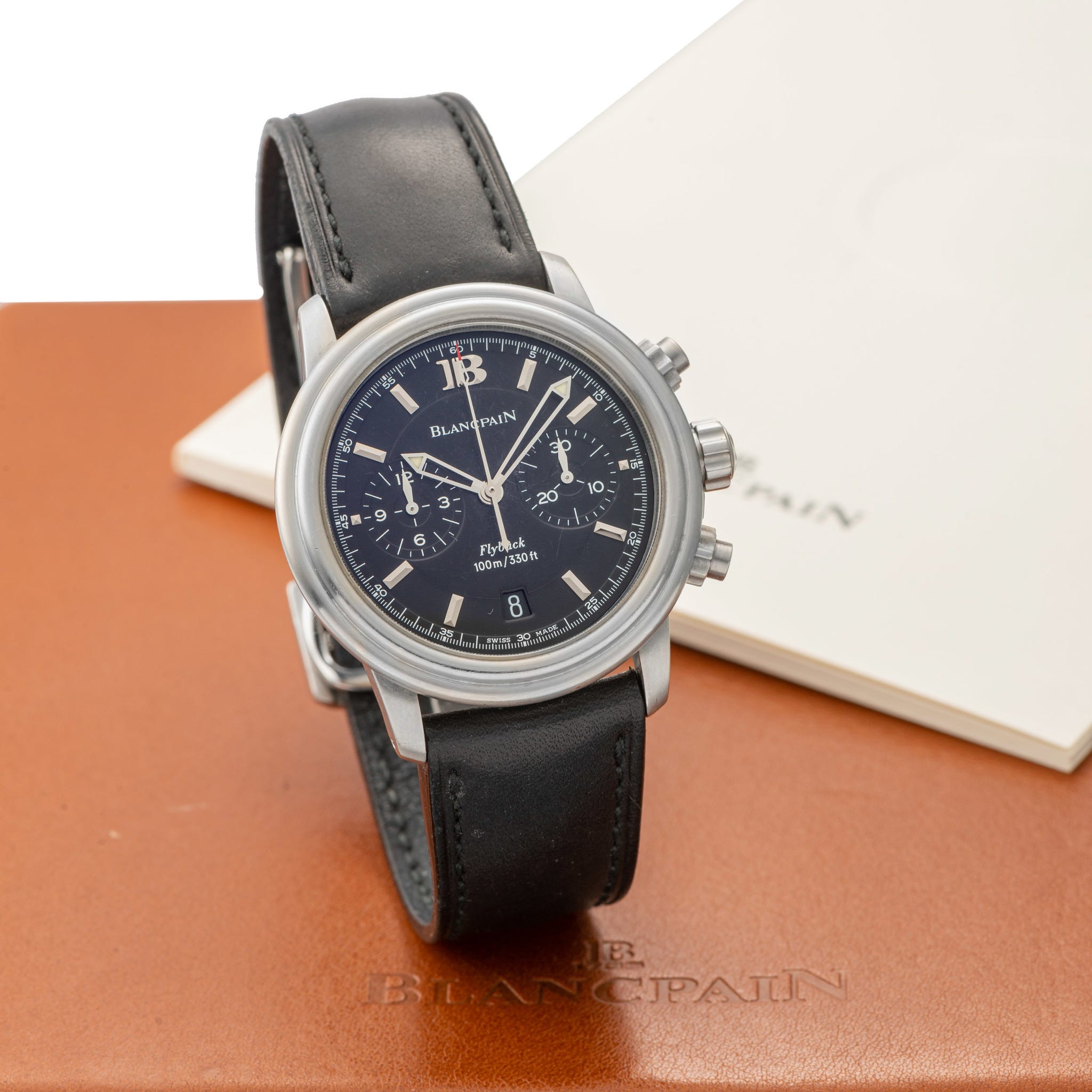
It’s on Ben’s wrist: A stepped-bezel titanium case chronograph with Arabic numerals that look like they’ve been lifted straight off a trench watch.
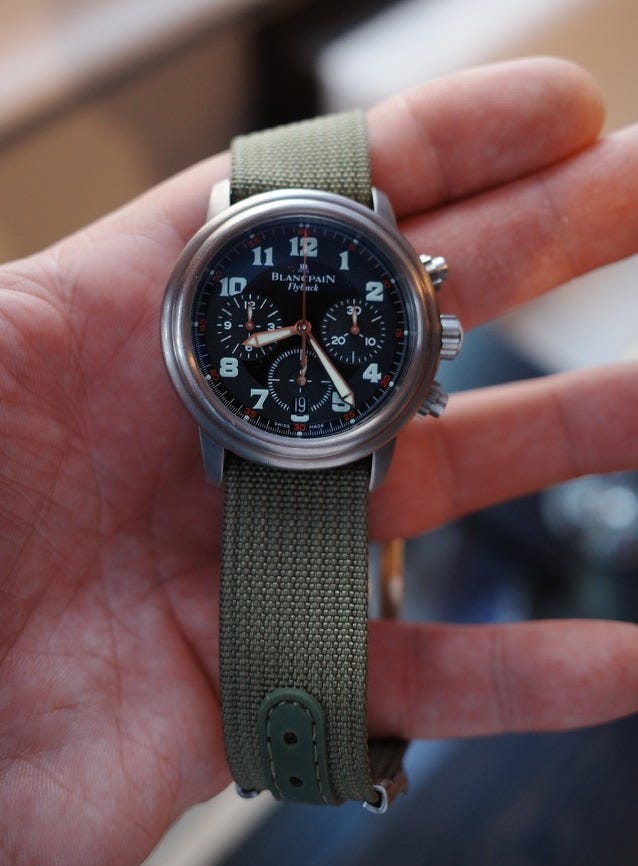
Not modern Blancpain. Not vintage either. Somewhere in between, but not quite the neovintage Blancpain references I was familiar with.
It sent me down a months-long rabbit hole that ends with a Léman reference 2585F – a perpetual calendar flyback chronograph – in my own collection. And leaves me with a nagging question: What exactly was this Léman line, and why had it slipped through the cracks of modern Blancpain storytelling?
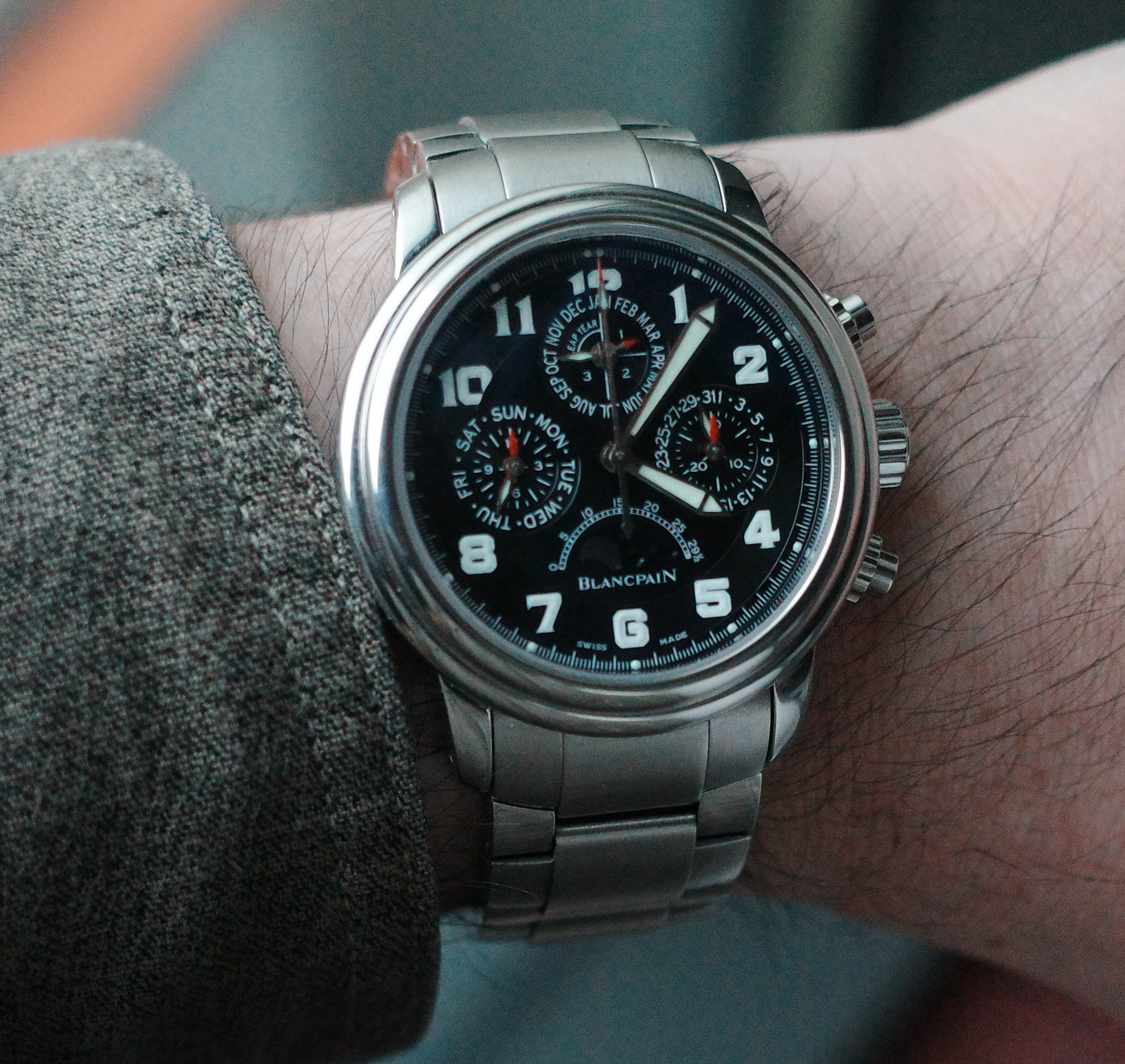
Because as it turns out, the Léman collection sits in a peculiar historical blind spot.
Too recent to really have a great deal of scholarship devoted to it; just old enough that its origins lie before the internet was really a thing.
And realistically without enough collector interest to demand cataloguing. Yet.
That said, take a look at the comments section of coverage of any new Blancpain watches. There’ll almost always be at least one person calling for the return of the Léman.
So I decided to trace the Léman story for myself. What follows is the fullest picture I can assemble of the Léman’s creation, evolution and quiet disappearance.
I should note I haven’t yet engaged with Blancpain directly on any of this. I may yet do that now my thoughts are in some semblance of order. I’m also hoping that by just putting this out there I will receive some corrections from Blancpain collectors more seasoned than I.
One seasoned collector I did talk to briefly in the course of writing this piece is Henrik, @shortyshome on Instagram and creator of The Blancpain Blog.
Henrik’s blog is one of the few places you can find detailed information about Léman watches. He even has a 3-part guide to the collection which is really useful in terms of getting to grips with the Léman line. Henrik’s series is linked at the bottom of this article.
The 5 eras of Blancpain – and where the Léman fits
The history of Blancpain is famously convoluted – and not something I am going to unravel here.
Stephen Foskett’s excellent Blancpain, F. Piguet, Biver, and the Path Forward and the accompanying Watch Files podcast does that far better than I ever could.
While you don’t need to know the full details of Blancpain’s history to make sense of where the Léman collection fits, understanding the five eras of the company’s history does help contextualise it.
1735–1932: Historic Blancpain
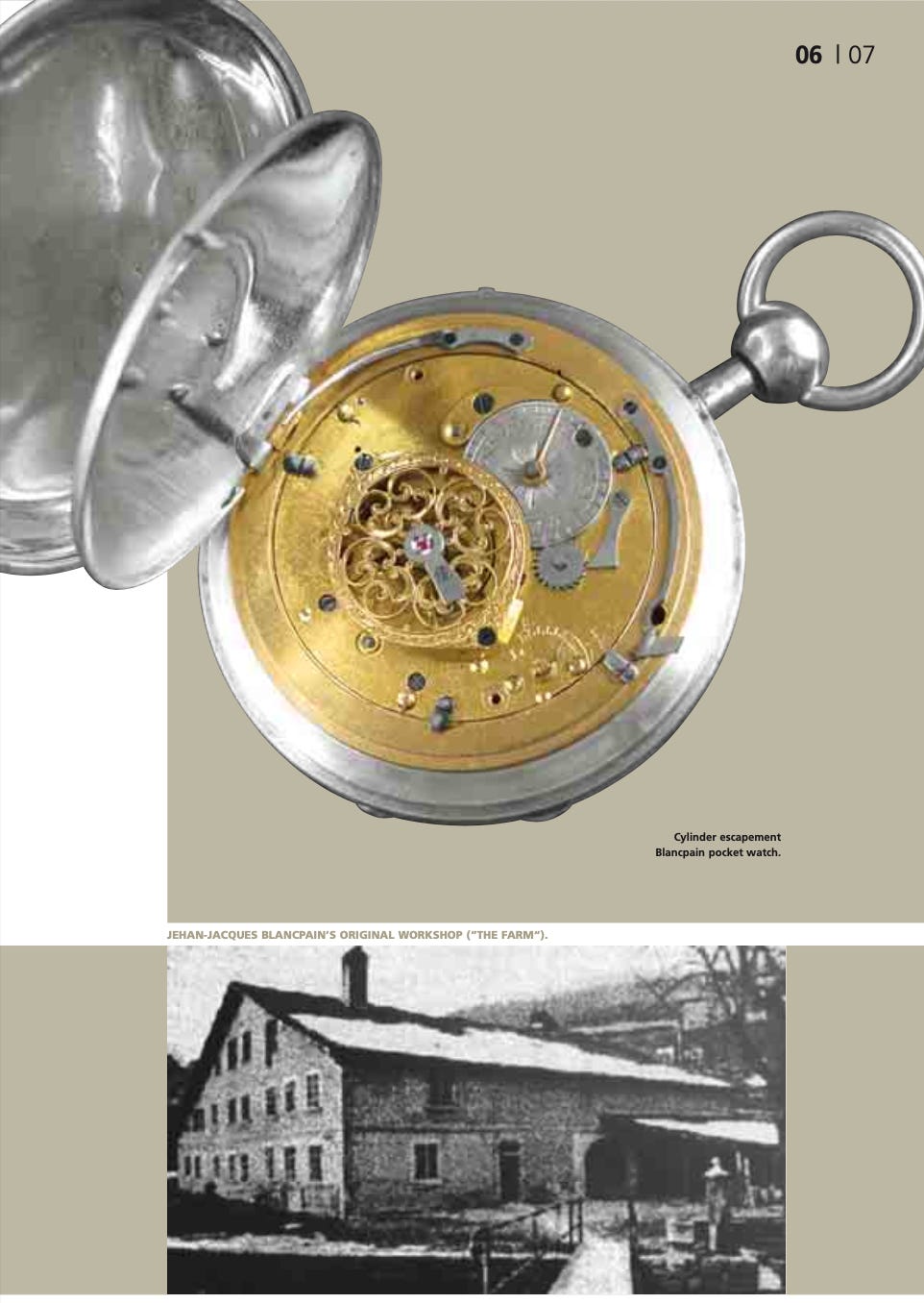
This period doesn’t have much connection to the era of Blancpain I care about and as such I don’t have much to say about it. I’m sure there are some interesting stories here but those are not mine to tell. Issue 5 of the company’s in-house magazine, Lettres du Brassus, has some of those stories if you can track it down.
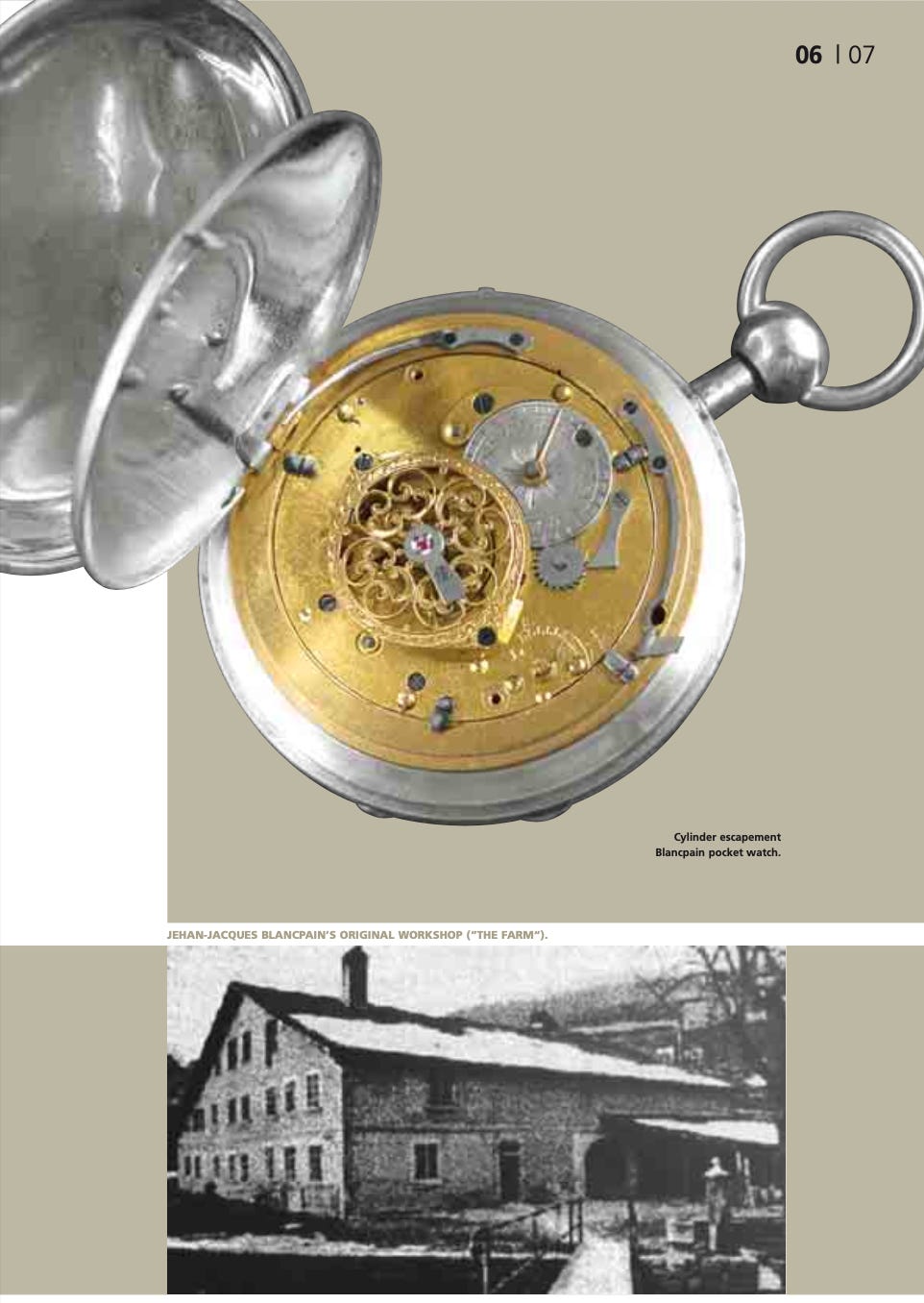
Lettres du Brassus, Issue 05, 2008. 1932–1980: Midcentury Blancpain
The Fifty Fathoms era that people associate most strongly with modern Blancpain and when the company joins the Société Suisse pour l’Industrie Horlogére SA (SSIH), alongside Omega and Tissot. The company ceases producing watches under the Blancpain name by the end of it.
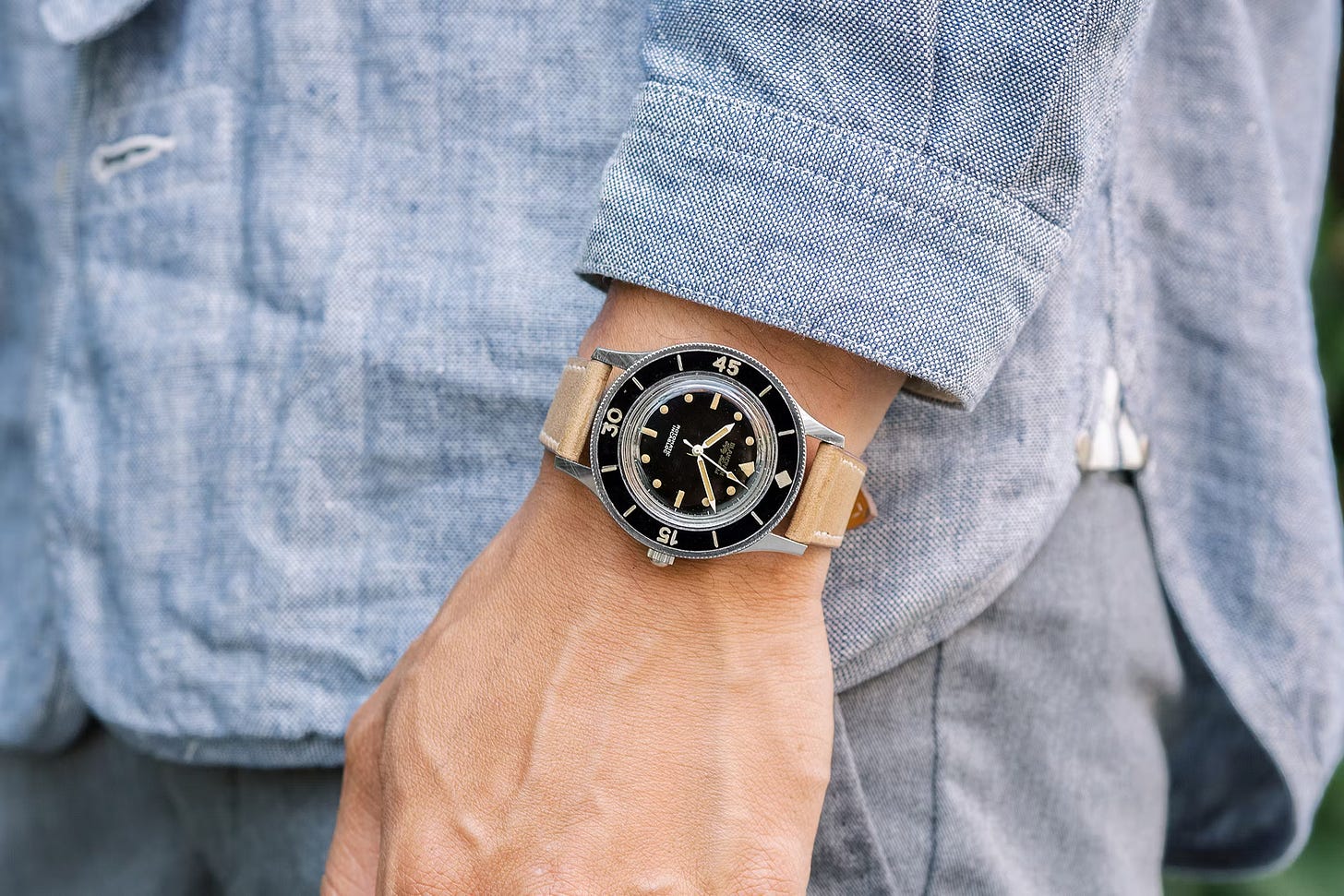
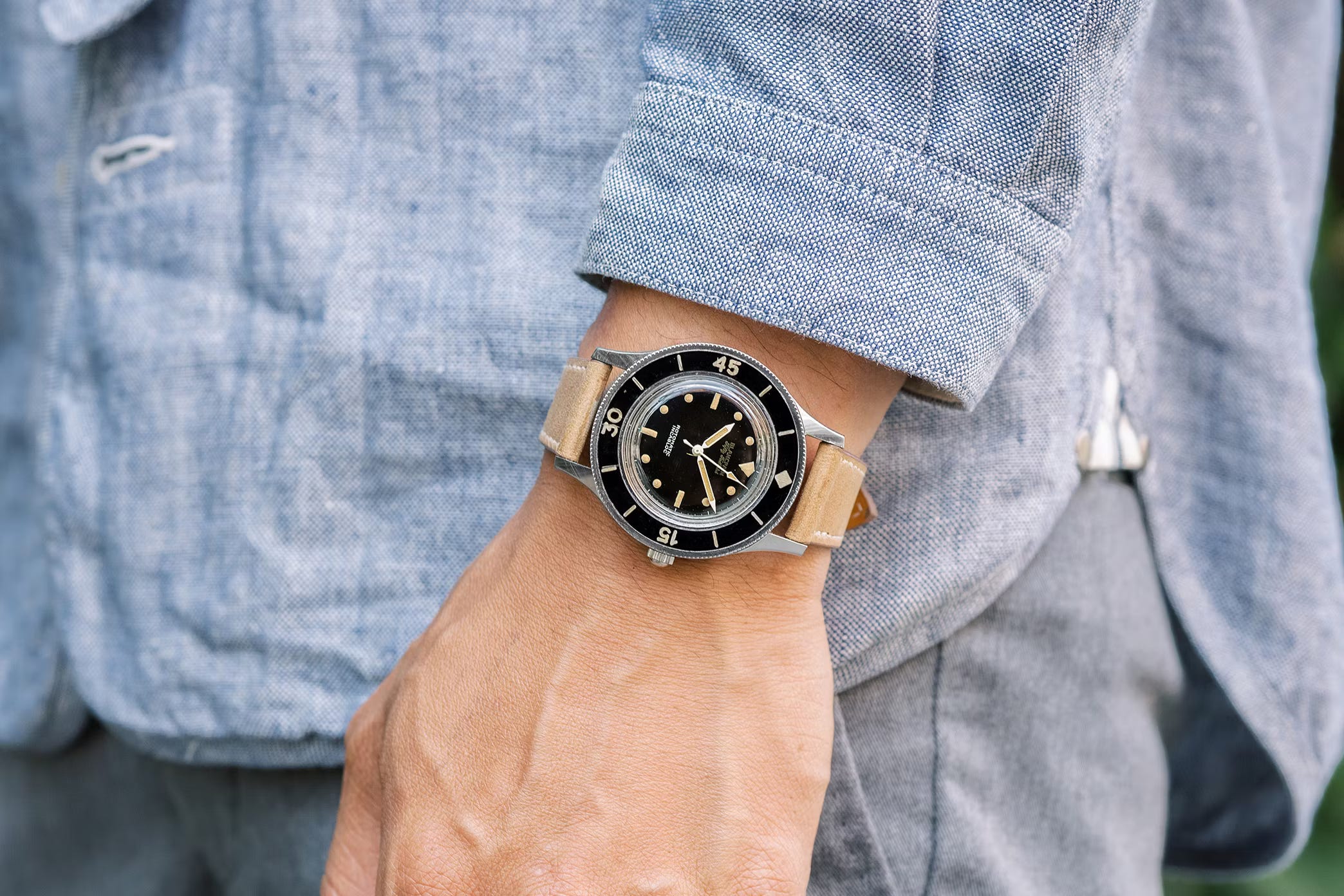
Vintage Rotomatic Incabloc Fifty Fathoms. Image courtesy of Hodinkee. 1981-1992: The Piguet-Biver Era
Blancpain is reborn in a period of watchmaking that generally fascinates me. The quartz crisis is still roiling traditional Swiss watchmakers. The enigmatic industry legend Jean-Claude Biver and movement manufacturer Frédéric Piguet buy the Blancpain brand from SSIH for a reported CHF 21,500, and it comes with…nothing. No archives, no tools, no parts. Nothing. Just the name. The assets of Rayville-Blancpain, meaning Blancpain’s movement manufacturing facilities and equipment, remained fully in operation, making movements for Omega by all accounts. Together Biver and Piguet set about creating a reimagined Blancpain that in some ways plots a path to save Swiss watchmaking and turn watches into the luxury items we understand them to be today. Pierre and Serge Maillard’s interview with Biver in 2019 for Europa Star is a great starting point to better understand this period of the company’s history.
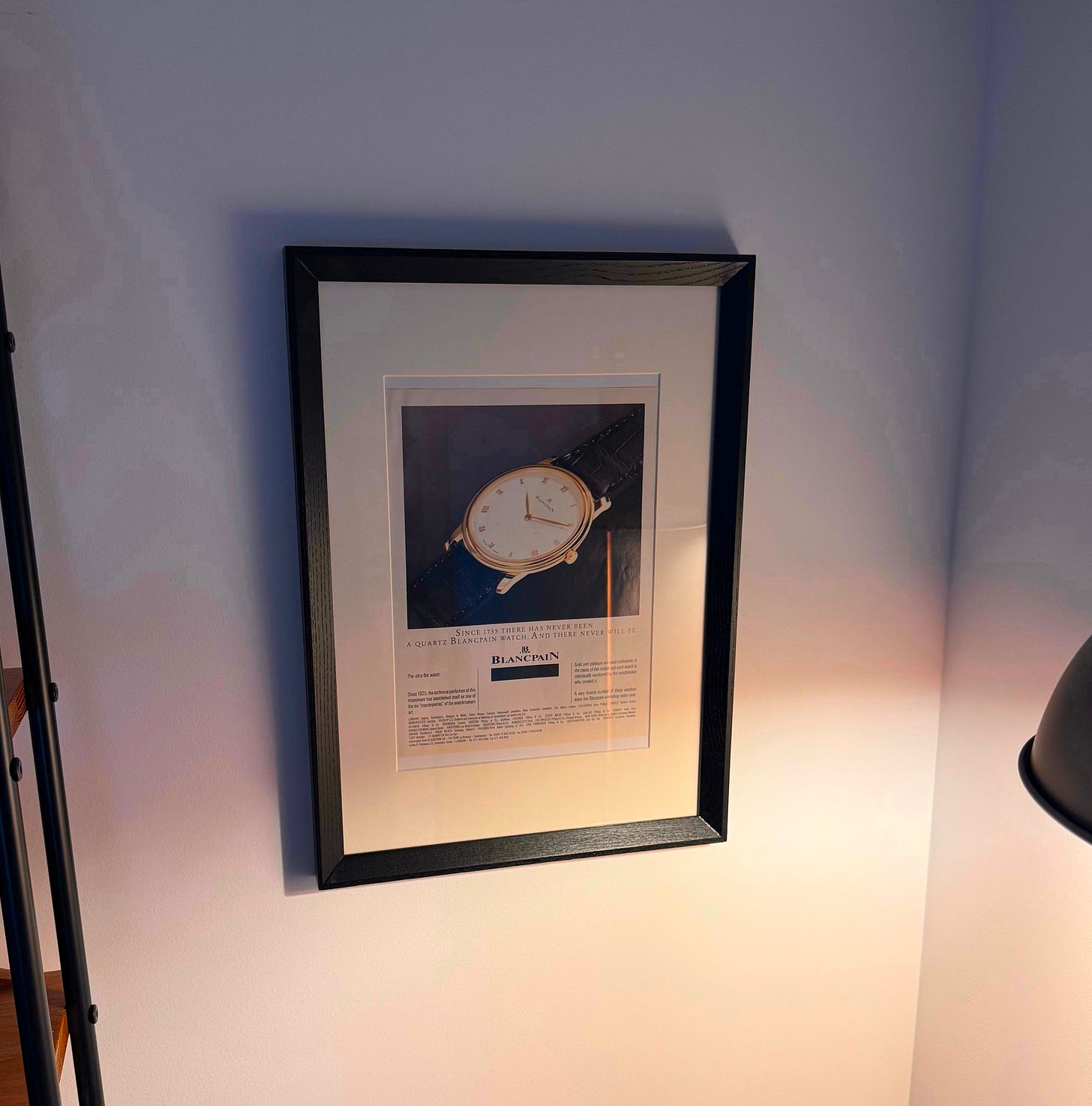
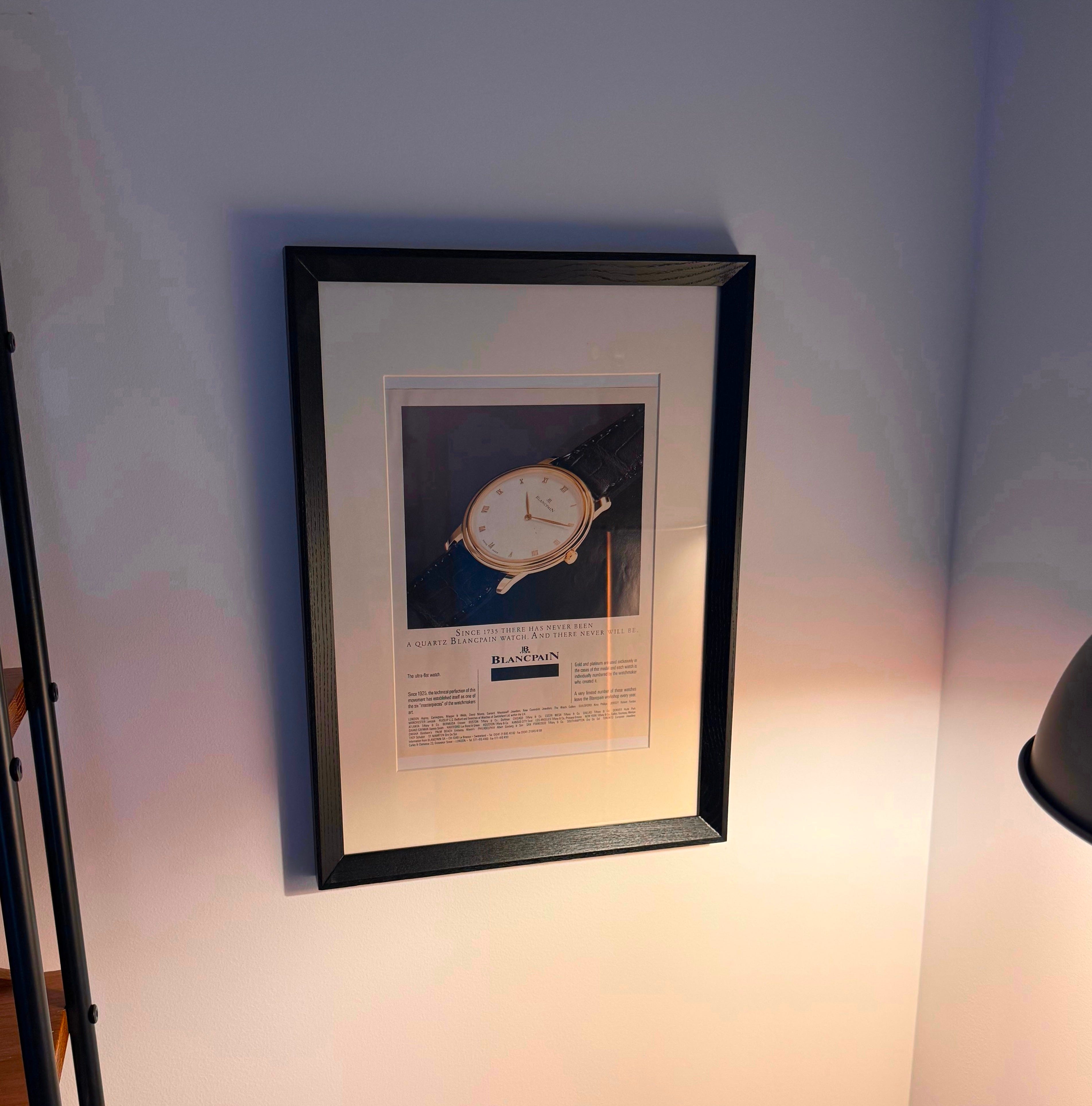
Biver-era Blancpain ad featuring ref. 0021 that hangs in my office 1992–2003: The Biver-SMH Era
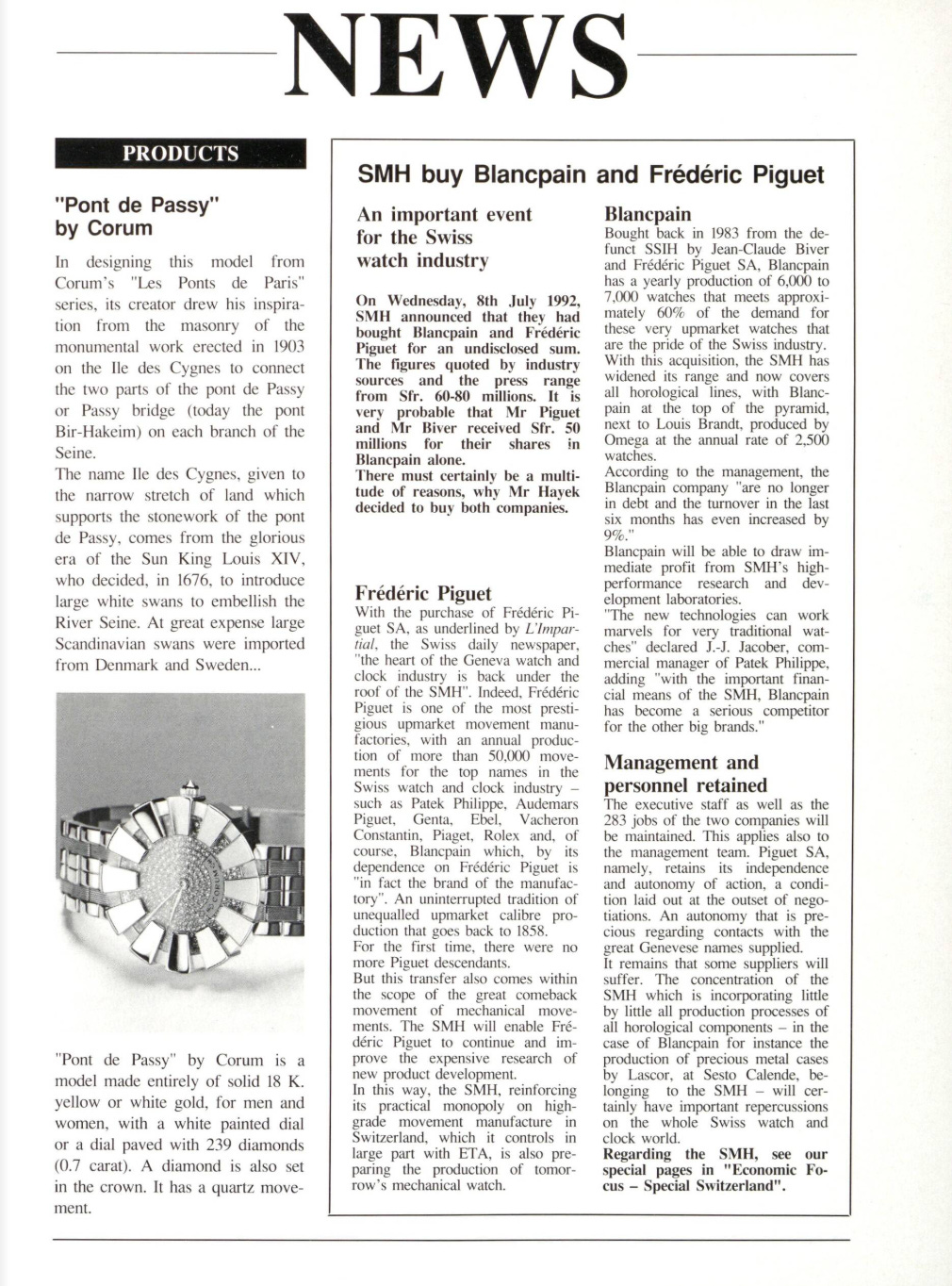
Frédéric Piguet and the Blancpain brand are acquired by Société suisse de Microélectronique et d’Horlogerie (SMH) in 1992, a group that was later renamed The Swatch Group Ltd. Biver remains in charge but also takes on responsibility for Omega before leaving Swatch Group entirely in 2003. Crucially, this is when the watches that will become the Léman line emerge.
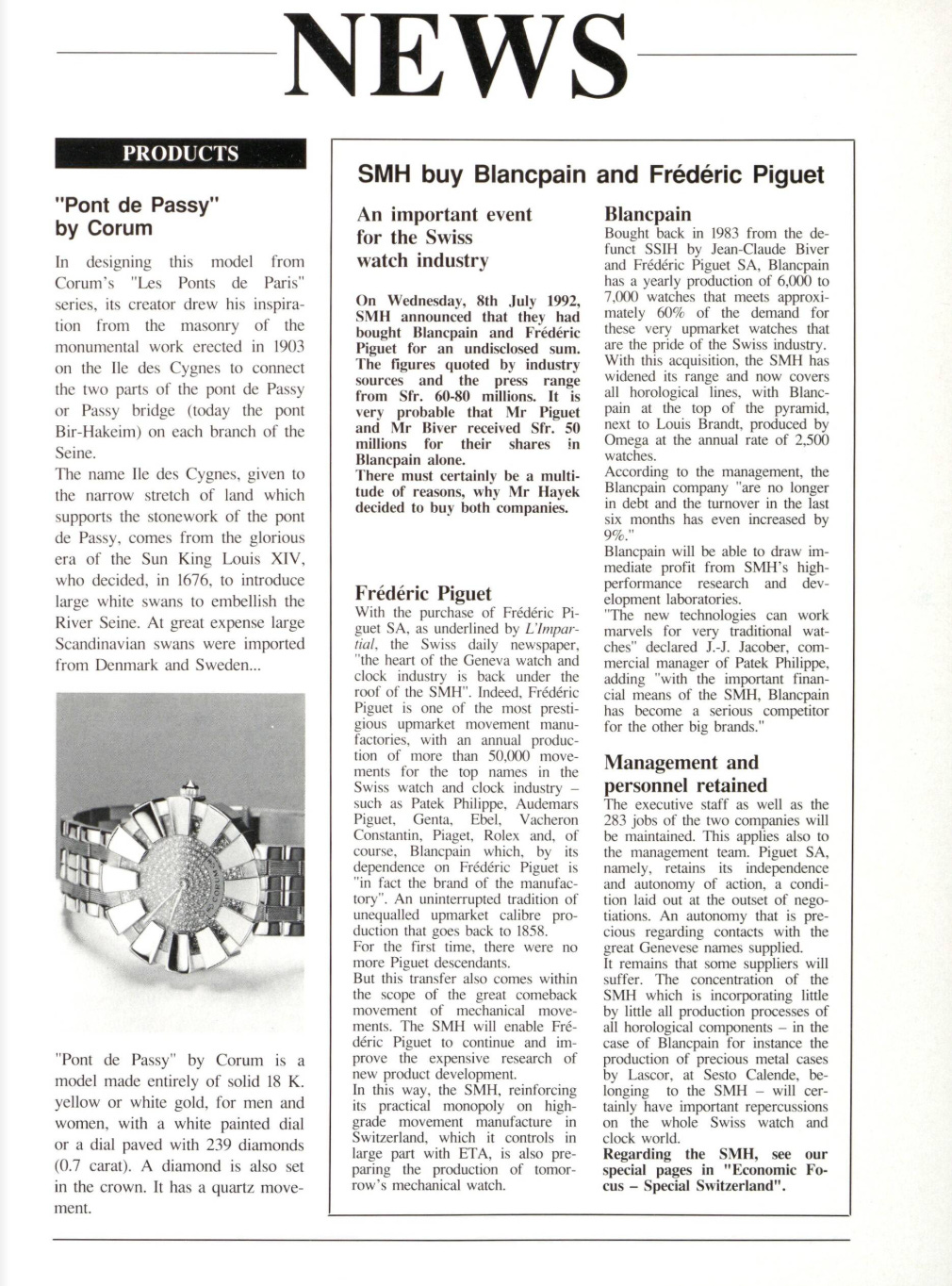
Europa Star Issue #194, 1992. 2003–Today: Modern Blancpain
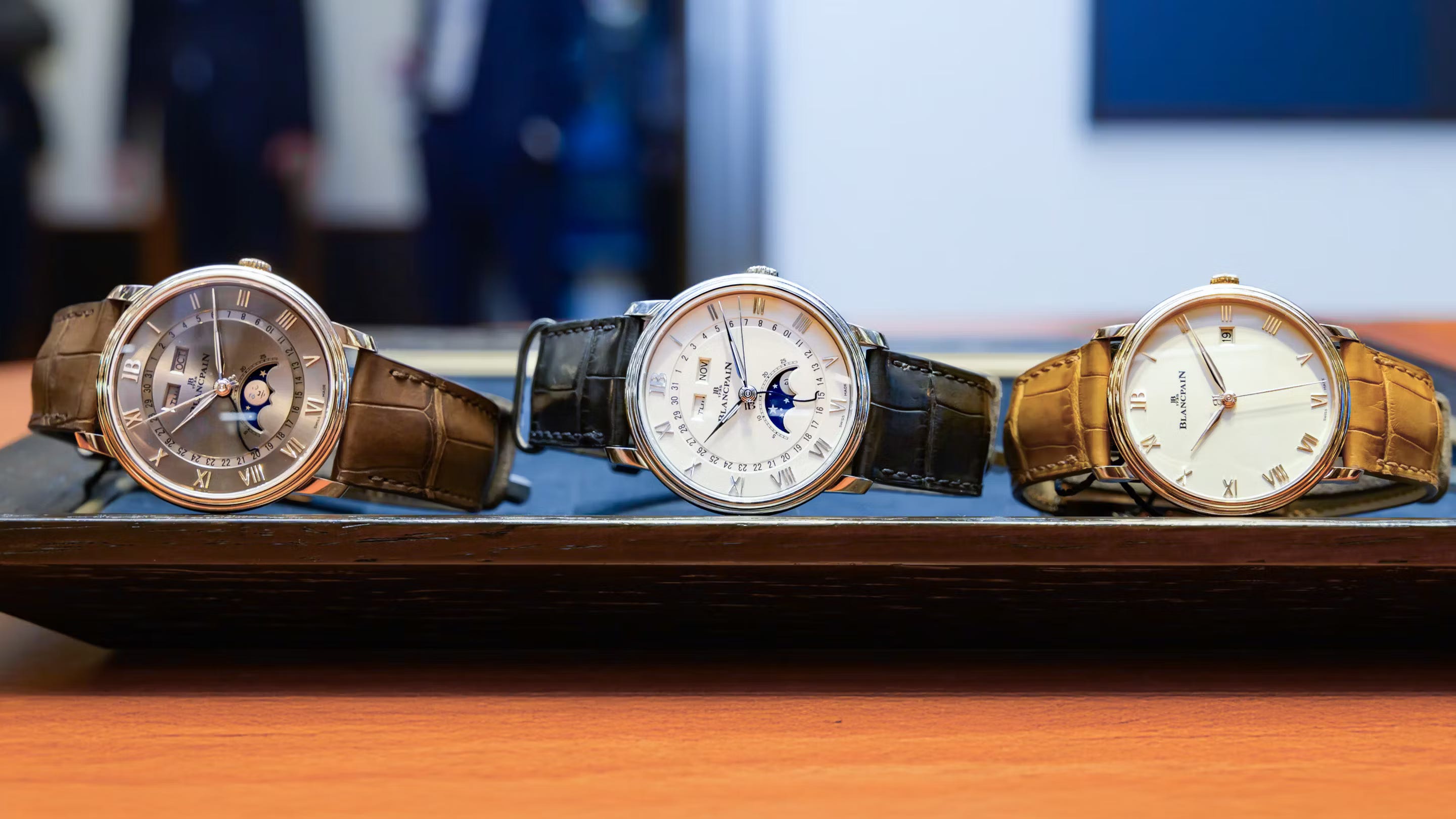
A brand that becomes anchored in two identities: the midcentury Fifty Fathoms diver and the classically-styled Villeret. The Léman line quietly fades away.
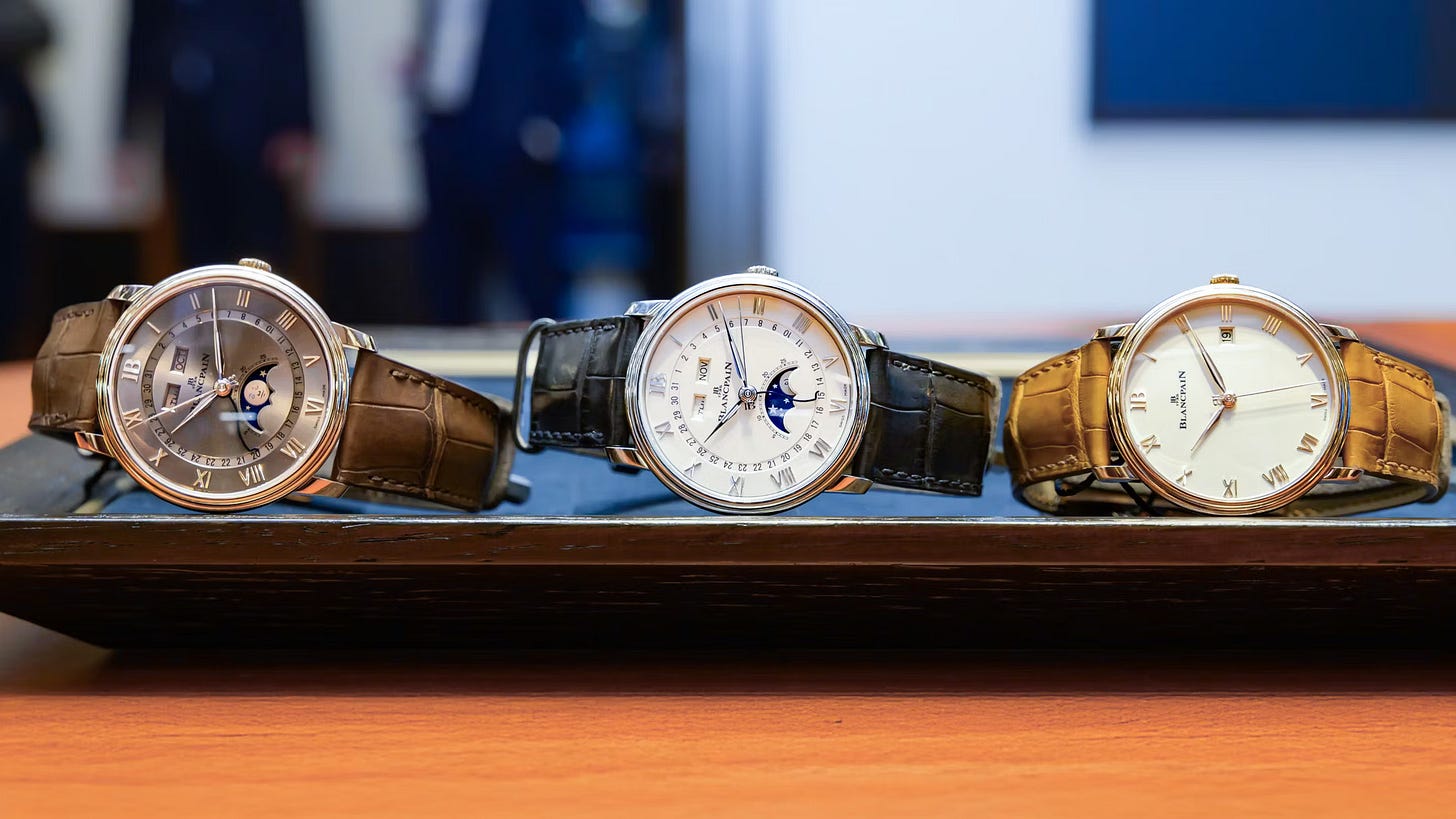
Modern Villeret collection. Image courtesy of Hodinkee.
From masterpieces to modernity
Piguet-Biver Era Blancpain relaunched with the complete calendar moonphase reference 6595 in 1983, verified by this reference first making an appearance in Europa Star in the same year.
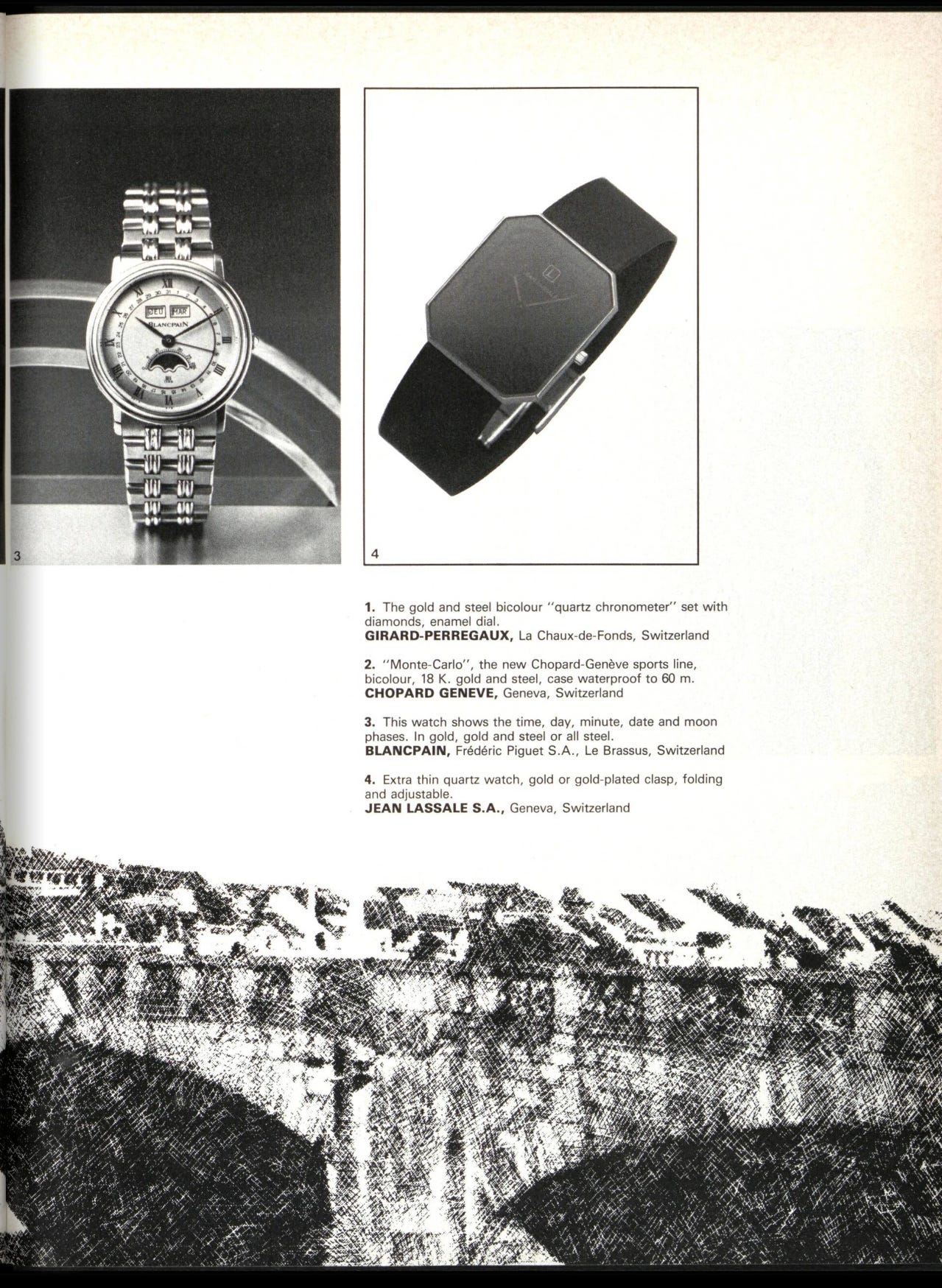
UPDATE: August 2026
A correction to the paragraph above. I originally identified the complete calendar moonphase in Europa Star in 1983 as the reference 6595 and used it to support a 1983 launch date for the 6595.
I wasn’t looking hard enough and that identification was wrong.
Thanks to ODE TO CHRONOS, who first pointed this out to me and shared some additional documentation, I now believe that the watch pictured may be the hand-wound 6501. Blancpain has separately indicated through correspondence that the 6501 was likely brought to market in 1983.
An automatic complete calendar moonphase watch from Blancpain first appears in Europa Star in 1984.
Exactly how these references figure in the early Piguet-Biver Blancpain chronology requires some more work as some sources give conflicting dates – which further explains why some of the dates move around in the documentation I’ve cited below. I’m going to continue to research and I’ll provide a more in-depth update once I’m more certain about what the evidence supports.
Hodinkee says the ultra thin 0021, a reference I also happen to own, follows in 1984, followed in turn by the perpetual calendar in 1986.
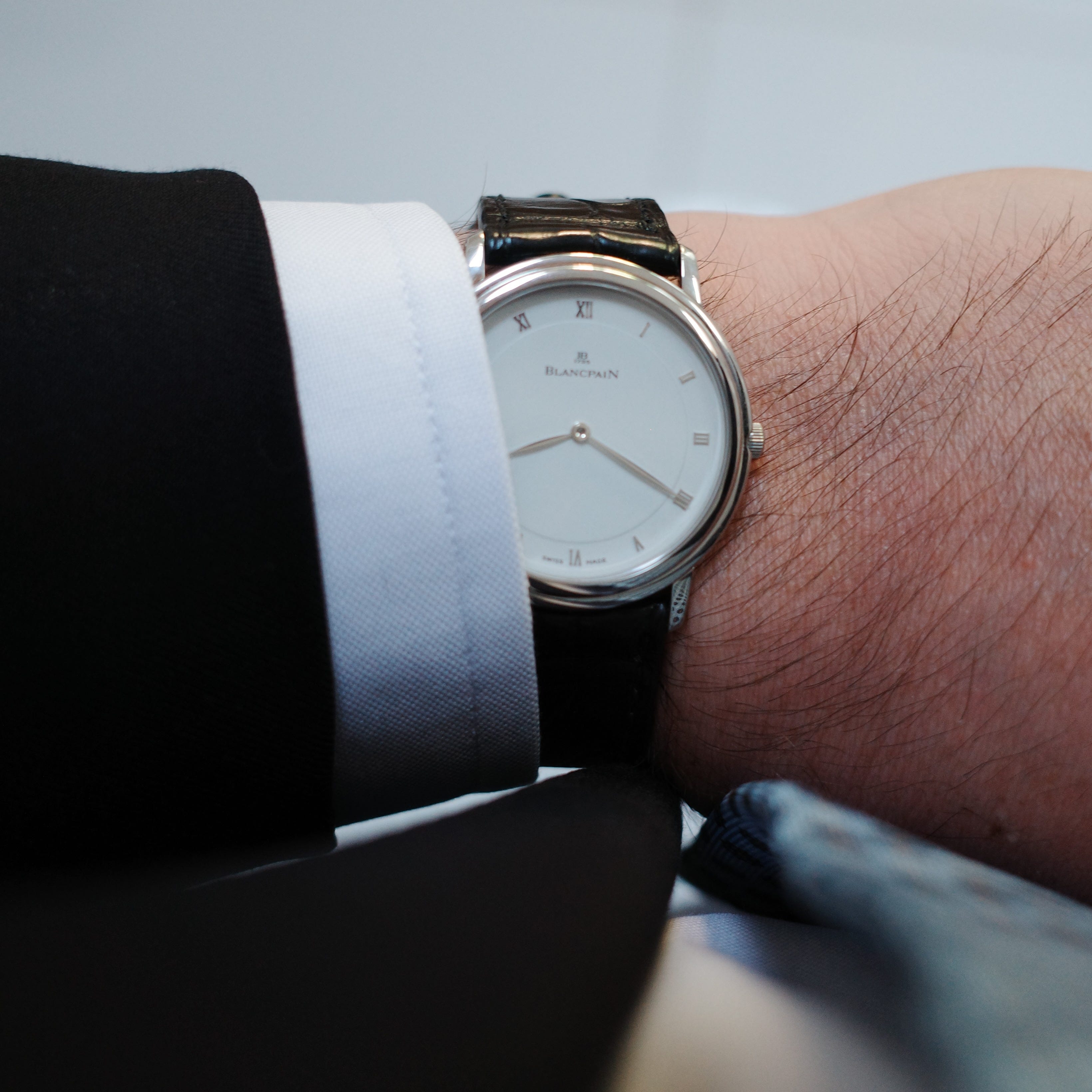
However, the perpetual calendar makes an appearance in Europa Star issue 150 from 1985 – so is likely earlier.
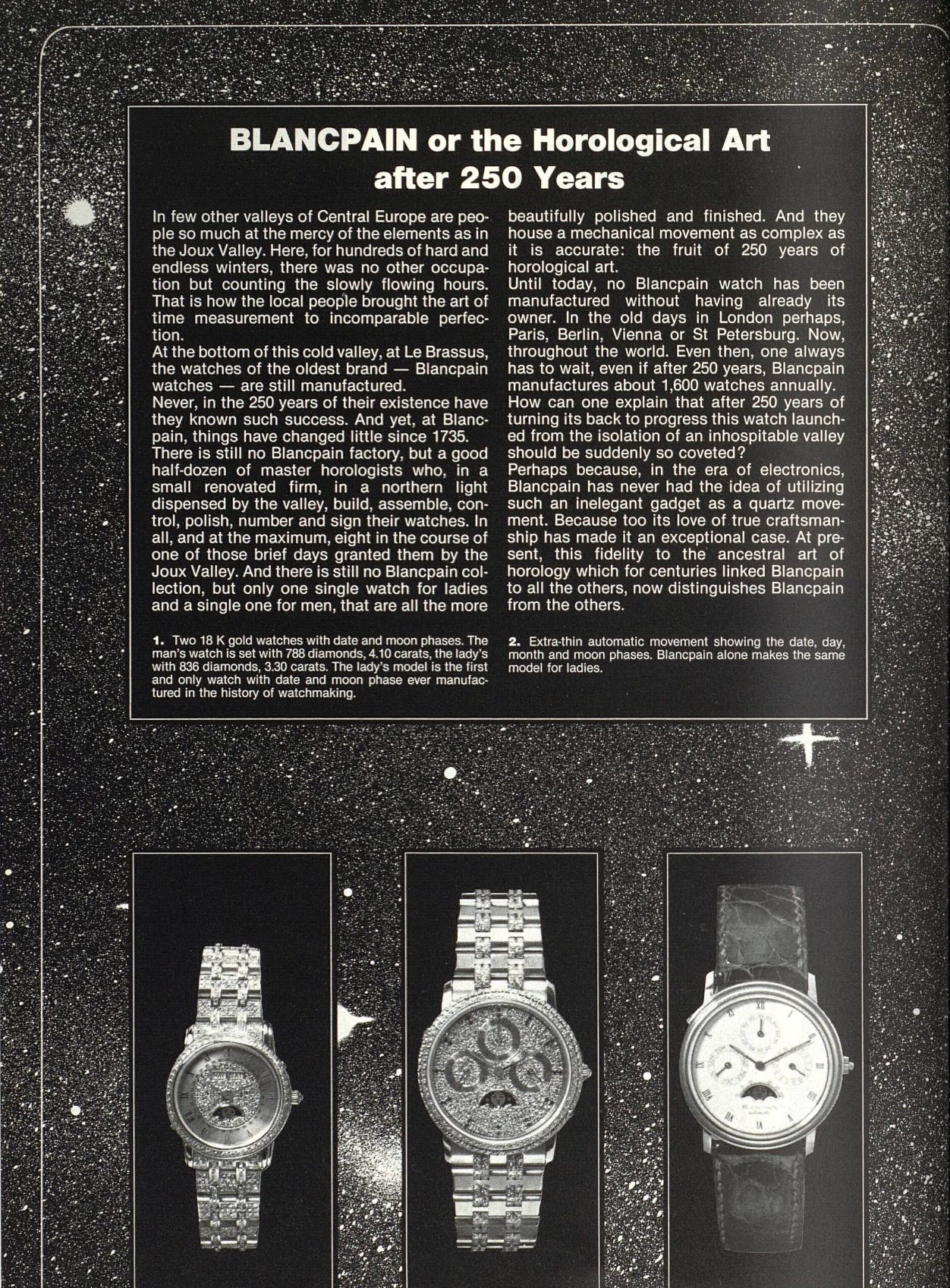
A Europa Star article from 1994 indicates the complete calendar moonphase (ref 6595) launched in 1984 and shifts some other dates around in relation to the other references.
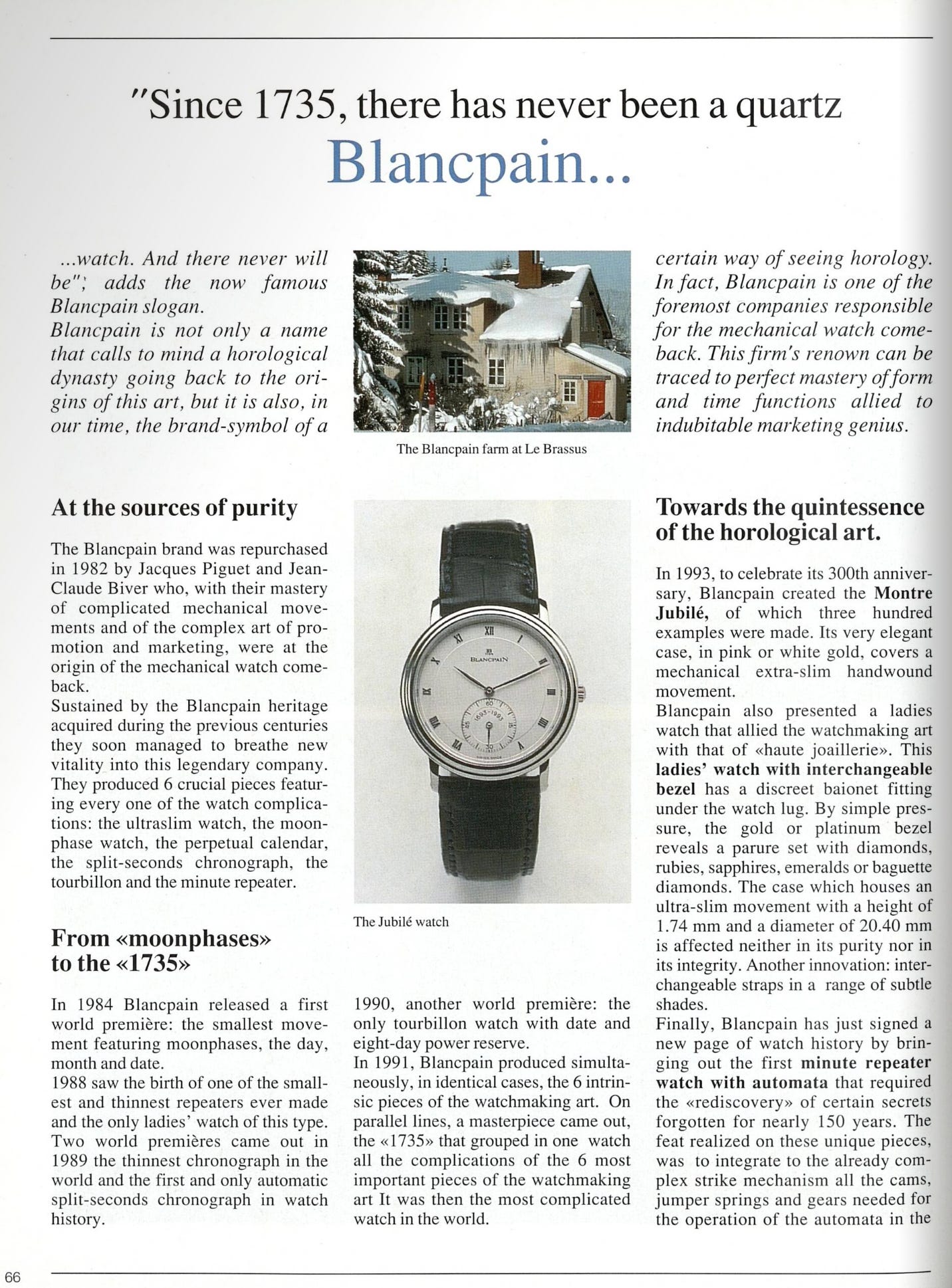
I’m not trying to call anyone out for inaccuracies or inconsistencies here, I’m more painting a picture of how murky this period gets in terms of understanding exactly when certain models were released.
The best documentation of watches from this era comes from Ben Dunn of Watch Brothers London in his Forgotten Watches – Neo-Vintage Blancpain And The Six Masterpieces article. This is the highest quality coverage I’ve come across about these references and Ben is careful to use “circa” when talking about specific years, as all sensible dealers and auction houses should.
There is so much to be impressed with from a horological perspective from Blancpain during this time, including a number of firsts.
You will note that although all of these watches tend to share some defining characteristics – 34mm case diameter, stepped bezel, white dial, roman numerals – there was no overarching collection name for them in the 80s as there didn’t need to be; they constituted Blancpain’s entire catalogue.
They later became known as the Masterpiece collection and were presented as such in 1991 to coincide with the launch of the 1735 Grande Complication which combined all six complications in one watch.
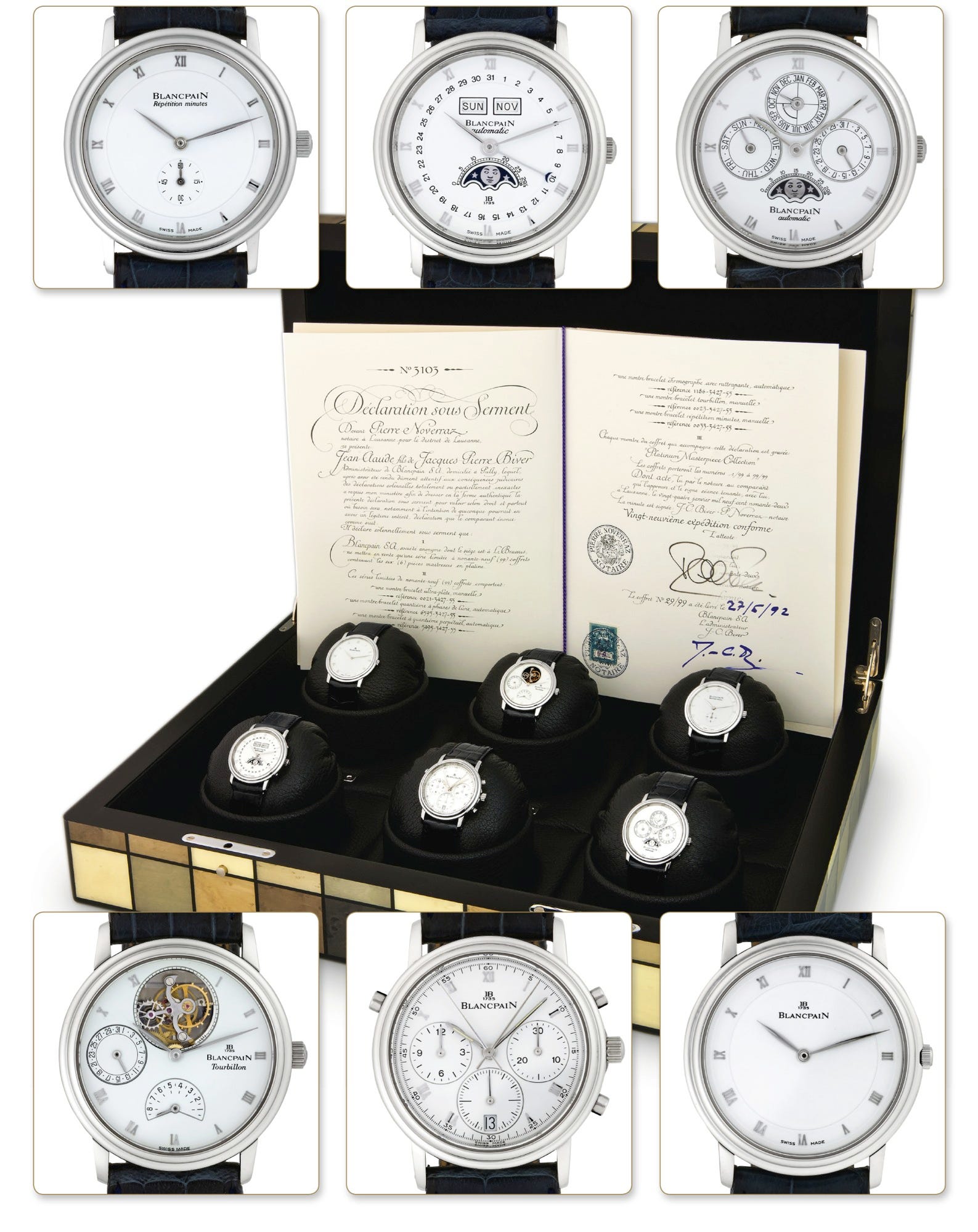
These watches are the predecessors of the modern Villeret collection.
At this point you may be wondering why I’m spending so much time on the Masterpiece / Villeret collection. Wasn’t this post supposed to be about the Léman line?
The reason for picking over the watches from this period is that the Frédéric Piguet movements of this era and the Masterpiece case shape help explain the development of the Léman line.
But before we get there we should talk about the 2100.
The 2100: Blancpain gets sporty
As the Masterpiece collection is to the Villeret, so the 2100 line is to the Léman.
Both collections underwent a rename in the early 2000s. Masterpieces became Villerets, 2100s became Lémans.
The 2100 launched as a single model in 1994. It was described at the time as tomorrow’s watch and a herald of the rapidly-approaching 21st century.
The “2000” in the name alludes to the year 2000; the “100” to the 100 metres of water resistance, the 100 hours of testing the watch goes through and the impressive 100 hours of power reserve that comes from a new double-barreled calibre 1151 developed by Frédéric Piguet.
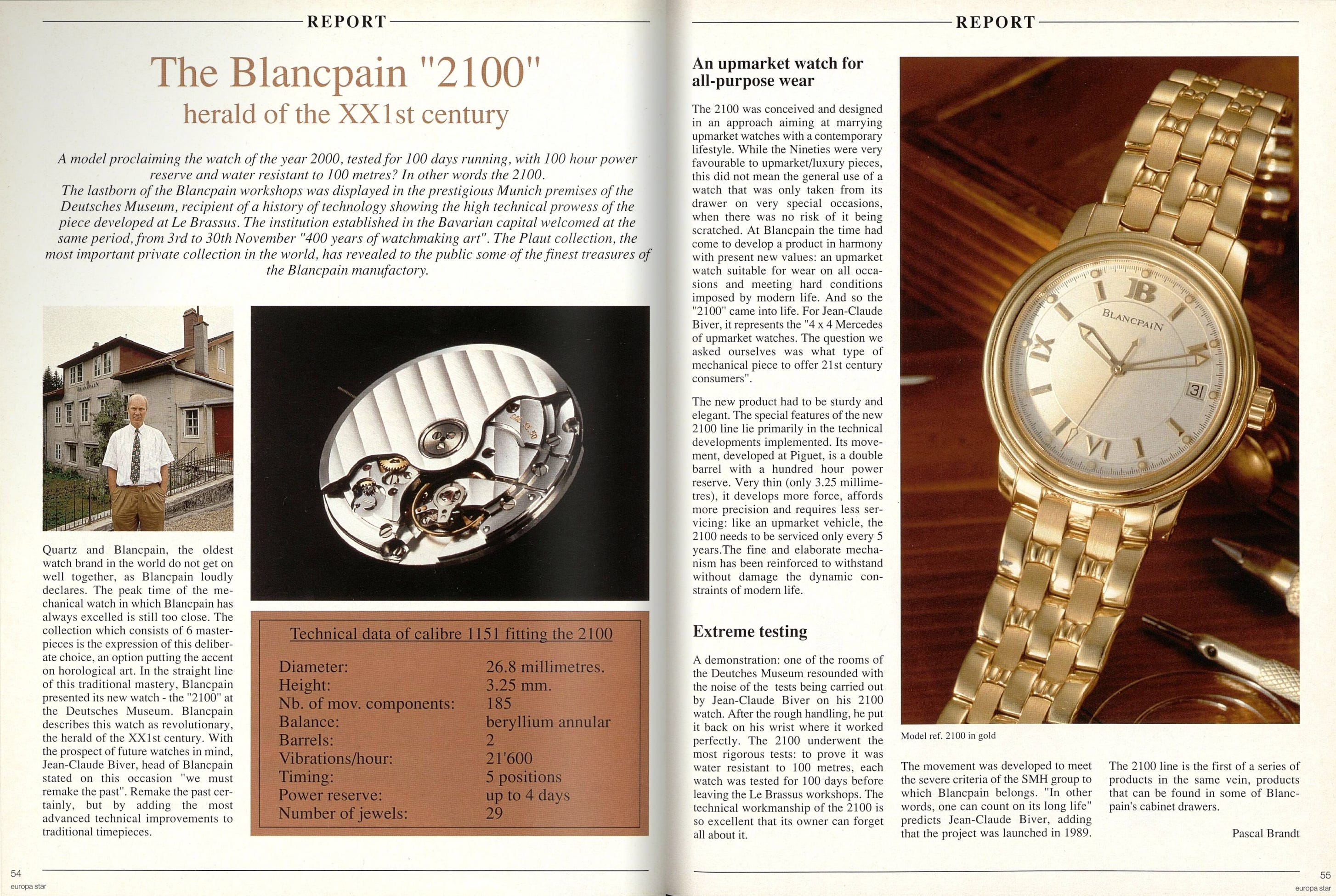
This is the first sports watch of the new era of Blancpain that began in 1981.
As well as a brand new movement it featured a beefed-up 38mm case that takes cues from the Masterpiece design but makes everything more…muscular. The distinctive stepped bezel (which Blancpain refers to as “double pomme” but I don’t think I can bring myself to) remains, but the steps are bigger and more rounded.
The 2100 line launched with just one eponymous reference, but the complications laid out in the Masterpiece collection soon began to be rolled out to this new range.
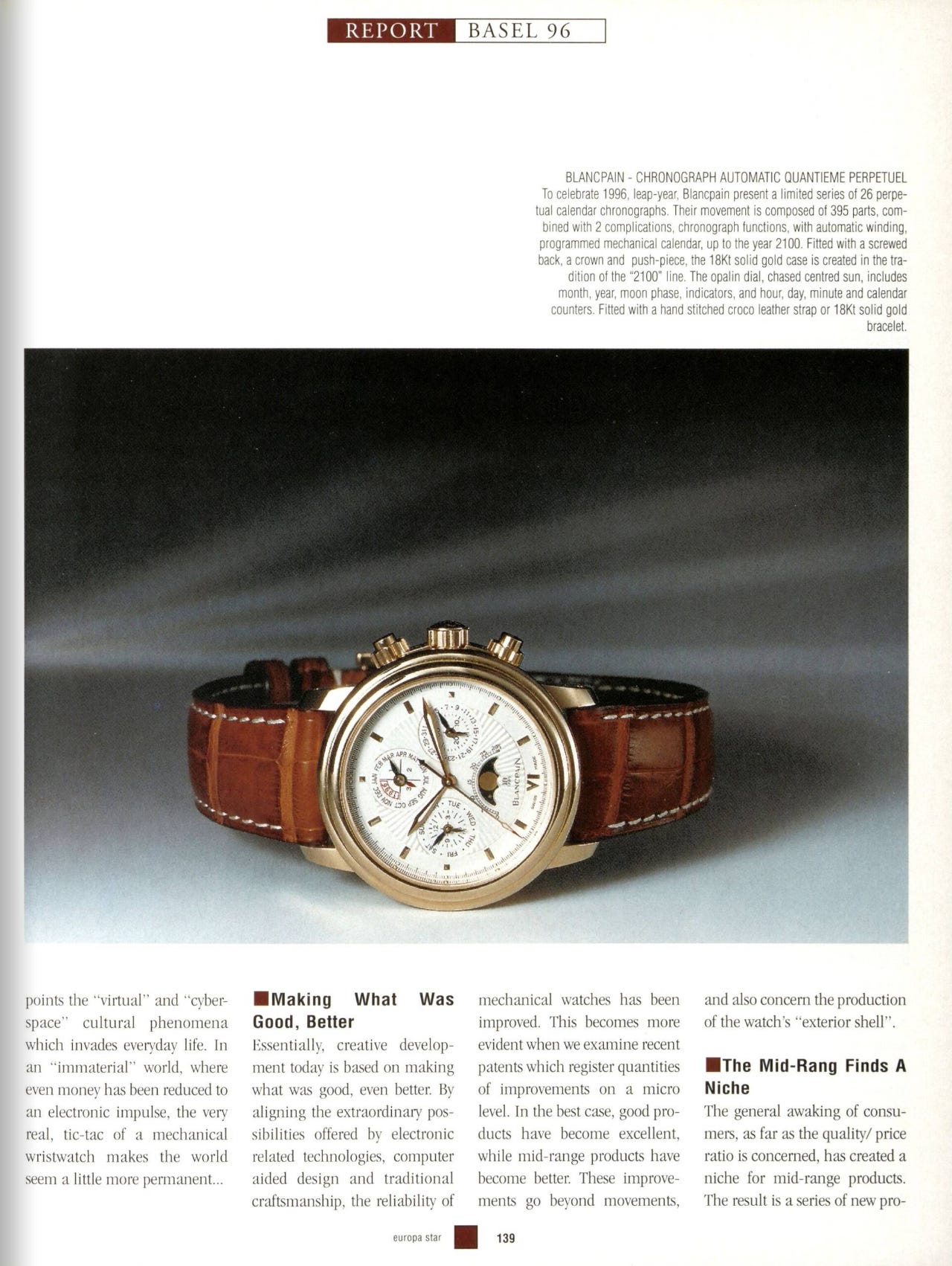
The moment the market muscled up
Why did Blancpain go sports in ‘94 given they had relaunched as a rejection of modernity in the 80s, and then celebrated that with the 1735 Grande Complication and the accompanying Masterpiece collection in the early 90s?
A Europa Star article in 1997 covering the appointment of Steve Urquhart as director of the brand is revealing.
“[Blancpain] has fixed its objectives on redefining the complication and rejuvenating the gold watch…After having spent more than 20 years with Audemars Piguet, Urquhart’s new mission is to direct Blancpain as it continues to move along the direction started three years ago with the release of a new sports line (the 2100 series).
With the introduction of its chronograph FLYBACK, Blancpain is moving towards equipping its sports watches with the most sophisticated mechanical movements…In the medium-term, the brand is going to add water-resistance and automatic winding to its entire range of complications. The goal is to be able to wear a tourbillon without harming the delicate inner workings.”
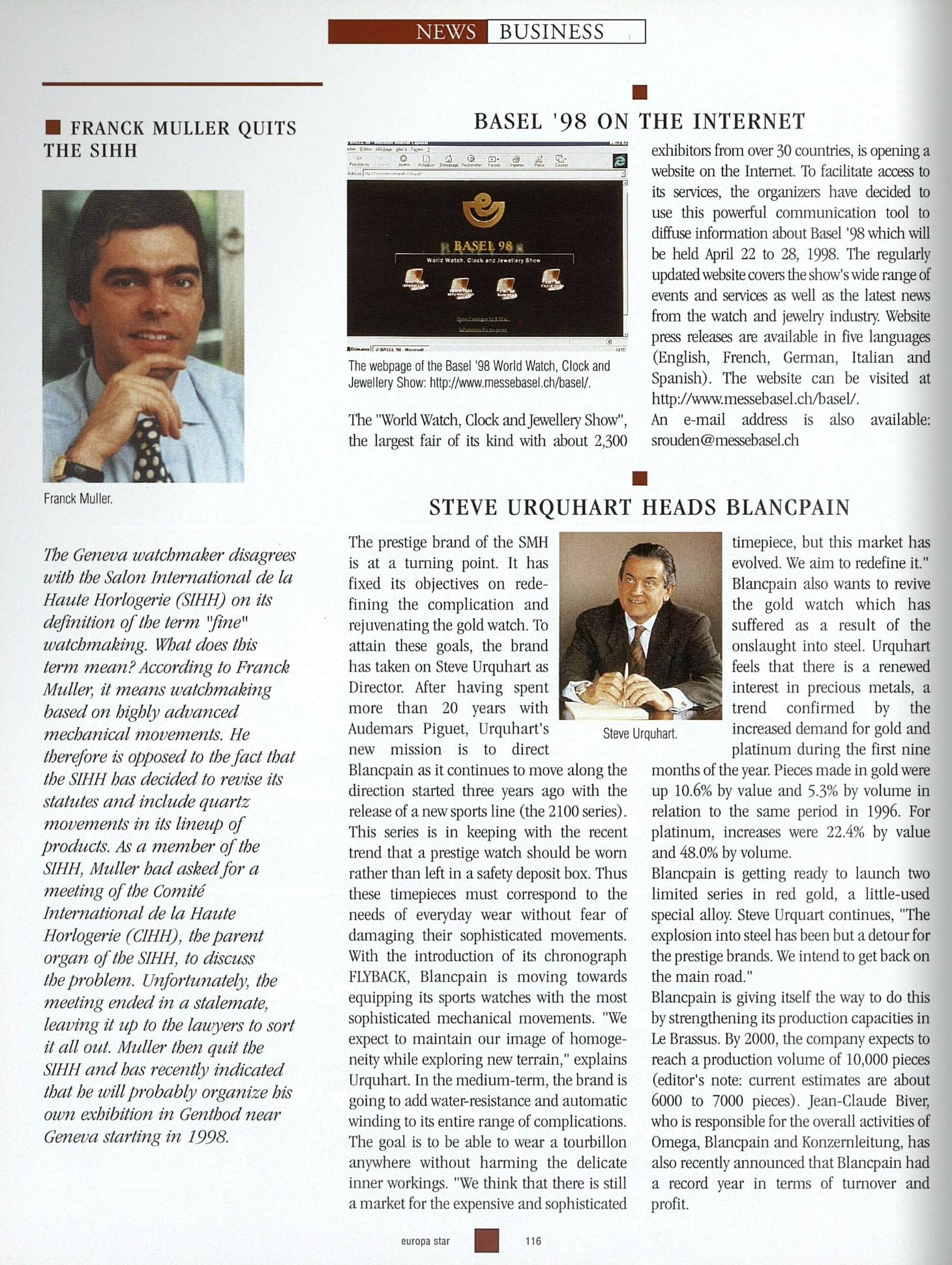
One thing to point out here is that though Biver and Piguet sold Blancpain to SMH in 1992, and despite Biver also having responsibility for Omega product and marketing, Biver remained as Blancpain CEO throughout the 90s, as detailed in Joe Thompson’s “personalities” article for Hodinkee in 2018.
The decision to release a more sporting collection then was not because Biver was somehow cut out of the picture following the sale and his stewardship was lost. In fact, after briefly leaving following the acquisition he was asked to come back to lead Blancpain.
By all accounts Blancpain was doing relatively well in terms of turnover and revenue at the time so although there may have been some commercial pressure from the SMH acquisition it doesn’t seem entirely plausible that flagging sales was a driver either.
It seems more likely that Biver and Blancpain in 1994 were reacting to – or trying to get ahead of – men’s luxury watches getting bigger. And sportier. The Masterpieces were 34mm in diameter, slim and classically styled. They were in danger of getting left behind.
The bellwether for the new trend was quite possibly the Audemars Piguet Royal Oak Offshore that Emmanuel Gueit started designing in 1989 and was launched at the Basel Fair in 1993 – where Gerald Genta infamously stormed AP’s booth shouting “you killed my Royal Oak!”. Or something to that effect.
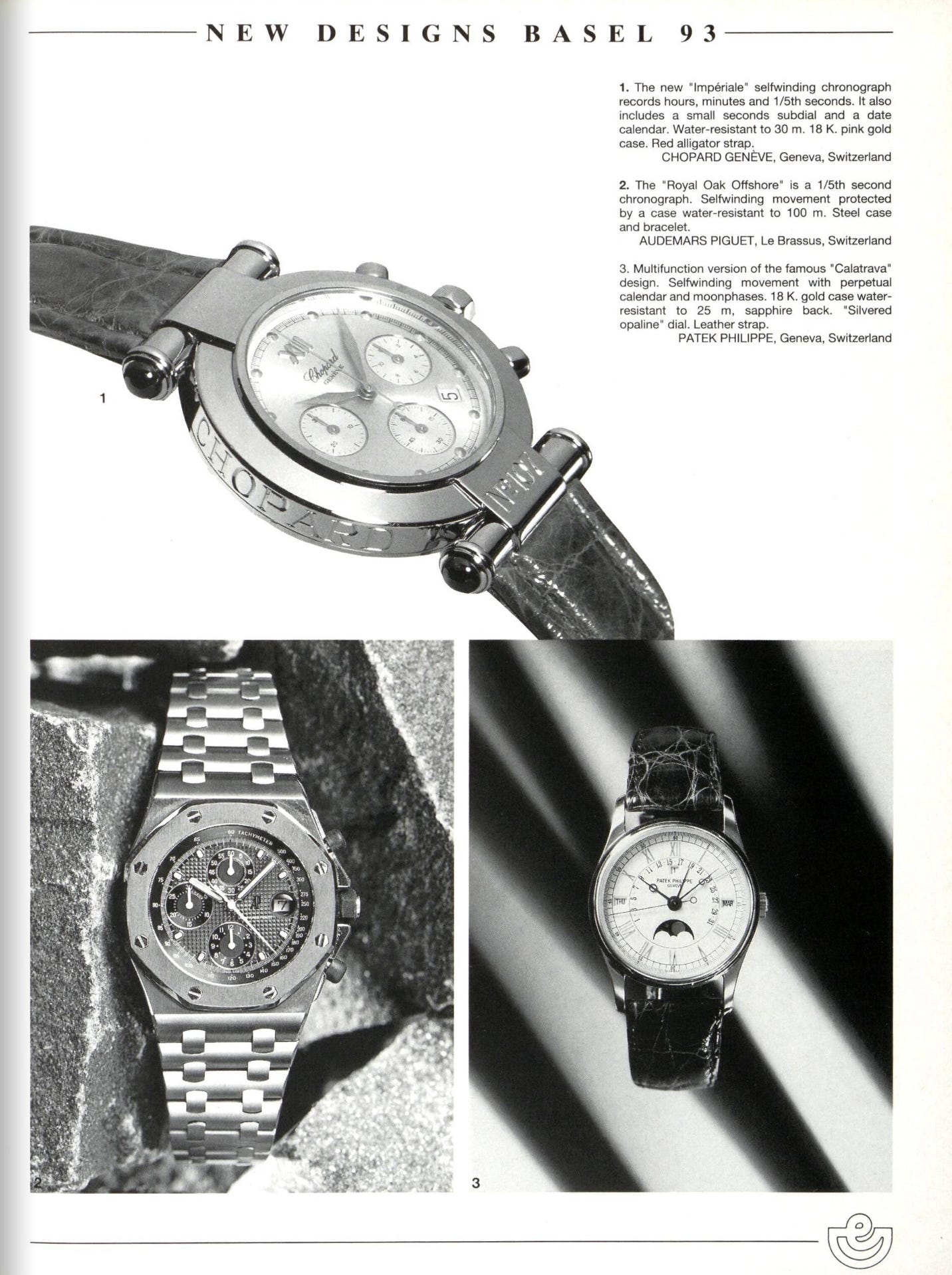
I also mention AP here because Steve Urquhart joined Blancpain from AP, where he had spent many years in senior roles while the brand launched not only the Offshore but the first Royal Oak perpetual calendars in the 80s. He had experience in the field of complicated sports watches. He and Biver briefly crossed over at AP in the late 70s. If you were to hire someone to help transition Blancpain to a more sporty aesthetic while retaining its commitment to complicated watchmaking you’d be hard pressed to find someone with a better resumé.
There are more connections between AP and Blancpain – and specifically the Royal Oak – the closer you look. For instance, AP used the Frédéric Piguet 1135 caliber in many Royal Oak chronograph references.
I’ve yet to see quotes from Biver or anyone else at Blancpain saying AP’s product strategy was a direct influence on the development of the 2100 line but it’s easy to imagine why it could have been.
The mystique of the military dials
At this point I have a confession to make: there are only certain watches in the 2100 / Léman lineage that I really like.
The classical stylings of the Masterpiece dials scaled up to a bigger, sportier case – an aesthetic which permeates across much of the 2100 / Léman collection through its years of existence – doesn’t hugely appeal to me. The design language seems a little too ornate for the cases they occupy – see the image immediately below – though I have come to appreciate them more through learning about the line.
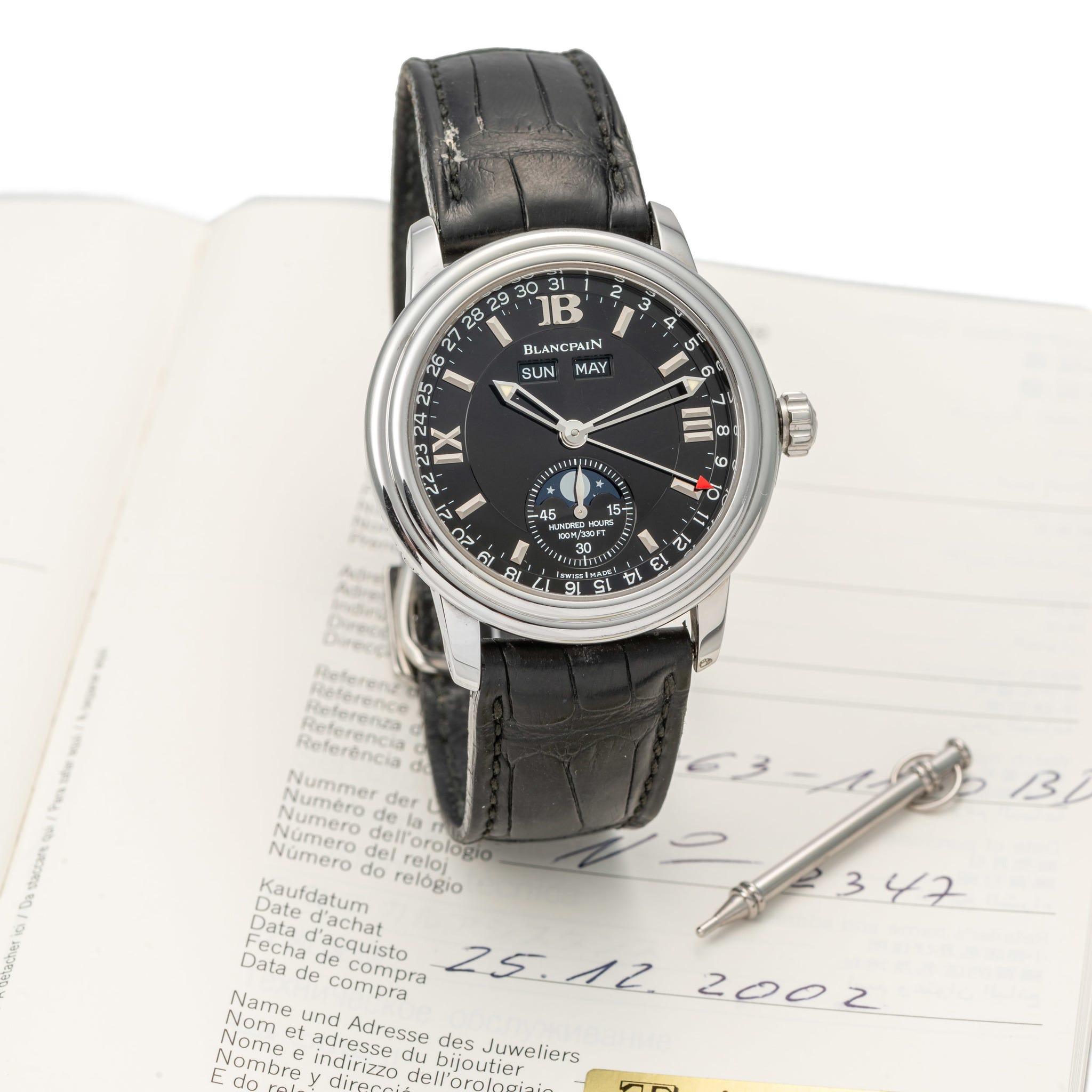
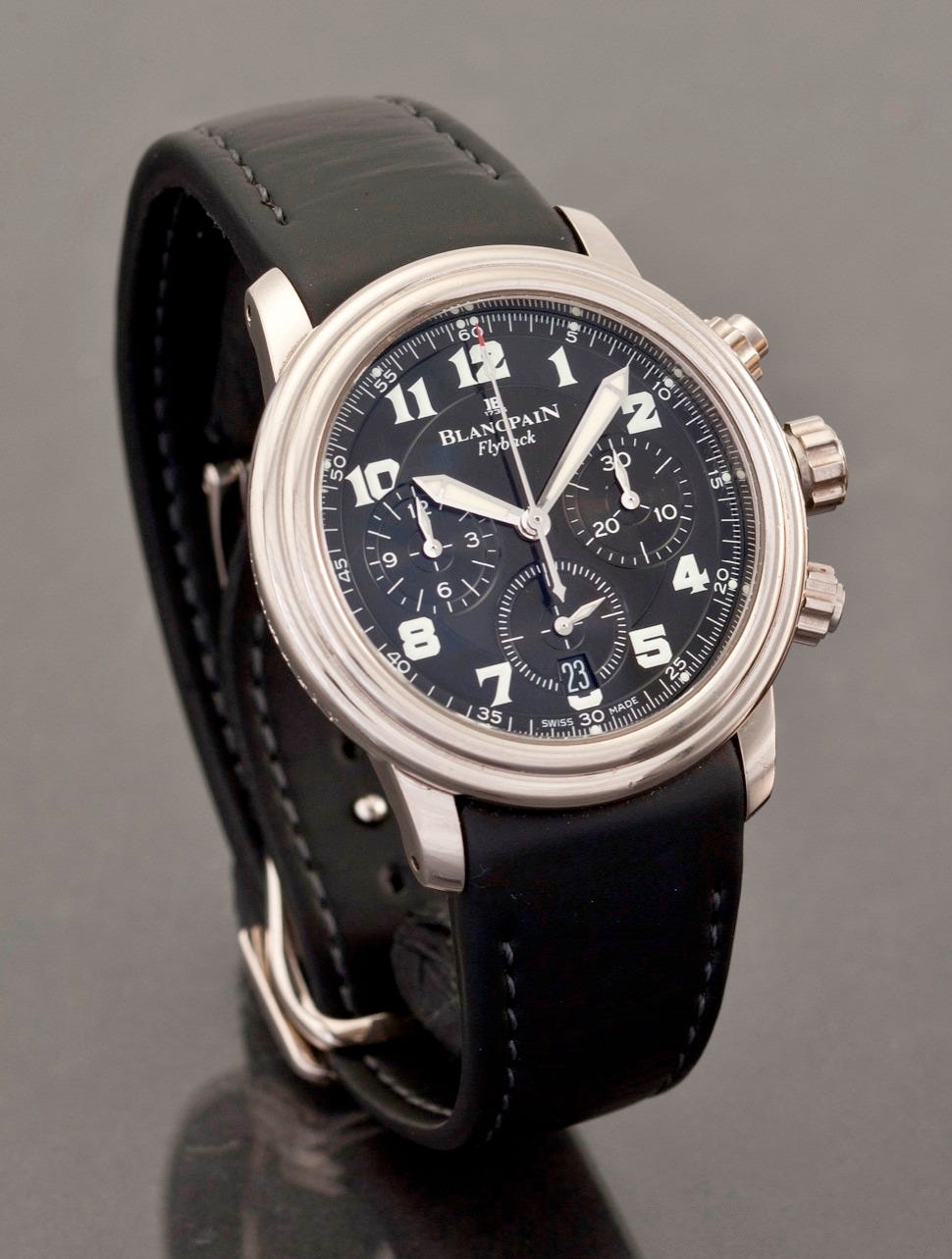
It is the 2100s and Lémans with military dials that really appeal, and I have a strong preference for those in the 38mm cases – which means watches released between the mid 90s and the early 00s. Military dials continued beyond that period, but in a bigger 40mm case size.
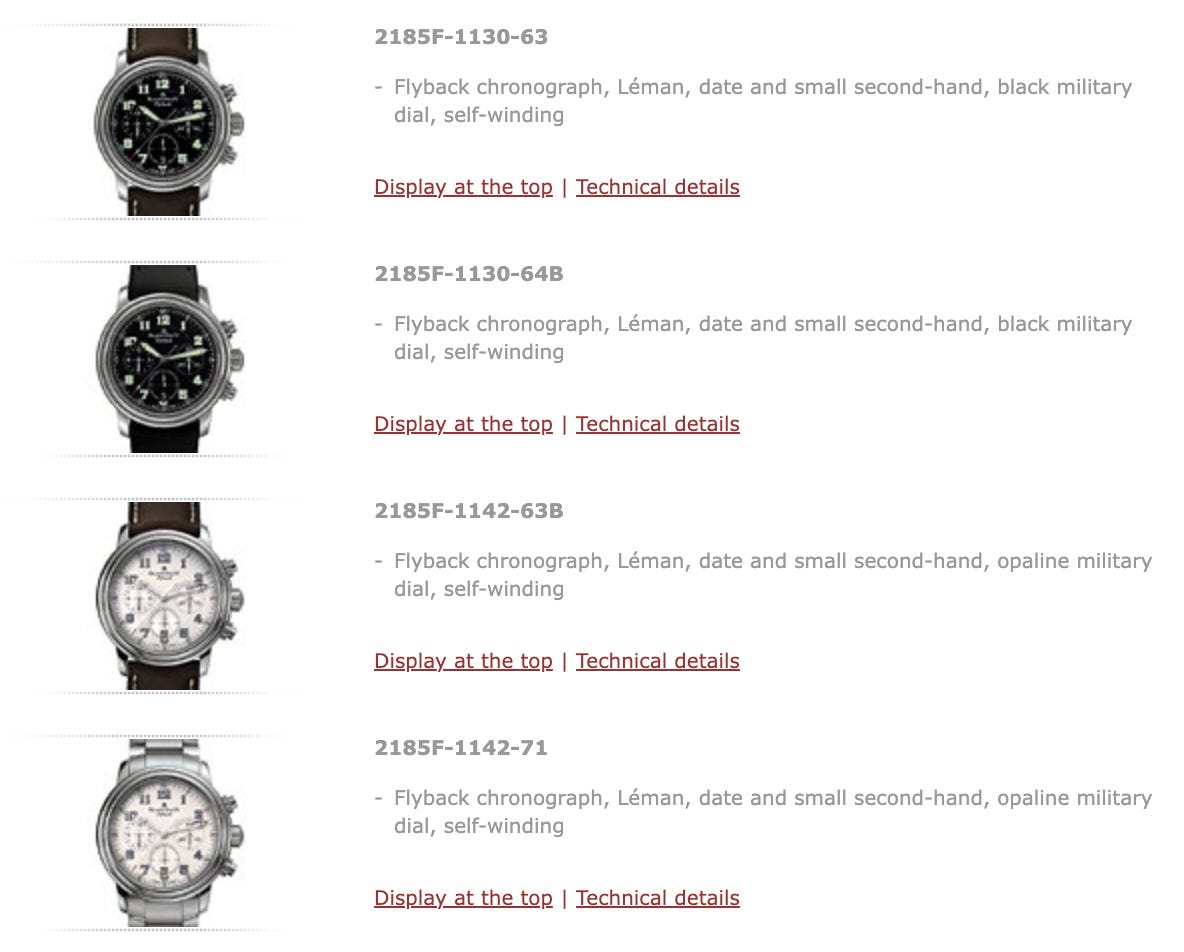
“Military dial” is not an enthusiast-coined nickname – it is how Blancpain itself describes these models that have Arabic numerals as hour markers. As we can see in this screen capture of the Blancpain website in 2003, accessed through the Wayback Machine.
The use of these numerals entirely changes the aesthetic of these watches and matches the case design much more effectively in my view.
I particularly like it when it appears on the more complicated watches, such as the tourbillon and the perpetual calendar. It is a juxtaposition no doubt, but one that profoundly appeals to me and seems like the apex of Blancpain’s 90s mission to make highly-sophisticated watchmaking more rugged.
Haute horologie for the field.
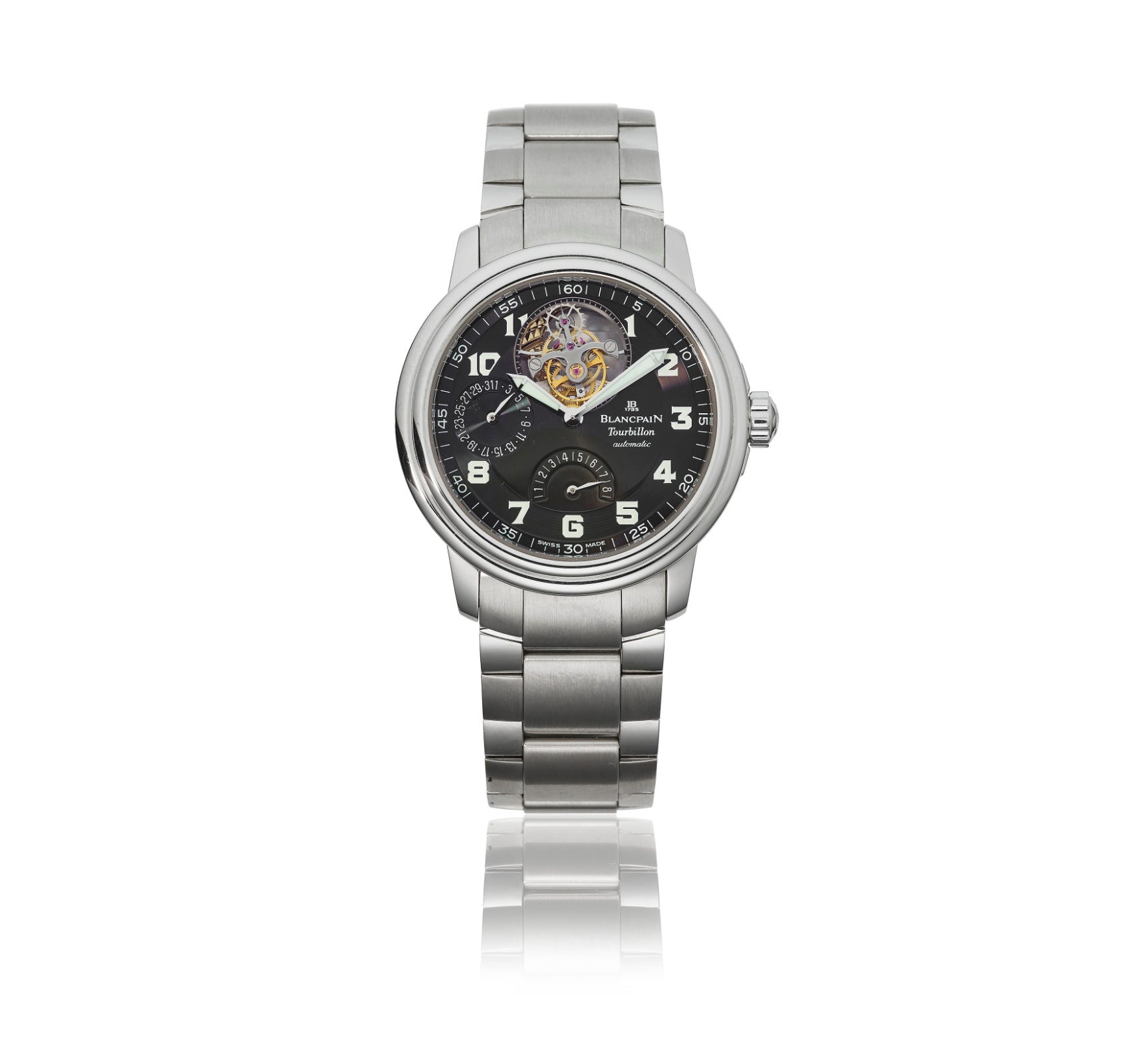
The look won’t be to everyone’s taste – here come the people mad about cut off numerals – but such divisiveness often means a design is doing something right.
Blancpain’s reference system deciphered
Determining what is and isn’t a military dial as it relates to the 2100 / Léman series using reference numbers alone is a little confusing.
First, here is how Blancpain’s system works:
XXXX(ref) - XX(case material) XX(dial) - XX(bracelet
So the Léman steel GMT is 2160-1130M-71.
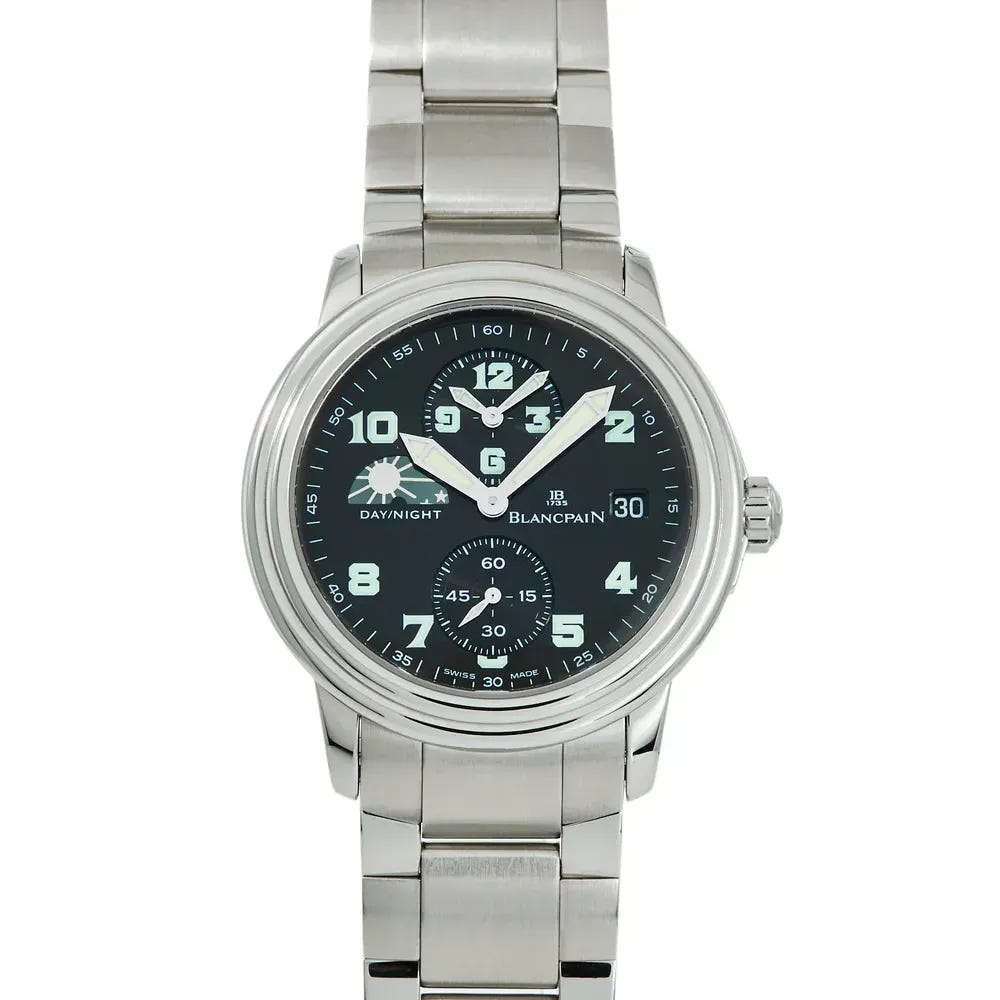
“2160” is the reference.
“11” means the case is steel.
“30M” means the dial is black (30) military (M).
“71” indicates it is supplied on a steel bracelet.
So you would think that “30M” is the key indicator of having a black military dial across the collection.
Not so.
Here are the reverse-engineered rules:
Any 2100 / Léman reference with a flyback chronograph and a black military dial has the “M” dropped because generally all the flyback chronographs – at least the 38mm cases – have military dials by default.
One exception among the 38mm flyback chronographs is the 2182F “Aqua Lung” references which use the F182 caliber and have no running sub seconds register – they get non-military dials.
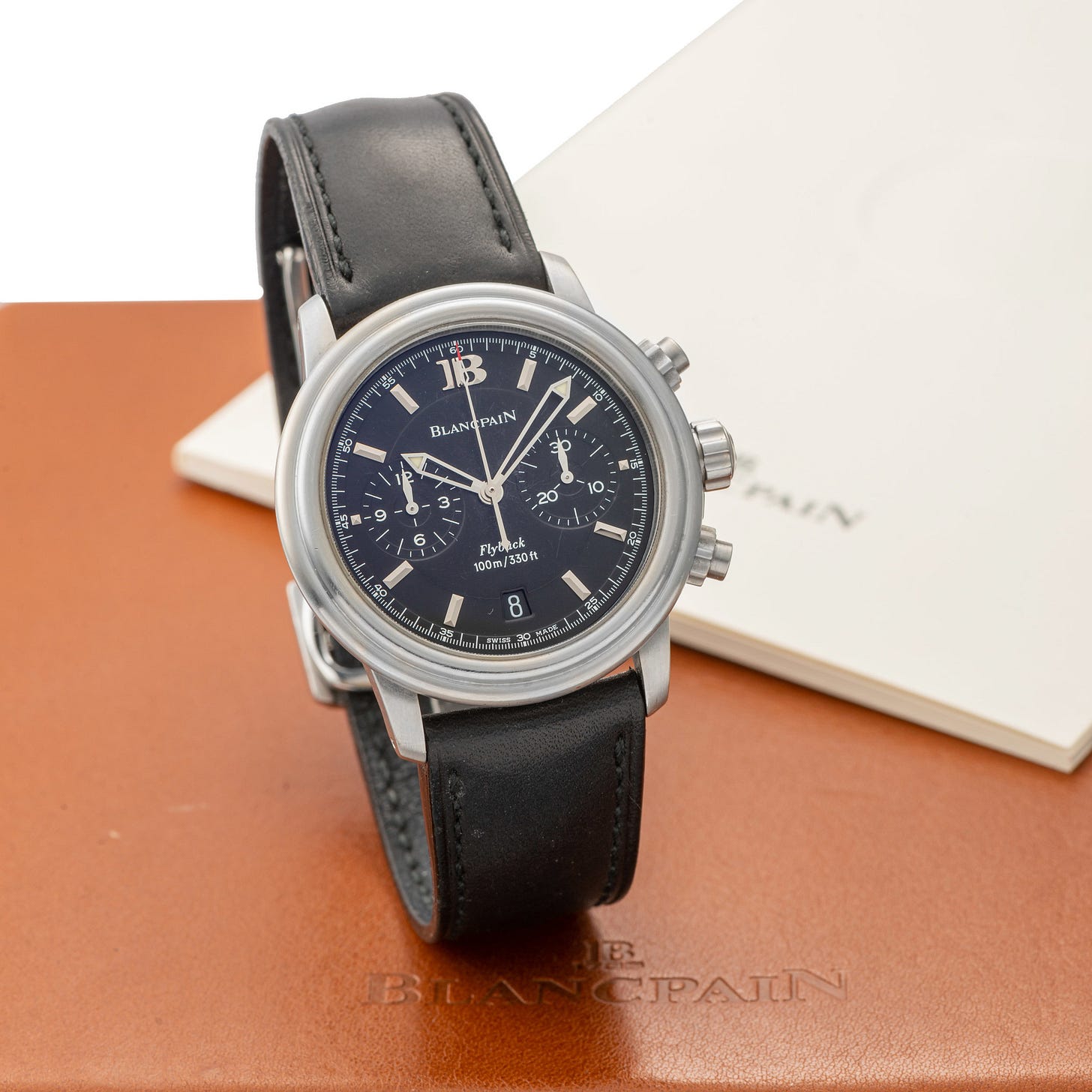
Blancpain ref. 2182F. Image courtesy of Antiquorum. The military dial = flyback chronograph logic extends to the perpetual calendar chronographs, where it is only the flybacks that get military dials. Non-flyback chronographs get non-military dials only.
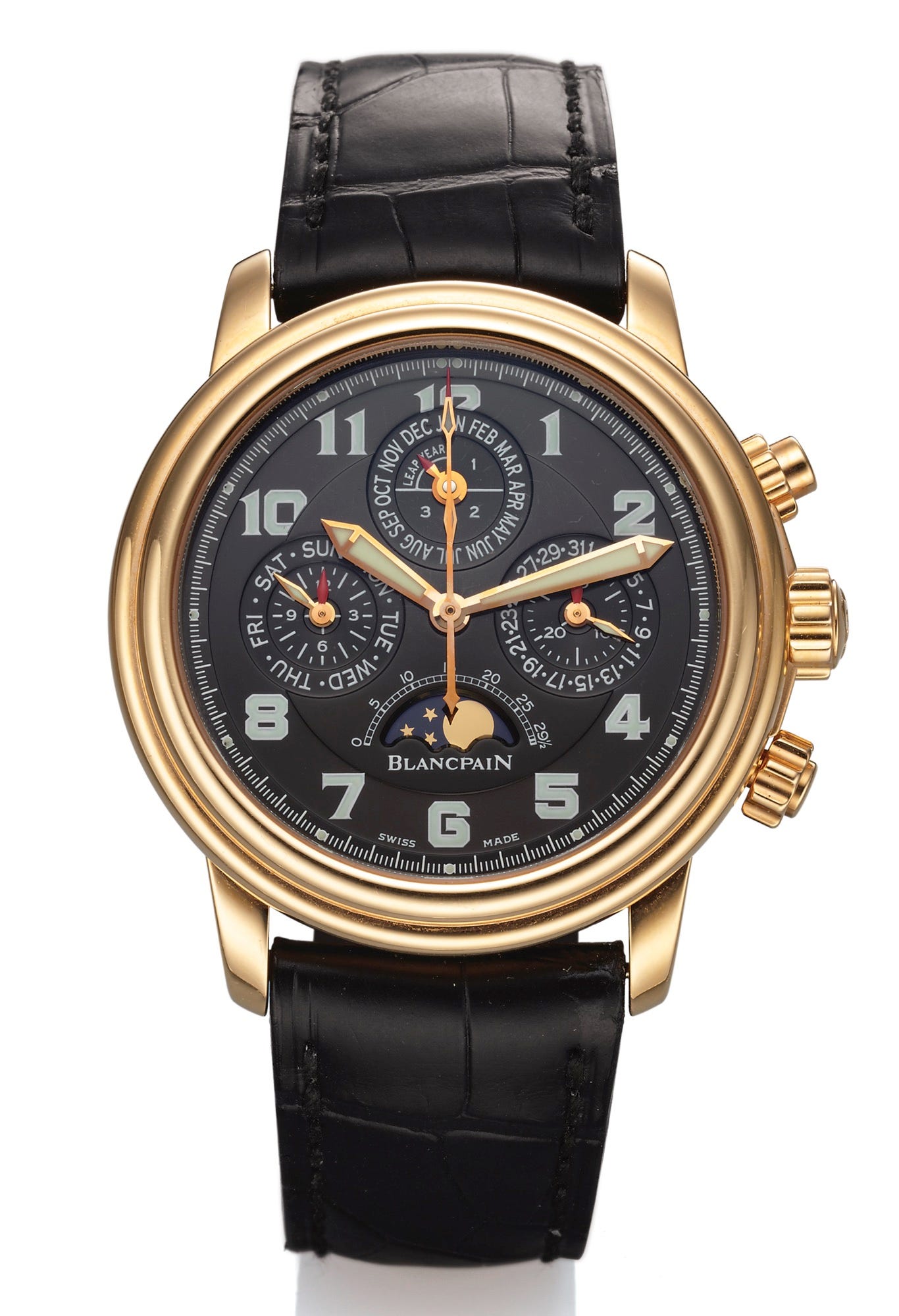
Blancpain ref. 2585F. Image courtesy of Antiquorum. Blancpain seems to have been using military dials to indicate flyback functionality for its chronographs.
There do not appear to be the same types of rules for other complications. Tourbillons, GMTs and moon phases get a mix of military and non-military dials for the exact same caliber.
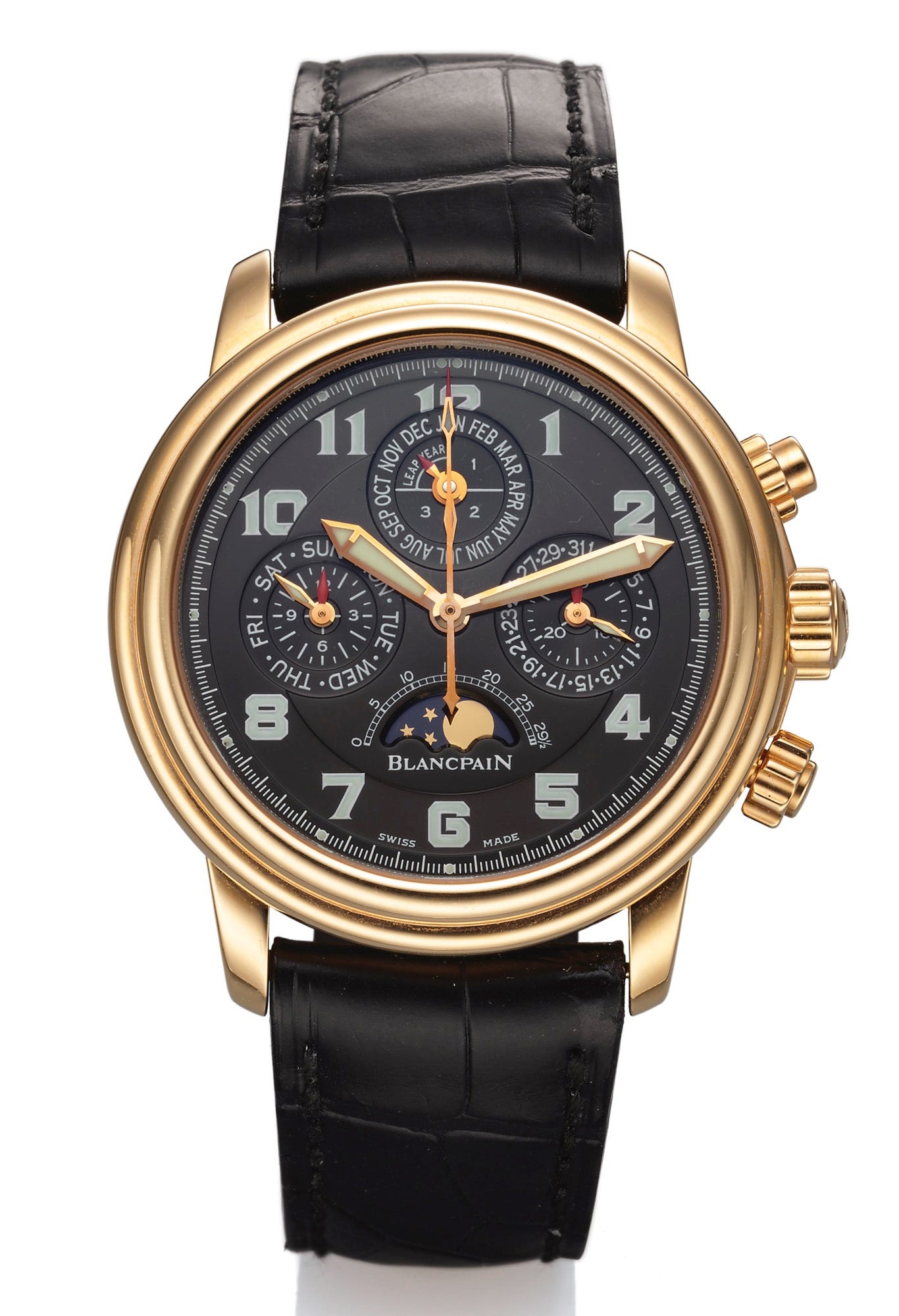
Military dials make themselves known
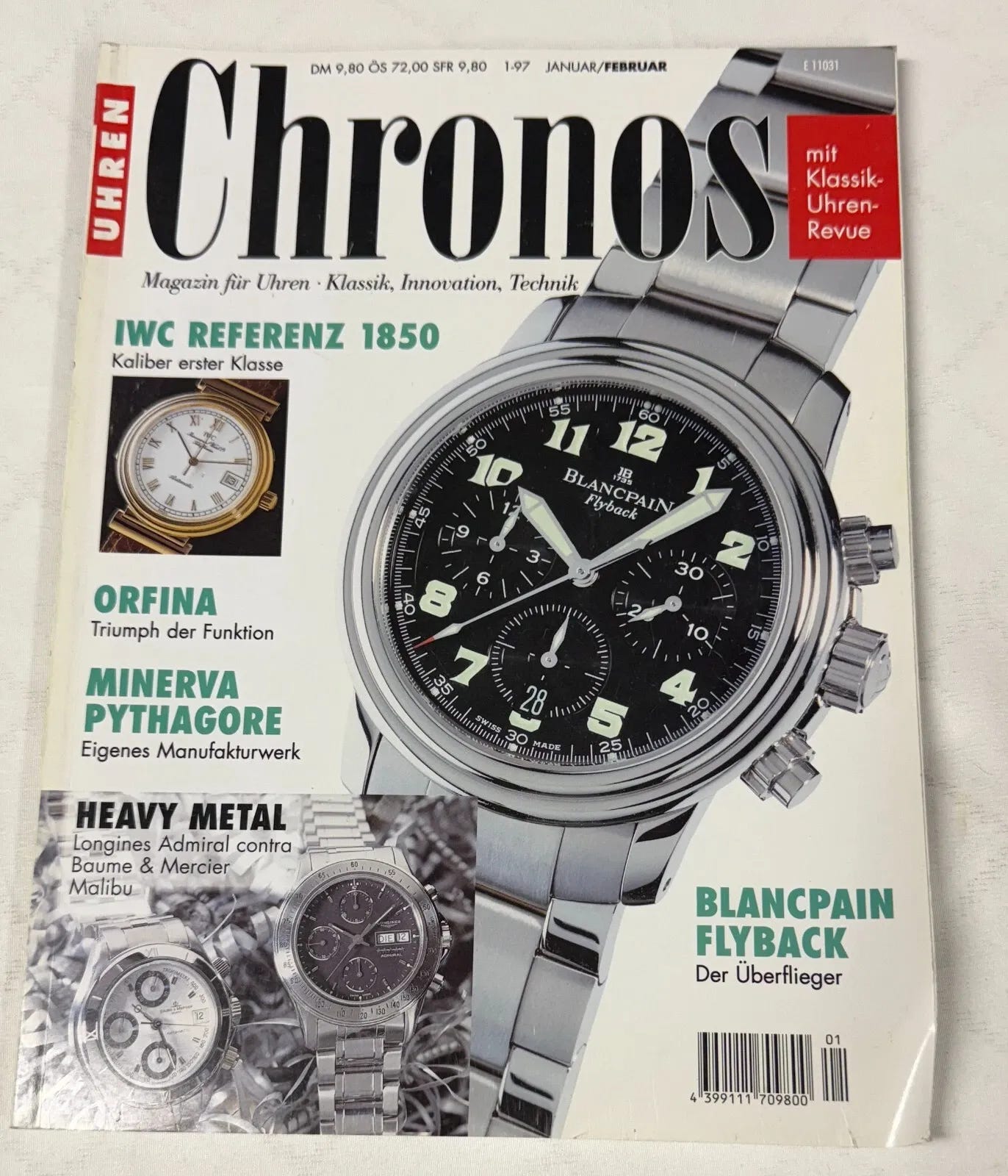
For the 2100 series, the earliest irrefutable sightings of military dials that I have come across so far are on the cover of Chronos magazine in early 1997 and then in Europa Star later that year.
Both sightings are the 2185F – the flyback chronograph. It seems plausible to me the military dial was brought out at the same time Blancpain launched the flyback chronograph F185 movement, which based on everything I’ve read is around the same time (1997).
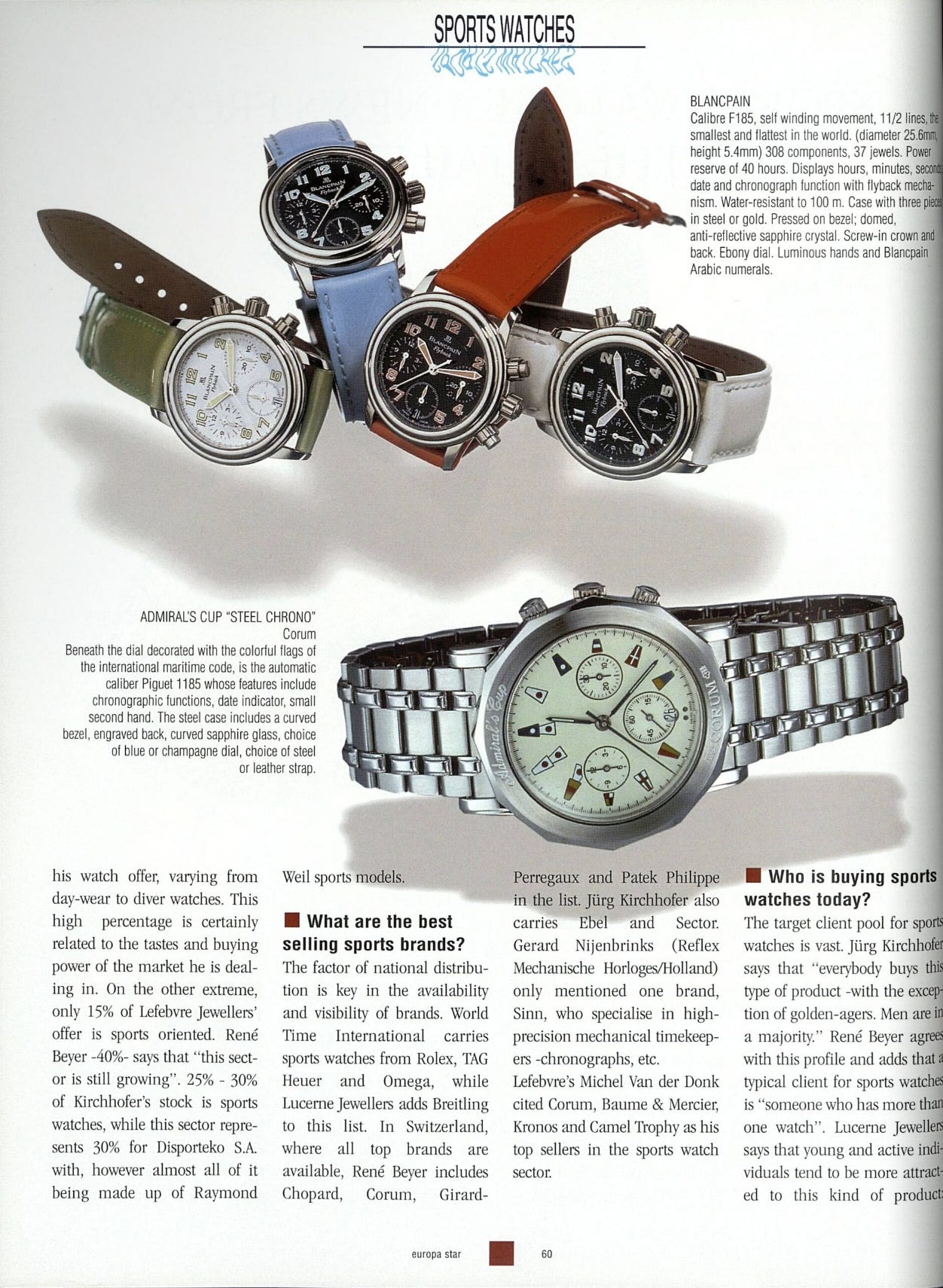
Another reason to believe in the 2100 military dials appearing at the same time as the launch of the F185 is that they appear on almost all flyback chronographs by default, as per my brief note on the reference system. It would therefore make sense for Blancpain to launch these dials in celebration of, and to denote, a new movement.
It seems on this evidence then that it is at least plausible that the 2100 / Léman military dials are linked to the launch of the F185 caliber. This is conjecture on my part so evidence may emerge at some point that changes my mind. Which I would welcome.
Military dials do however appear earlier in the neovintage Blancpain era.
Military masterpieces
There are Masterpiece collection Blancpains with military dials. By all accounts these are extremely rare.
In Hodinkee’s Talking Watches with Bill Higgins he shares his military dial tourbillon. This is a Vincent Calabrase-designed first-ever flying tourbillon in a wristwatch. The world’s thinnest hand wound tourbillon at the time. The world’s first 8 day power reserve tourbillon. And it’s made to look like a field watch.
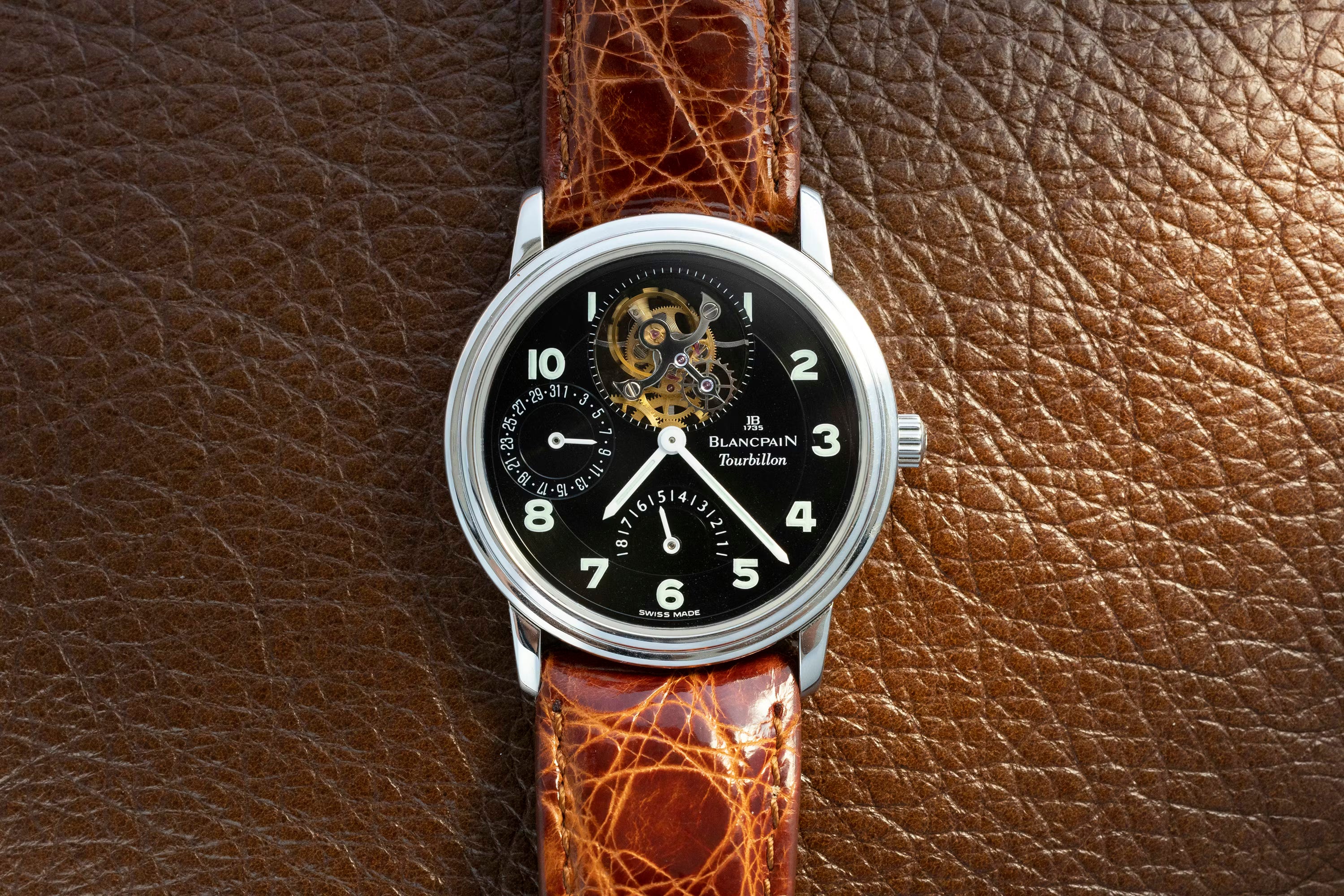
Hairspring found an incredible 1 of 20 steel case tritium dial 1186 in 2023.
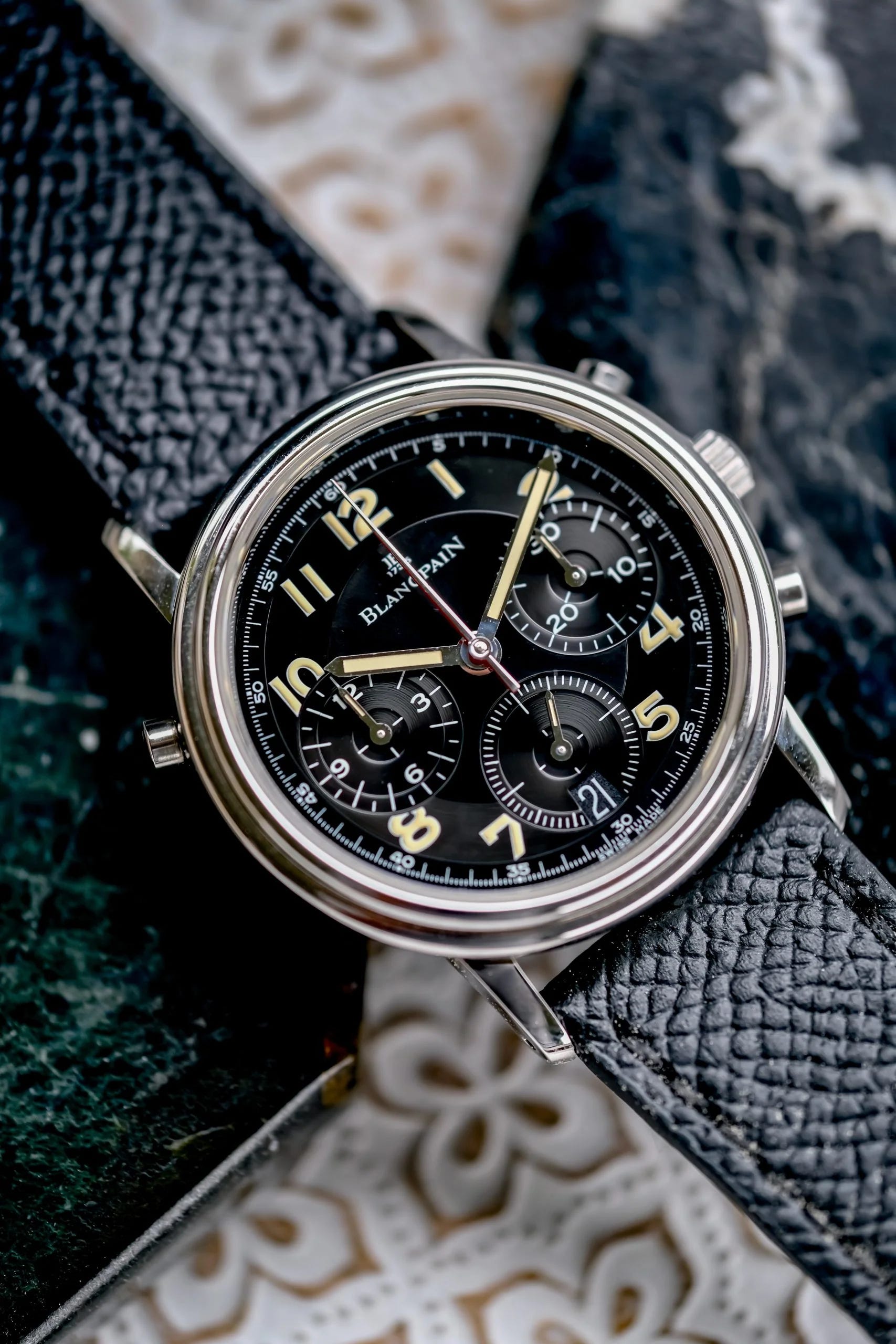
Platinum 1186s with military dials were sold by Christie’s in 2006 and 2007.
A platinum 0021 was sold by Antiquorum in 2004.
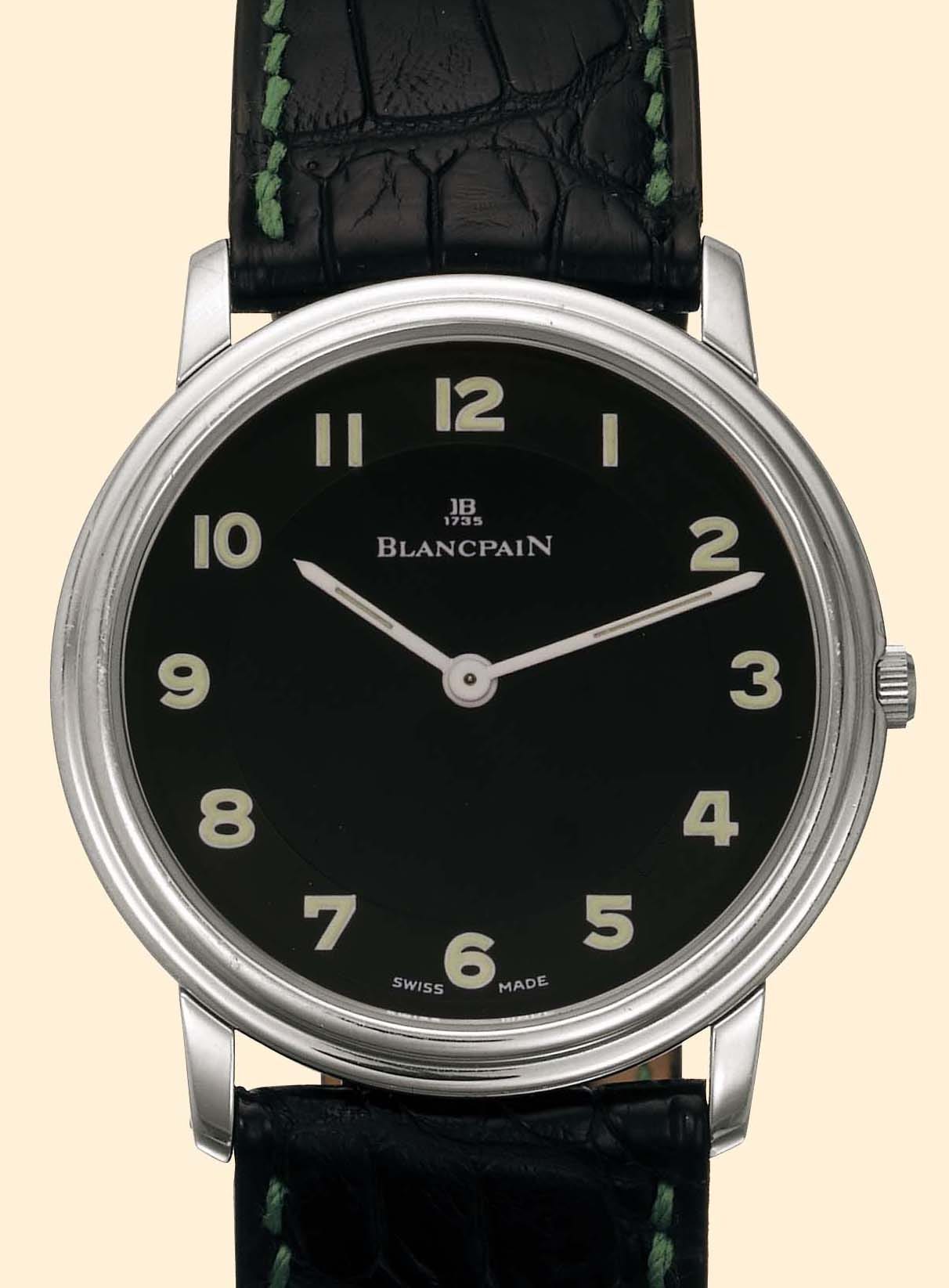
A platinum perpetual calendar with the same green stitching on the strap as the 0021 sold by Antiquorum in 2004 was sold by Christie’s in 2008.
Could there have been a six masterpieces military dial collection sold as a set? I really hope so, but maybe there was just a collector with a penchant for a certain shade of green.
Needless to say I love these almost as much as the Léman military dials.
What I really like is that the Masterpiece military dials have a simple sans serif font, while the 2100 / Léman collection features expressive serifs and oversized numerals, beefed up and exaggerated in a way that’s in tune with the evolving case designs and just creates a really neat continuity. Or does it…?
The military problem children
There are two references I’ve come across that don’t quite fit the military dial timeline I’ve laid out. Rather than pretend they don’t exist, I’m going to cover them briefly in the hope that someone out there can shed some light.
The mysterious 1185F
There is a reference that gives me pause about my conclusion about military dials: the 1185F. A reference that I struggle to find any definitive information on and that pops up only very occasionally on the internet.
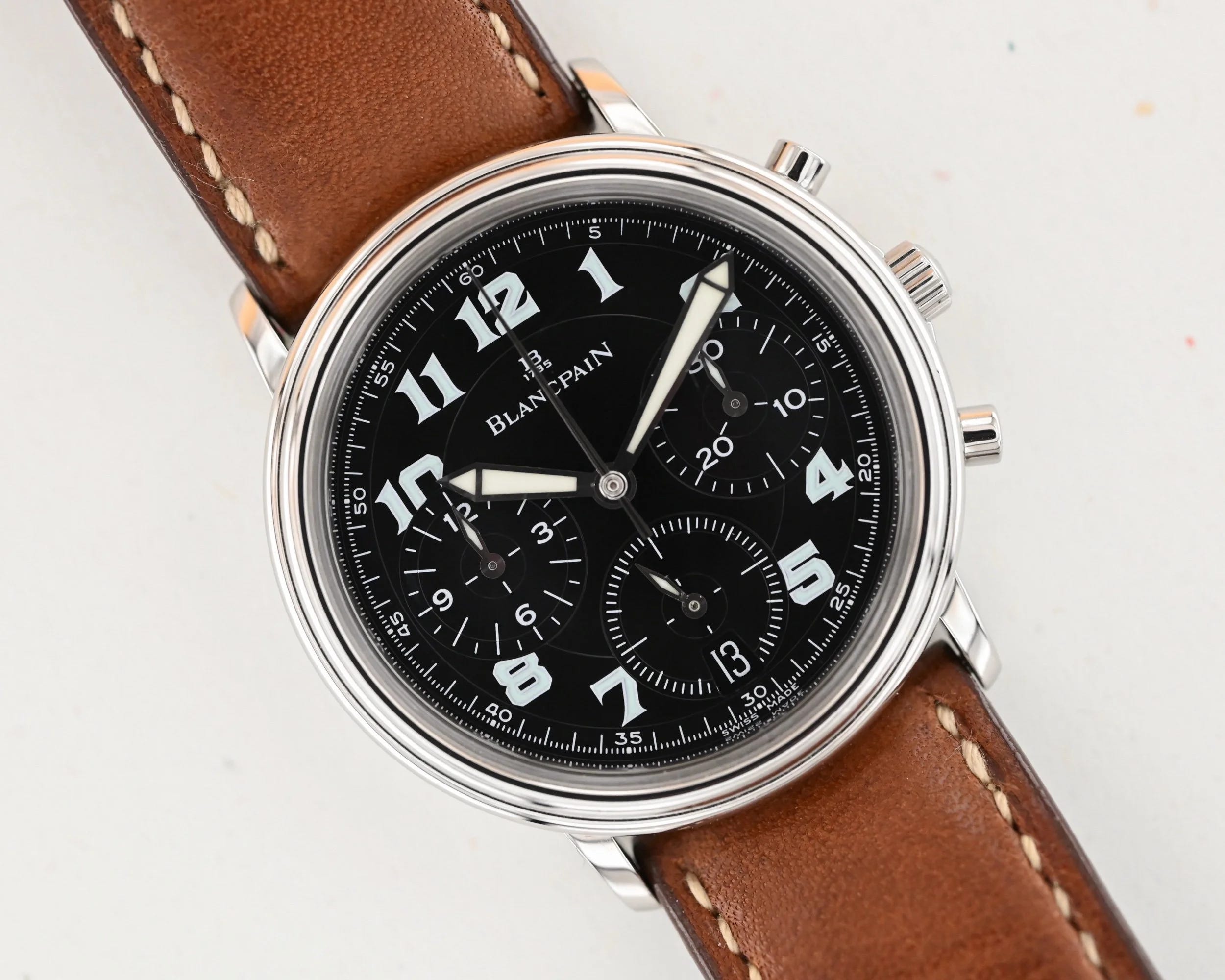
This looks like a Masterpiece case rather than 2100 and the given reference number would suggest as much. It looks like a 2100 / Léman military dial rather than a Masterpiece military dial however and it doesn’t have screw down pushers like the other flyback chronographs from 1997 onwards.
When it does appear the diameter is said to be 33mm (I guess this could be 34mm) and that it contains the F185 movement. In the few images I have seen it looks like it has SuperLuminova applied, which would suggest post 1997.
It doesn’t say “Flyback” on the dial, even though there is room.
In 2003, Blancpain was making 1185 chronographs and 1186 split second chronographs in 34mm as part of the Villeret collection (source: Wayback Machine again). But there were no flybacks and no military dials in the Villeret collection by this date as far as I can tell.
There were “women’s” flyback chronographs in the Léman collection in 2003 with military dials and 34mm cases that use the F185 caliber, but they have screw down crowns, 2385F reference numbers and “Flyback” on the dial.
I am a little sceptical about the 1185F. I would love for someone to show me something concrete that dissipates that scepticism.
The limited edition full gold 1186
It seems there may have been a 100-piece limited edition ref. 1186 – so a split seconds chronograph – made in the 90s with a military dial that has the Léman-style serif font.
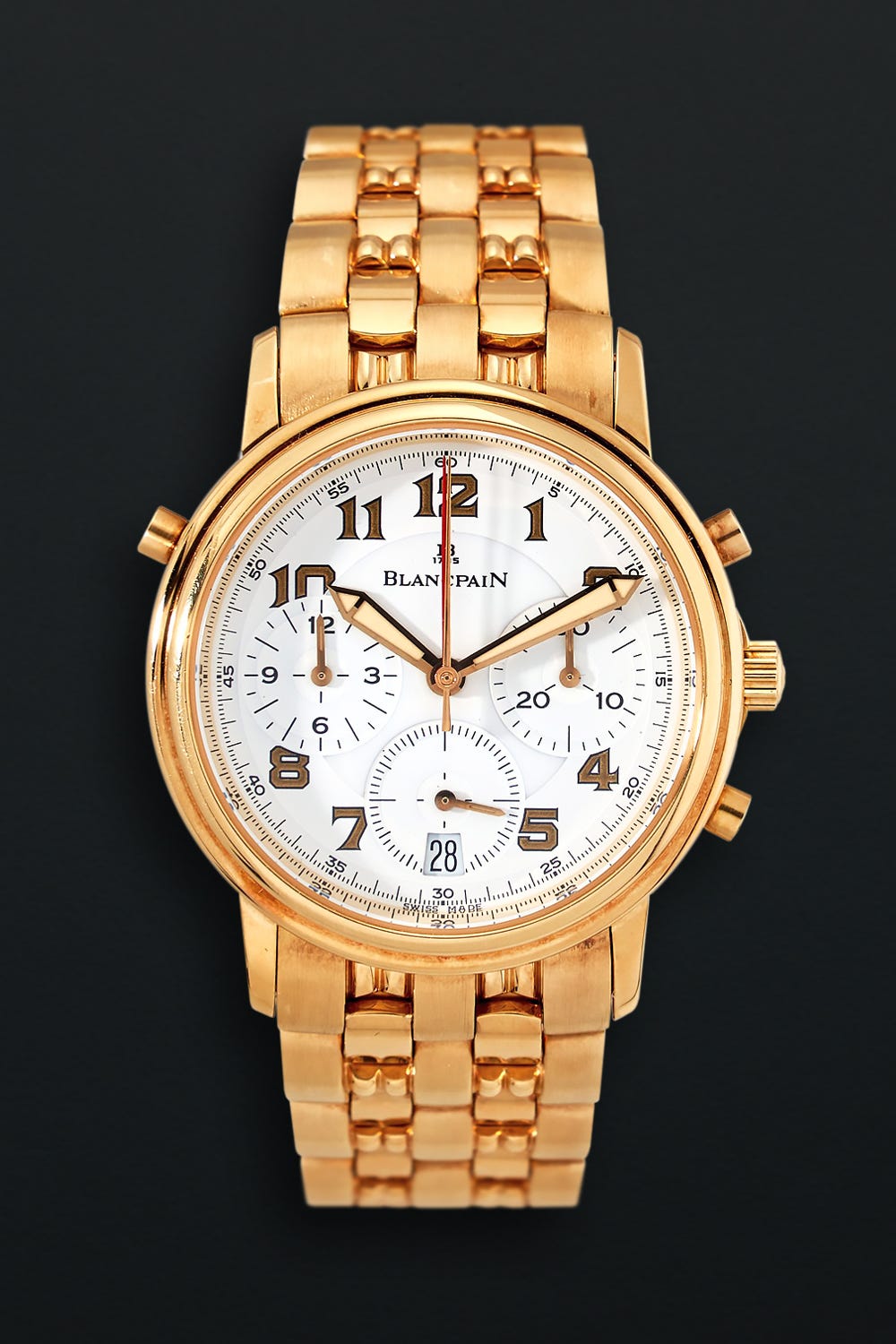
See this Christie’s listing and this one on Ineichen for example.
I am much more comfortable with the existence of this dial in this case than the 1185F because the 1186 caliber had been part of the catalogue since the late 80s. The F185 had not.
It’s possible this limited edition was the first to get the sans serif oversized font.
Evolution, expansion, extinction
At some point the Masterpiece and 2100 collections were renamed as the Villeret and Léman collections respectively.
I say at some point because 1998–2002 seems to be something of a gap in the historical Blancpain record, which makes finding out what models were present in the catalogue at this time, and identifying when exactly the names of these lines were updated, a challenge.
Villeret does not appear in connection with a Blancpain reference in the Europa Star archives until 2002.
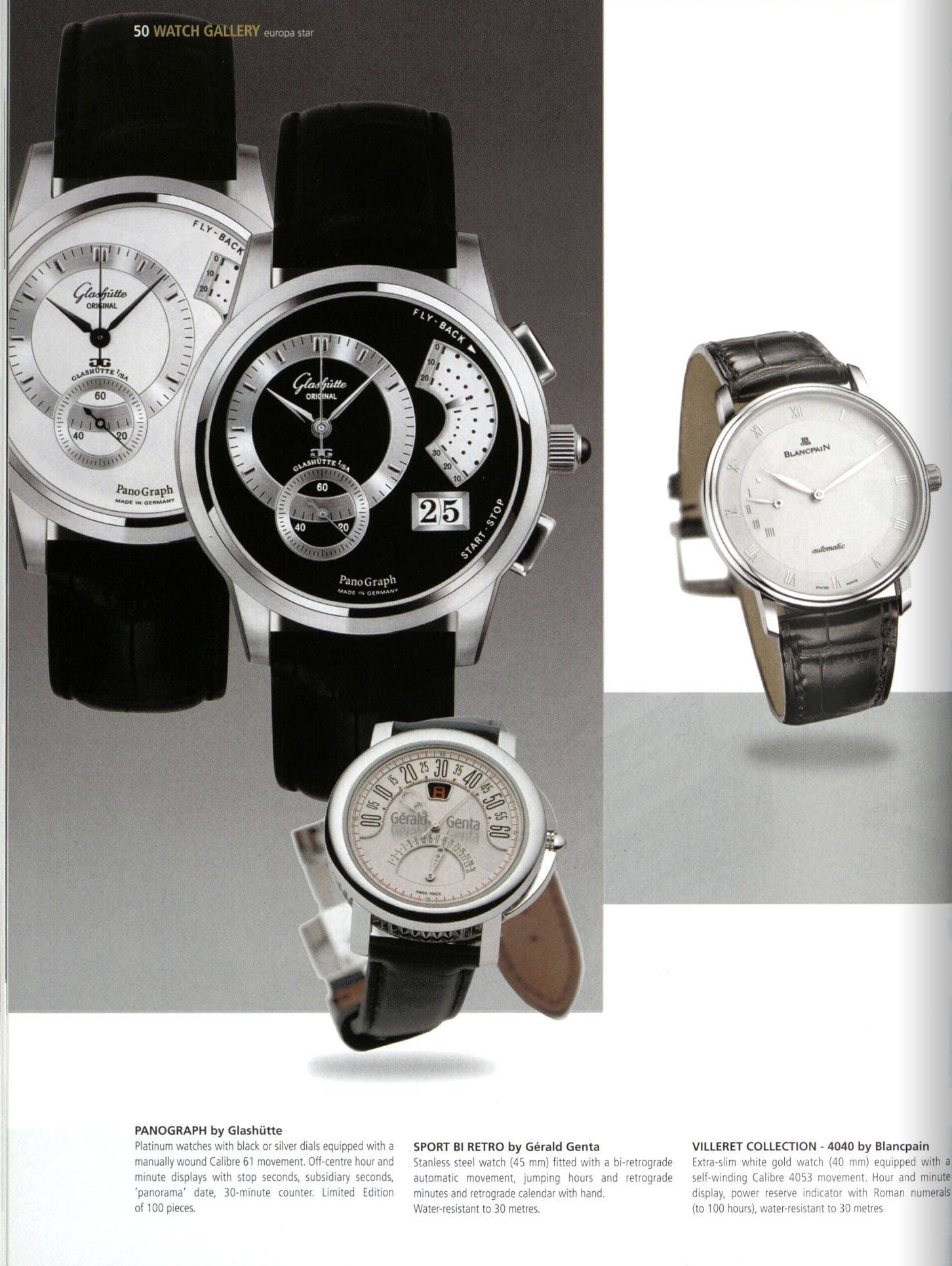
Blancpain’s entry in the Wristwatch Annual 2003, published in 2002, says:
“The [Blancpain] model palette has now been quartered into four collections. The Villeret collection is an homage to the roots of Blancpain and embodies the soul of the manufacture…the modern Léman collection combines traditional watchmaking techniques with practical characteristics to fit an active lifestyle. The name is based on Lac Léman, as Lake Geneva is called in its native French, and upon whose shores the new technical and administrative buildings of the brand are situated.”
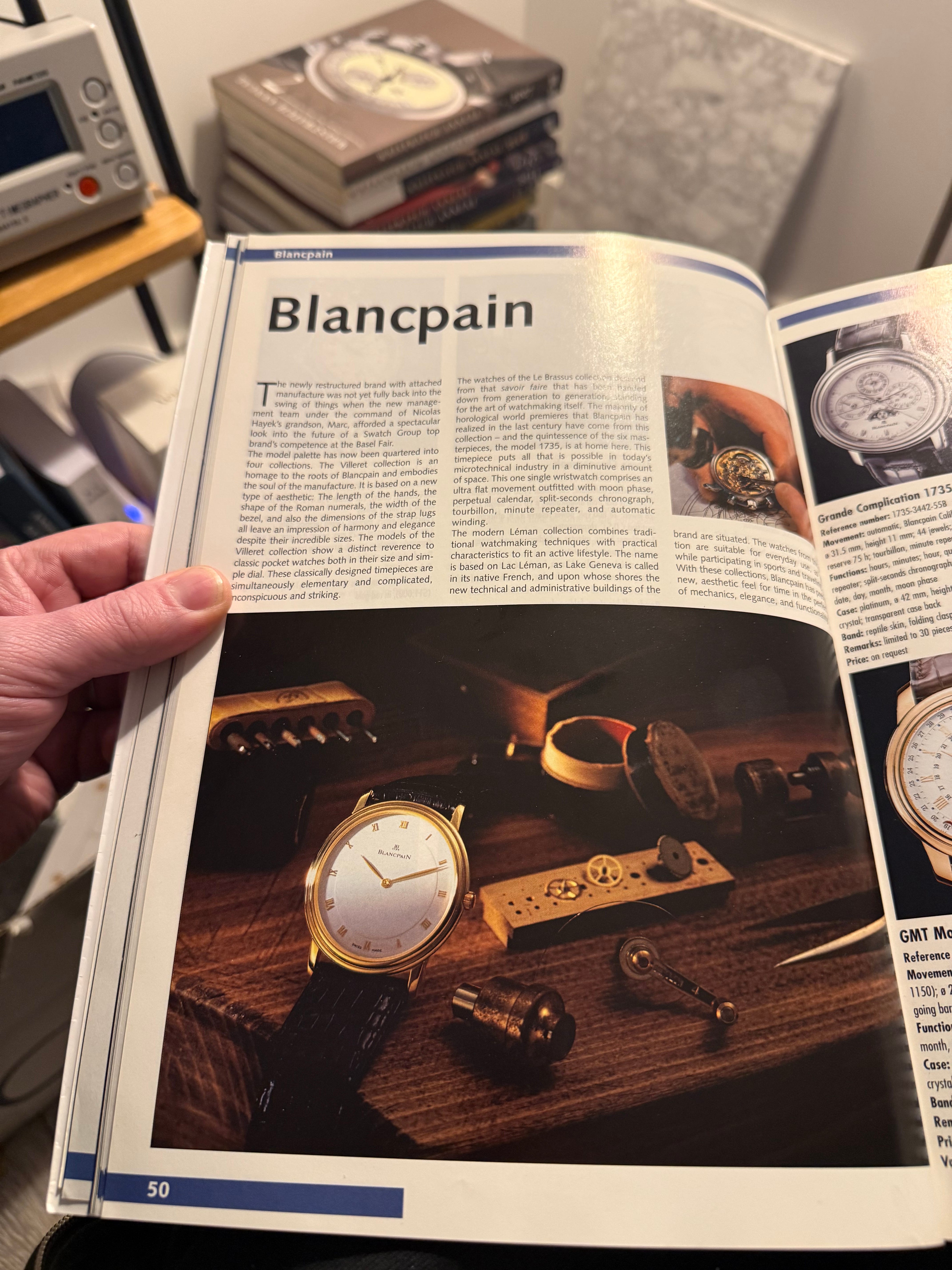
Using the Wayback Machine I can get back to a 2003 version of the Blancpain website that indeed has four collections: Le Brassus, Villeret, Léman and Spécialités (note the distinct lack of a Fifty Fathoms collection at this point).
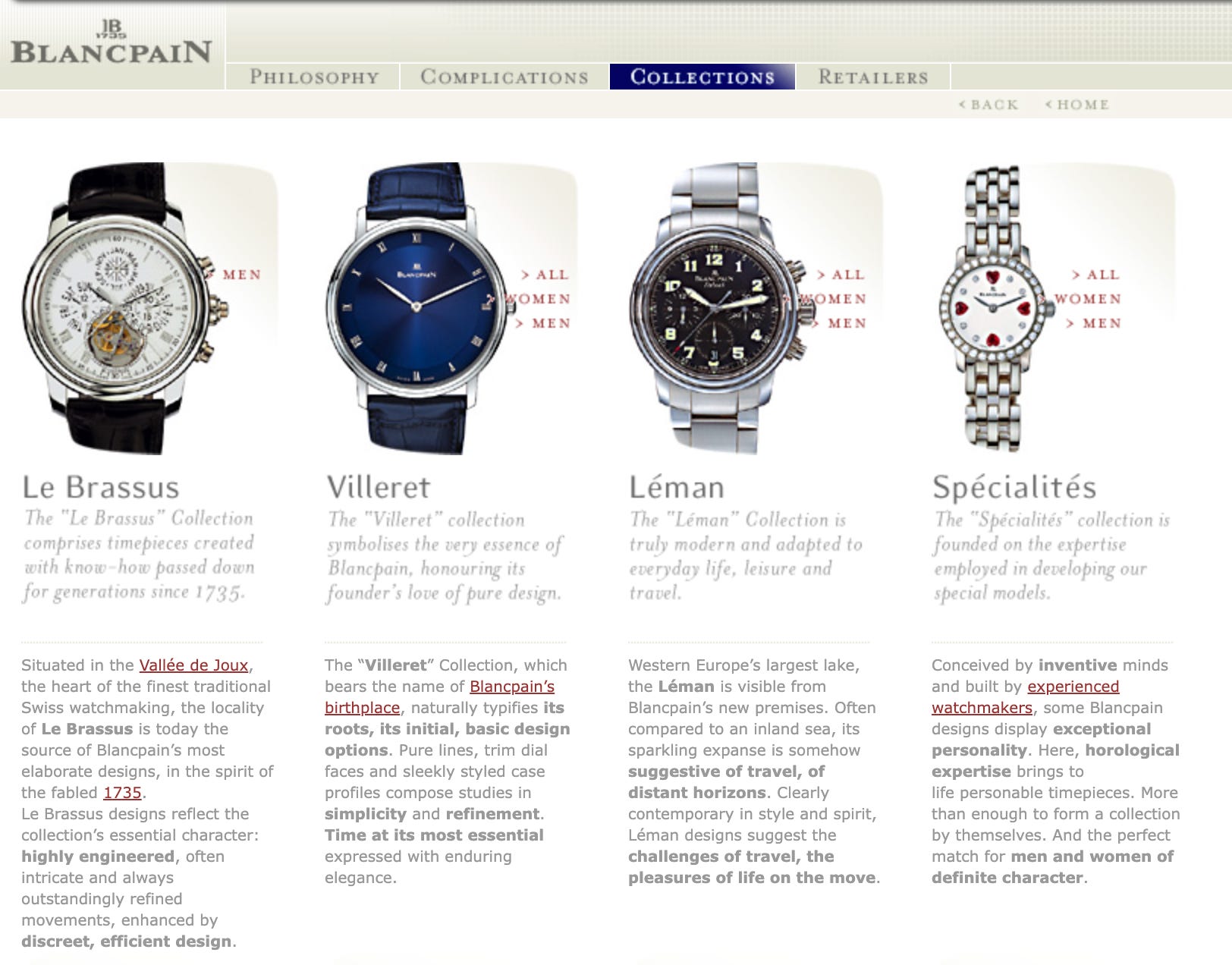
Taken together this would suggest the collections named Villeret and Léman emerged at the same time at some point in 2002.
Why did the name change? Well, I assume that a collection conceived to look to the future that was called “2000” didn’t really cut it in 2002.
According to the Blancpain Blog, 2004 is when the Léman case sizes start increasing to 40mm which tracks with my findings, though the 38mm references likely continued to appear in the catalogue for a while.
By 2005 the 40mm 2885F Flyback Chronograph Grande Date in 40mm had begun to replace the 2185F but it still had a military dial.
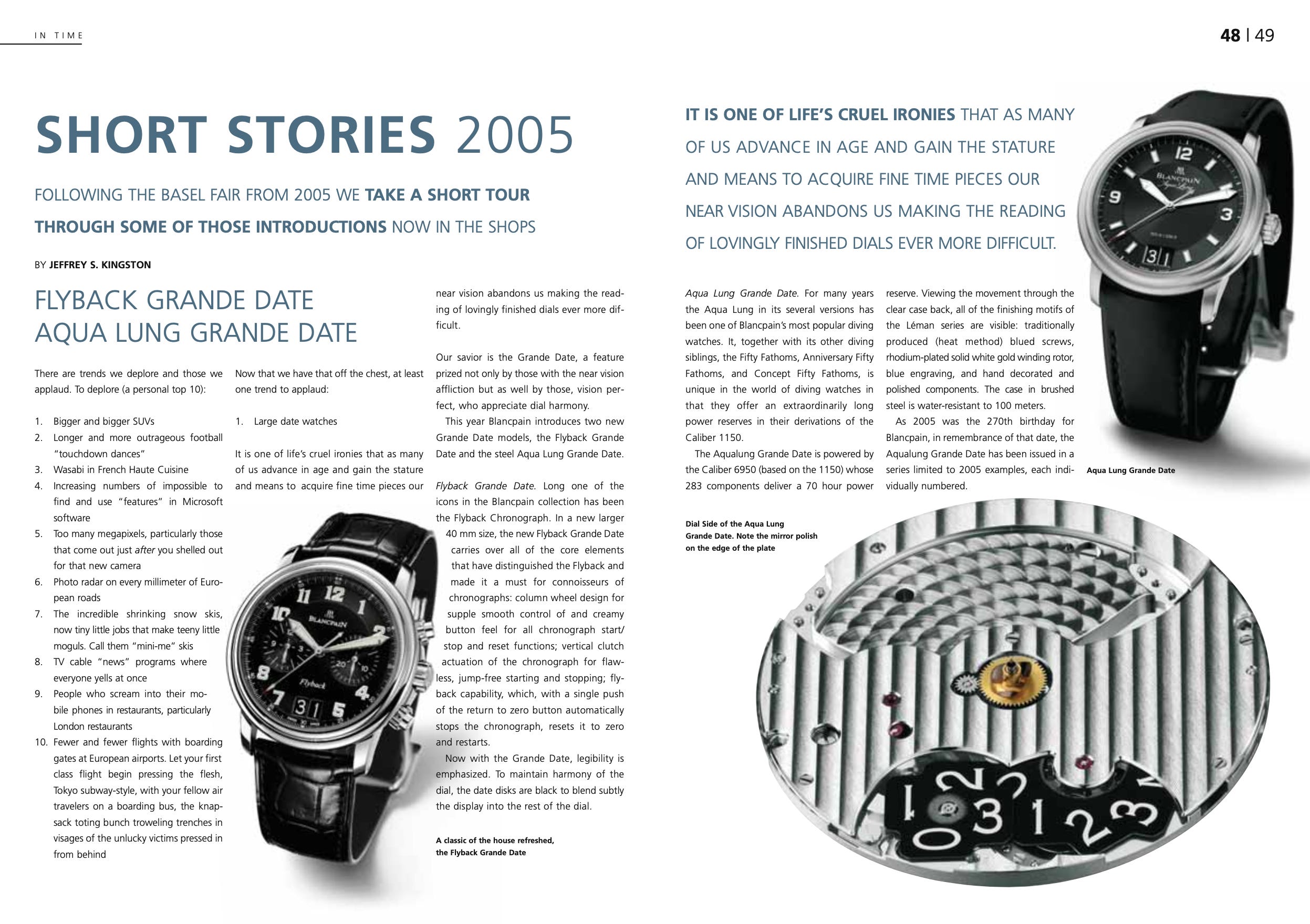
By 2006 Léman models had started to switch to Rolex Explorer like-numerals and ditched the serif numerals on the original Léman military dials, though some models stuck with them for a while. Blancpain launched a full-blown, non-limited Fifty Fathoms collection a year later.
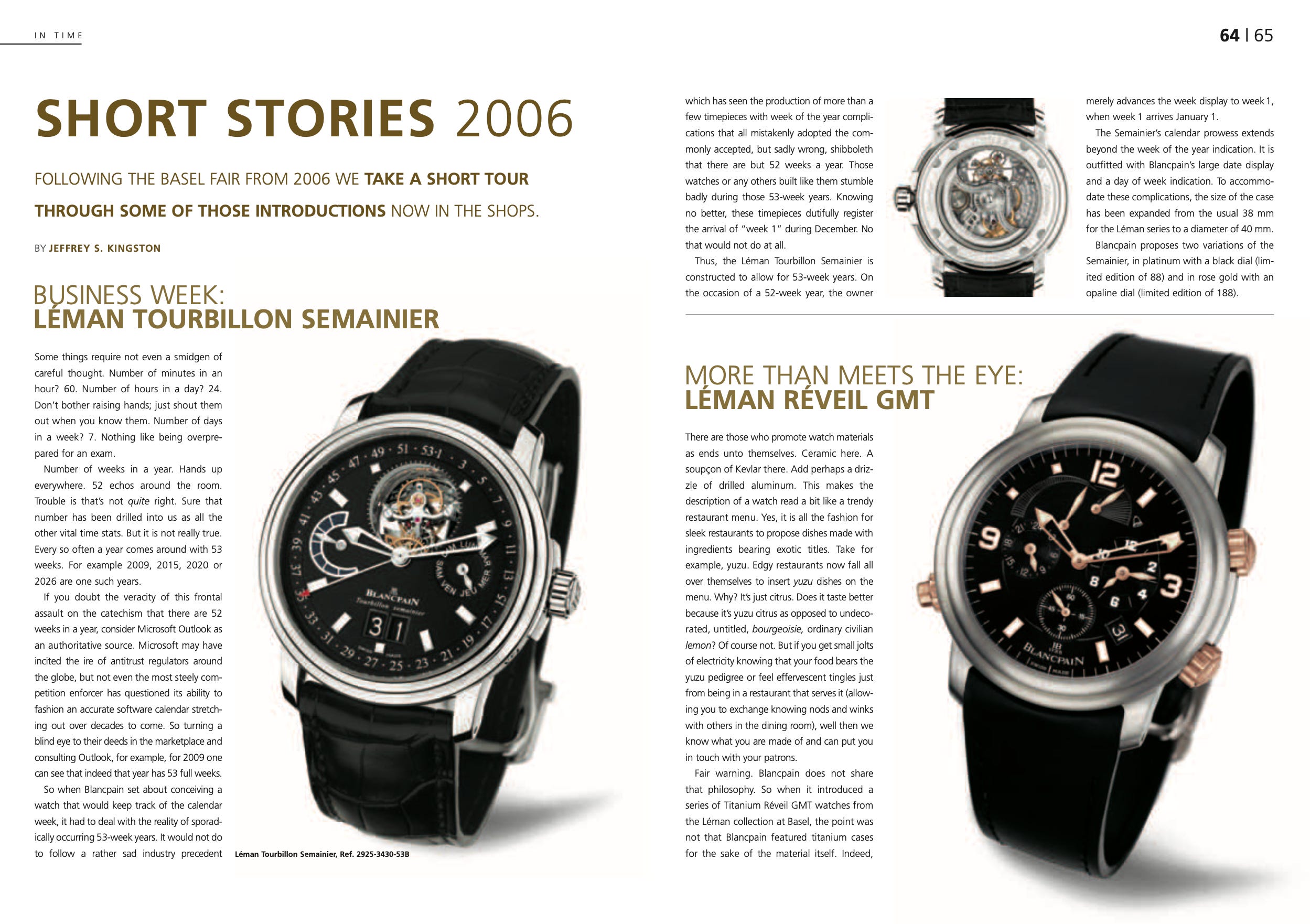
In 2009 Blancpain launched the L-Evolution collection to “stand alongside the classic Villeret and Le Brassus collections and the Sport Fifty Fathoms Collection”. The Léman collection is pointedly not mentioned but the “L” in L-Evolution most certainly stands for Léman – and it sounds the death knell for the collection.
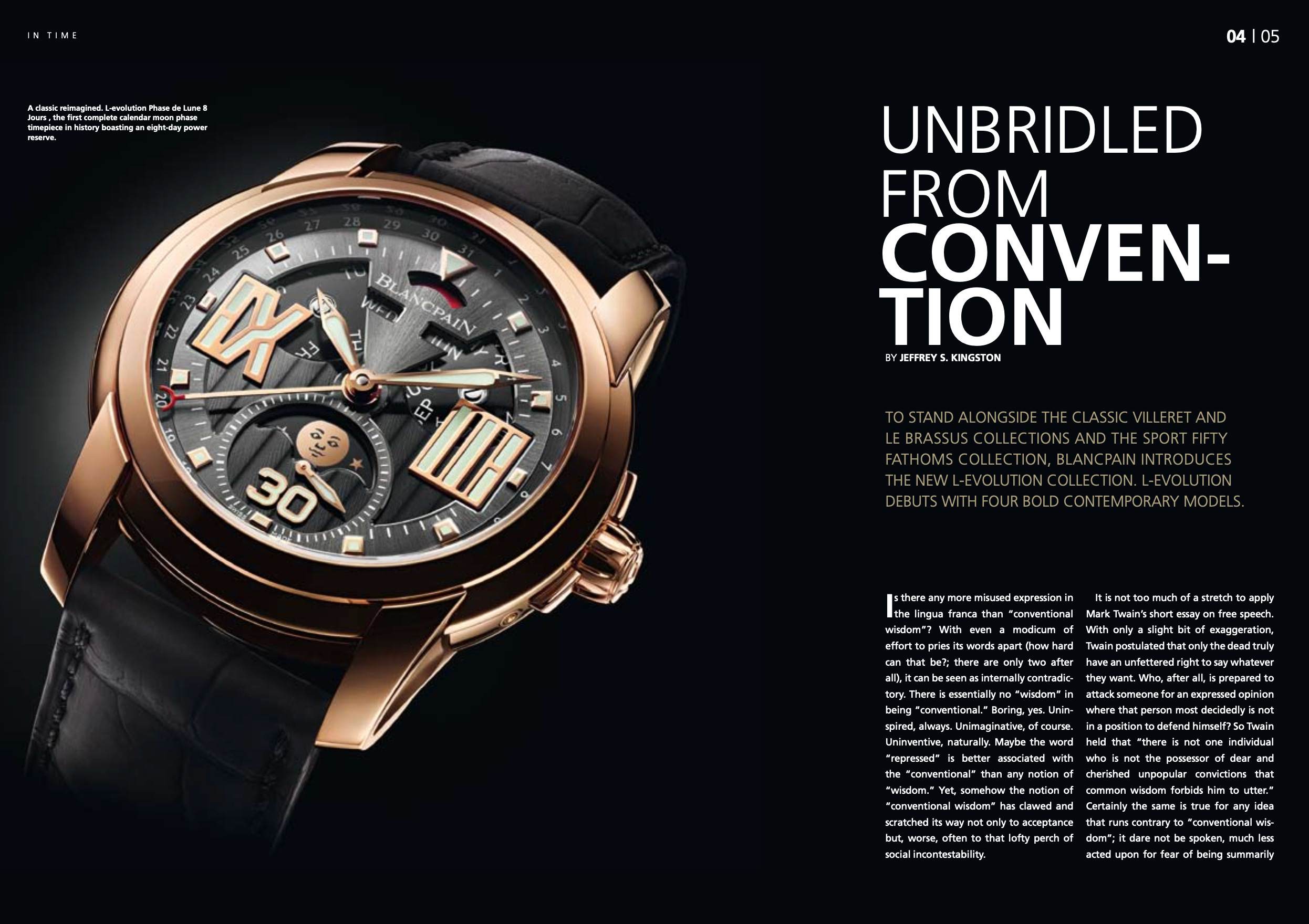
The L-Evolution watches are technically impressive but the kindest thing I can say about the designs is that they are of their time.
Both the Léman and L-Evolution lines hang around till the mid-to-late 2010s before disappearing completely from the Blancpain catalogue. They don’t come back.
A Personal Quest: Dating the 2585F
Which brings us back to the watch that entered my collection and started this journey: the 2585F perpetual calendar flyback chronograph.
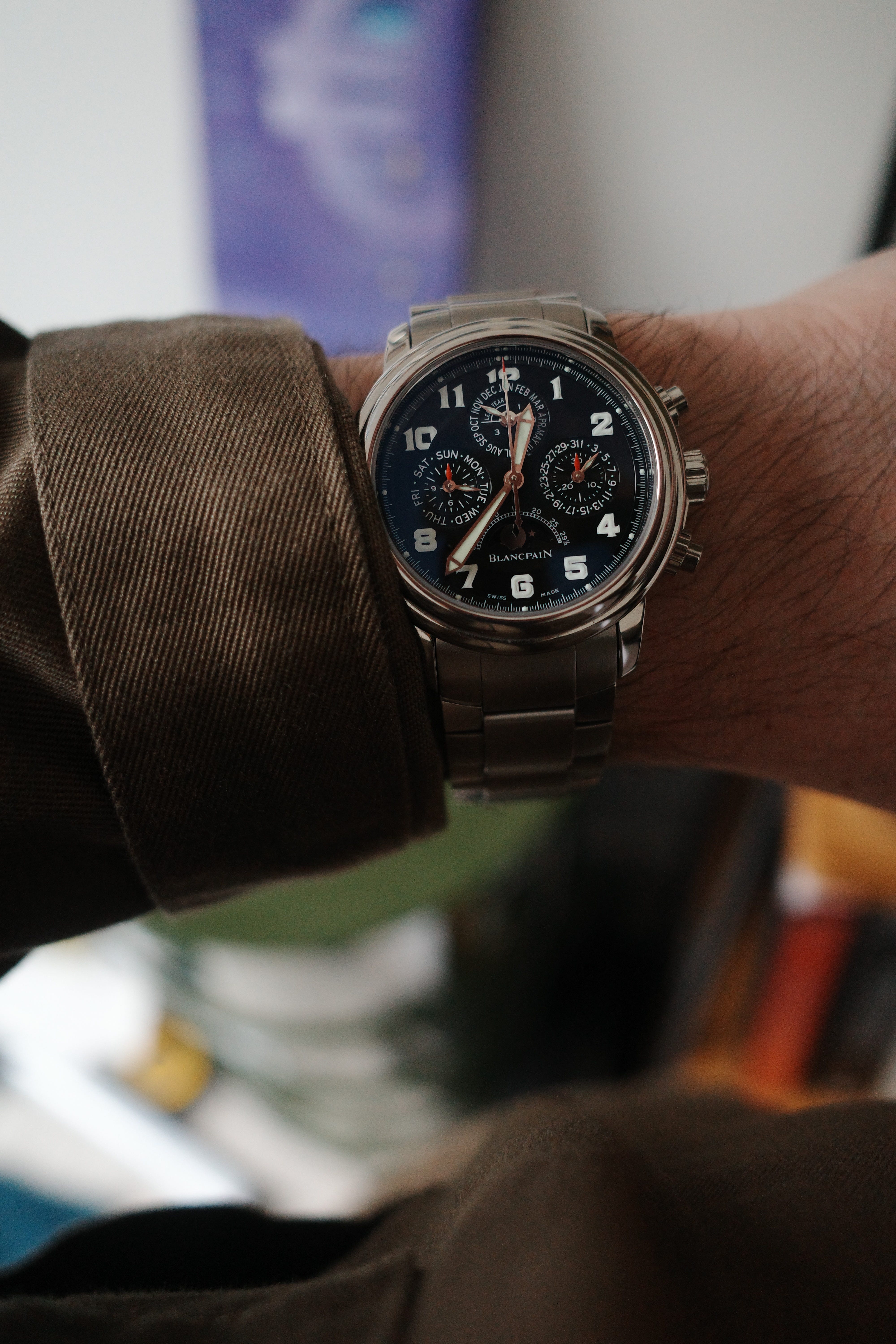
My goal was simple: figure out when it was made.
Why did I want to know?
Because it’s kind of perfect to me. The case size and shape. The collision of high horology complications with sports and field watch aesthetics. The flyback functionality as a point of difference and one that doesn’t feature in any current Blancpain perpetual calendar. The pointlessly mirror polished case back. Possibly the best steel bracelet ever made in the 71 (I said possibly, chill out). The specs. The finishing details. The aesthetics.
It’s not for everyone, but it is very much for me. I had to know when it came to be.
The reality of figuring out when it was made was less simple than I had imagined.
Papers provide sale date, not production date. Blancpain only issues archival information during service – and mine doesn’t need one so I’d rather not incur that bill yet.
But my research offers clues based on what we know for certain:
1996: A 2100 with a military dial and flyback chronograph movement appears
2006: The 40mm replacement for the 2585F, the non-military dial 2685F appears
A ten-year spread is not as precise as I’d like it to be.
The Blancpain Blog tells us that:
Blancpain stopped using tritium lume around 1998 (my watch features SuperLuminova)
Earlier 2100s have a distinctive blue hue to the outer anti-reflective coating (which mine does).
If we then throw in an assumption that:
It took some time to go from the F185 flyback chronograph movement to the F585 perpetual calendar flyback chronograph caliber
And the knowledge that:
In 2004: 40mm Léman cases start appearing in the Blancpain catalogue
Then I reckon that likely puts my watch somewhere from 1999 to 2003.
That’s precise enough for me for now.
A window into a brief, fascinating and transitional chapter in Blancpain’s modern history through the lens of one watch.
Closing the chapter
This piece is, at its heart, the story of how a chance encounter with a single titanium chronograph on another person’s wrist opened a doorway into a discarded chapter of Blancpain history.
A chapter defined by a design language the brand no longer really speaks.
I hope this serves as a foundation for future collectors to build upon. Because the military dial Lémans deserve a clearer place in the record. And because the next person who falls under their spell deserves easier breadcrumbs than I had.
With thanks and gratitude to:
Forgotten Watches – Neo-Vintage Blancpain And The Six Masterpieces by Ben Dunn. [2022]
In-Depth: Blancpain’s Six Masterpieces by Tony Traina. [2023]
Blancpain, F. Piguet, Biver, and the Path Forward by Stephen Foskett. [2021]
Jean-Claude Biver: Past, Present Future by Pierre and Serge Maillard. [2019]
Flashback: The Leman Series (Part 1, Part 2, Part 3) by Henrik. [2019–2020]
Collecting Blancpain Timepieces: 2100/Leman Series by Henrik. [2023]
Flashback: The 2185F Titanium by Henrik. [2021]
Flashback: The Iconic Flyback 2185F-1130-71 by Henrik. [2022]
Really great article. Coming from an owner of a leman big date flyback!
excellent article and research!